Source :- THE AGE NEWS
International Rugby League chairman Troy Grant has defended the decision to permit players to represent the nation where one of their great-grandparents were born, arguing it does not undermine the credibility of international competition but enhances it.
The new eligibility rules were announced in Sydney on Monday as the Pacific and the United States were confirmed as the host of the next World Cup in 2030.
The Australian Rugby League Commission will organise and run the tournament, which will be staged in a Magic Round-style format with a full slate of men’s and women’s pool matches to be played over three days in one stadium before moving onto another venue.
Under the format, the group stage will take place at up to five venues from Australia to the US, with potential host cities and states including Sydney, Brisbane, Auckland, Hawaii and Utah.
The IRL hopes to hold the 2034 World Cup in Europe and Africa, Grant said.
The latest change to rugby league’s eligibility criteria continues its fluid approach to regulations governing the international game and was the result of an application from the Cook Islands and their coach, Karmichael Hunt.
While payers have previously been allowed to wear the colours of a country where one of their parents or grandparents was born, they can now point to the nation of birth of one of their eight great-grandparents.
Sport governing bodies such as World Rugby, FIFA and World Athletics also have a grandparent rule.
But the IRL’s extension to another generation in a player’s lineage puts the code in a league of its own.
“It may not be as pure as some people may think it should be, or fit their mindsets. I don’t really care about that,” said Grant, a former NSW racing minister.
“I care about growing the game and giving every player the opportunity to represent their nation and I care that the fans are getting the best outcomes, which we have seen during this World Cup.”
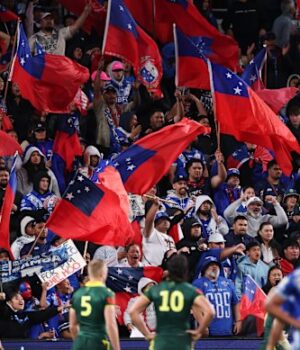
International rugby league has enjoyed the fruits of players embracing their heritage, particularly those from Pacific Island backgrounds. Tonga and Samoa, who met in an unforgettable pool game at CommBank Stadium eight days ago, have become heavyweights as a result.
The new move is a shameless bid to spread even more NRL talent around the globe, no matter how distant the connection between players and the nation of their forebears.
Grant cited Canberra fullback Kaeo Weekes as a player who could benefit from the updated rules, saying they would have allowed him to turn out for the Cook Islands at this World Cup if they had been in place before the tournament.
“I think we have players sitting on the sidelines who the public deserve to see show their skills,” Grant said.
“We want the best players available and with the economic conditions, the way the geopolitical world’s operating, there is a lot of movement from nation to nation.
“I think it enhances rather than in any way undermines the game into the future.”
The call was made nine months after a State of Origin eligibility shake-up that freed New Zealand internationals to also play for NSW and Queensland, clearing the way for Maroons star Kalyn Ponga to declare his allegiance to the Kiwis.
Grant said the IRL board had also committed to explore elevating Tonga and Samoa to tier-one nations.
“They’ve lit up international rugby league like we haven’t seen before and we’re enormously grateful for that,” he said.
Despite the 2030 World Cup being hosted by the Pacific and the US, it’s highly unlikely that the group-stage travelling roadshow will reach the likes of Fiji, Tonga and Samoa due to limited infrastructure there such as stadiums and hotels.
News, results and expert analysis from the weekend of sport sent every Friday. Sign up for our Sport newsletter.
 Chris Barrett is a senior sports reporter for The Sydney Morning Herald. He is a former South-East Asia correspondent for the Herald and The Age.Connect via X or email.