

Source : THE AGE NEWS
A Qantas plane that was struck by lightning on October 30 remains in Melbourne where it landed almost two weeks ago, with evidence of “significant” damage to the aircraft’s skin.
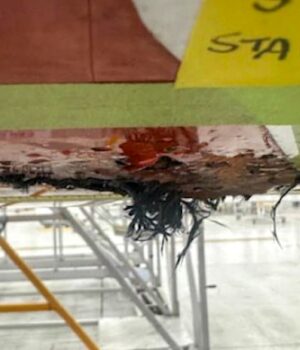
Pictures obtained by this masthead show the damage left by a lightning bolt, with charred areas of the skin and mesh exposed on the Boeing 787-9 Dreamliner which had flown flight QF94 from Los Angeles to Melbourne.
“It is a significant repair,” said UNSW Professor Mechanical and Manufacturing Engineering Dr Sonya A Brown, who reviewed the pictures.
“We design aircraft effectively to be hit by lightning,” said Brown. “However, because lighting is such a variable event, we would always inspect the aircraft afterward to ensure how extensive the damage and the level of repairs needed.”
Some damage can be minimal with less than a centimetre on the surface, said Brown. In this case, it appears to be tens of centimetres, she said.
Qantas confirmed the plane was struck by lightning in-flight. But could not provide a time frame for its return to service.
“Commercial aircraft are designed to withstand lightning strikes, and the aircraft continued its journey to Melbourne without incident,” a spokesperson for the airline said.
What happens when a plane is hit?
Commercial jets are designed to conduct electric currents safely away from crucial equipment and fuel aboard the plane, often toward wicks on the wing or tail.
Metallic surfaces give planes a Faraday Cage effect conducting the charge across the surface toward wingtips or the tails. (Faraday Cages are metal enclosures or frames that block external electricity from reaching their interior. They are used to protect sensitive equipment or facilities from unwanted electrical charges).
Commercial planes in regular use get struck by lightning about once or twice a year, according to the US National Oceanic and Atmospheric Administration.
“They are designed and built to have conducting paths through the plane to take the lightning strike and conduct the currents,” the NOAA said.
This is one of the reasons planes typically avoid thunderstorms if they can. The aircraft themselves can often trigger the strike “because their presence enhances the ambient electric fields typical for thunderstorms”.
When a lightning strike is suspected, “there is a mandatory inspection for damage, which can delay flights and be quite expensive”, the NOAA writes.
The composite body
In the case of the Qantas plane, the Boeing 787 Dreamliner uses a carbon fibre composite for the skin, which does not by itself conduct charges.
So it’s fitted with a mesh that creates a continuous path for the electrical charge.
FlightAware shows the plane has not moved from Melbourne since the incident, suggesting another constraint on Qantas’ long-haul capacity.
Qantas said its engineers in Melbourne are “inspecting and conducting repairs to the aircraft, and it will return to service once that work is complete”.
One expert with deep knowledge of commercial aircraft safety, who reviewed the photos, said: “The bronze lightning protection mesh on the fuselage belly skin has certainly taken quite a decent hit.”
When an Australia-based plane is hit by lightning, in some cases, the airlines can either repair it themselves, or conduct a temporary repair and then ferry the plane back to the US.
If an airline needed to fly it to the US with no temporary repair done beforehand, it could be flown across the Pacific, unpressurised, “a long flight at low altitude to the States”.
The Market Recap newsletter is a wrap of the day’s trading. Get it each weekday afternoon.
 Chris Zappone is a senior reporter covering aviation and business. He is former digital foreign editor.Connect via X, Facebook or email.


