

Source : THE AGE NEWS
Two years after regulators slammed the brakes on Boeing’s assembly lines, the iconic plane-maker is fighting its way back, improving processes and quality. But its journey back to the top will depend on how things operate on its factory floor – now and far into the future.
The aircraft manufacturing giant is trying to break free from a series of reputation-shattering events. Two fatal crashes in 2018-2019, both involving 737 Maxs, claimed 346 lives and led to the model being temporarily grounded worldwide. Flaws in an anti-stall system were blamed, which led to the company’s then-chief executive being fired.
In 2024, when a door on an Alaska Airlines plane came off mid-flight, regulators moved in, capping the pace of production of 737s, imposing new limits on the program and increased oversight to ensure safety.
Since then the company’s output of 737s – overseen by the Federal Aviation Administration – is being watched around the world, not just because of the enormous backlog of 737s on order but also because Boeing’s production is a bellwether of how well the company’s factories are running.
Boeing currently expects to produce 47 737s a month by early 2027, after previously targeting the northern summer of 2026. It currently produces about 42 a month. Over the long term it hopes to make 52 planes a month. Higher output means more revenue but only if the planes are error-free.
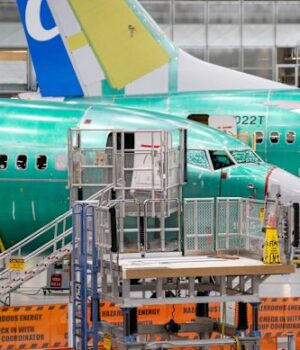
In an industry where attention to detail is everything, the company’s recovery is tied to its Renton, Washington plant, where fuselages enter as massive green tubes and leave as fully kitted-out 737s.
“As you can imagine, lots of our customers, they love this aeroplane, they want more of this aeroplane,” said Boeing’s vice president of quality Hector Silva. “Our responsibility is to deliver safe, quality aeroplanes to them when they expect them.” The 737 is a global workhorse for airlines and a key revenue earner for Boeing, which opened a fourth production line for the plane in Everett, Washington this year. Since the launch of the 737 Max variant in 2016, for example, more than 7000 of them have been ordered.
‘It clearly has lost its verve … Full recovery will take time but it’s unlikely before 2030.’
Shukor Yusof, aviation analyst from Singapore-based Endau Analytics
Silva told this masthead Boeing had many safety processes before its public problems began – but big changes have been made since 2024. Before the crisis the choice about whether to stop an airframe from advancing down the assembly line while work was checked or repaired was down to the discretion of whichever team was doing the work at the time, Silva said. “We were inconsistent in how we were making those choices.”
Today, using what it calls the “move ready” process, the criteria for judging the readiness of the plane are standardised across engineering, operations and quality, which leads to “better discipline and rigour” in preventing mistakes on the line.
The new approach has helped cut in half instances of “travelled work”, work completed outside its assigned place on the assembly line, which opens up more opportunity for errors. The 2024 Alaska Airlines door plug incident – involving a defect from the supplier – was also partially attributed to “travelled work”.
Having a standard, understandable process for staff “also demonstrates to our teams: ‘hey, we have ways of hearing your input’,” Silva said. Improving relations with its 50,000 manufacturing employees – all up, the company has 182,000 staff, including in areas like defence and space, around the world – was a key internal reform prompted by its recent woes.
Even before the crisis, stories had emerged about the factory floor concerns being ignored and corners being cut. One 2016 internal survey showed a third of employees felt “potential undue pressure” from their bosses.
For Boeing, possibly the greatest single name in aviation, to face these troubles underscores just how precarious even an industrial giant can become when its internal focus slips.
Not only did the manufacturer develop the 707, a plane that helped make commercial aviation possible, it also created the iconic 747, the ubiquitous 737 used throughout the world, the 777 and the 787 Dreamliner.
Reports from whistle-blowers and embarrassing internal emails showing disregard for regulators and clients have cost Boeing dearly. The company has posted losses since 2019, when the 737 Max crashes occurred, until last year, when it finally revealed a $US1.88 billion ($2.78 billion) profit.
The plane-maker’s health impacts airlines worldwide, including in Australia.
Virgin’s has more than 100 737s in its fleet and is adding more, including the recently certified 737 Max 10. Its fleet of 737s is a part of Virgin’s strategy of simplified, more efficient operations. Even as Qantas invests big in Airbus A350-1000ULR to fly Project Sunrise routes, it’s mulling new orders for wide-body aircraft including, possibly, the Boeing 787 Dreamliner.
But Boeing’s recovery is fragile and complex.
Production relies on meshing multiple elements: parts, operations, labour, safety and quality control. If one piece loosens, the process slows. Last week Boeing announced it would cut 5 per cent of its 50,000-strong commercial workforce after delaying production increases. “While we have made substantial progress, we have not yet fully recovered,” its head of commercial aeroplanes Stephanie Pope said.
“It clearly has lost its verve,” said aviation analyst Shukor Yusof, from Singapore-based Endau Analytics. He expects Boeing’s production rate to lag rival Airbus’ for the foreseeable future. “Full recovery will take time but it’s unlikely before 2030.”
In a bid to sift out problems before they become part of the final product, employees are now encouraged to use a “speak up” program, an internal reporting channel for staff, contractors and suppliers to confidentially or anonymously report safety, quality or compliance concerns.
The “speak up” program has made management more responsive to employees, says Boeing’s quality process governance manager Brion Baker, although he maintains raising your hand was “always” part of Boeing’s culture. “The shift was when the teammates started to see the leadership team responding directly to those things immediately,” Baker said. “When you see that happening then it just encourages more of that.”
Sprawling supply chains have created complexity for the aviation industry, especially when parts are delayed or contain faults. Boeing tracks time spent on fixing issues that came from suppliers. Outsourcing, especially in the aftermath of COVID-19, has made supply chains fragile. Now, Boeing is in the process of bringing some sources back in-house.
Kelly Ortberg, who began his career as an engineer, was entrusted with rebuilding the brand when he became chief executive in 2024. The following year Boeing repurchased fuselage maker Spirit AeroSystems, two decades after selling it off as part of an outsourcing trend.
Building an airliner is not just about parts. It’s also about ensuring people know how to fit them and what to do when confronted with production issues. “While Boeing has lengthened the duration of foundational training for employees, it’s also enhanced on-the-job training, to increase proficiency,” Silva said.
That means shifting the goalpost from simply providing training to asking an employee, in Silva’s words, “‘Do you feel comfortable with the knowledge that you acquired?’ ‘Do you feel confident that you’re able to do the job?’”
With multiple changes on the factory floor, a more robust work process and better servicing of the needs of engineering. How safe are Boeing’s new planes today?
“With what Boeing is focused on – quality and safety … I don’t think we’re going to see any issues at all,” says Forecast International’s Grant Holve.
Boeing’s overall recovery is still heavily influenced by certification from the Federal Aviation Administration. In a positive sign, the 737-Max 10, on order from Virgin, was approved by the FAA. With 10 737-Max 10 aircraft on order, the certification is an important milestone in the aircraft’s pathway to delivery and entry into service, Virgin said.
“Folks rely on our products every single day. Every single second of every single day there’s an aeroplane taking off, a Boeing aeroplane in particular taking off,” Silva said.
“[We must] continue to rebuild trust, one aeroplane at a time.”
 Chris Zappone is a senior reporter covering aviation and business. He is former digital foreign editor.Connect via X, Facebook or email.


