Source : the age
MUSIC
Death Cab For Cutie | I Built You A Tower Tour ★★★★
Margaret Court Arena, November 13
By a strange twist of fate, three very different acts are playing across Melbourne’s arena precinct on the same night. Metalheads are out in force to see Iron Maiden tear up AAMI Park. The young and online are swarming Rod Laver for TikTok pop sensation Benson Boone. And at Margaret Court Arena, elder Millennials are politely queuing for Death Cab for Cutie, the quintessential indie rock band of the 2000s.
Death Cab is synonymous with a certain kind of earnest, novelistic songwriting that emerged from the Pacific Northwest on the tail end of the grunge boom, part of the same wave that birthed Built to Spill, Modest Mouse and Bright Eyes.
The band’s most career-defining records – 2003’s Transatlanticism and 2005’s Plans – recently marked their 20-year anniversaries; they celebrated the occasion with a string of shows across the US. Now, returning to Australia after a seven-year absence, the band offers a set showcasing the breadth of their catalogue, spanning songs from 2000’s We Have the Facts and We’re Voting Yes to I Built You a Tower, released only a few months ago.
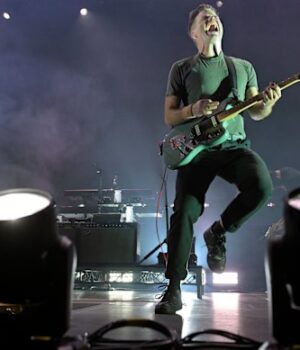
True, the arena setting feels a little at odds with the intimate nature of Ben Gibbard’s songwriting, especially during the opening songs when the audience is still warming up. But the band rises to the occasion, delivering beefed-up, rockier versions of their hits that build to well-earned crescendos.
Gibbard’s tightly wound, almost jittery energy makes him a compelling presence, and his boyish tenor is as fine and clear as ever. During a rendition of beloved acoustic track I Will Follow You Into The Dark, he announces he’s going to do some “arena rock shit – and there’s no more arena rock shit than a singalong”. At this invitation, we lift up our voices in chorus, filling the space with unadorned, a cappella melody. It’s one of the night’s most transcendent moments.
Lyrically, Death Cab for Cutie’s register has always been one of melancholy and nostalgia – so many songs mourn the inevitability of time’s passage, a place that cannot be returned to, a love that can never been recaptured.
From the vantage point of the present, this sense of loss is rendered all the more acute, and the past gilded in an ever more rosy light. These are songs steeped in bittersweetness – but tonight, they deliver nothing but pure pleasure.
Reviewed by Nadia Bailey
MUSIC
Melanie C ★★★★★
Northcote Theatre, November 13
Spice Girls fans came out in droves to Northcote Theatre to see former band member Melanie C live. The singer – Melanie Chisholm – comes out on stage in a wrestler’s robe, busting out Undefeated Champion off her 2026 album Sweat.
The dress code was clear: a Spice Girls T-shirt or athleisure. “Did you get the memo? I can see there’s lots of sportswear,” she says after performing the first two songs in her set. The crowd hollers at the allusion to the artist’s ’90s moniker, Sporty Spice.
The Spice Girls represented a girl-power-driven pop music movement that inspired a generation. At their peak between 1996 to 1998, they disrupted an industry dominated by boybands. The predominantly Millennial and Gen X women and queer fans are determined to relive the hype as they danced energetically with abandon, fuelled by the nostalgia of Spicemania and unfulfilled childhood dreams.
When asked by Chisholm if they’d never attended a Spice Girls or Melanie C gig before, the majority of the crowd raised their hands. She indulges their desires, performing hit solo singles and Spice Girls songs, along with tracks from her latest album.
Fluorescent light tubes jut out across the stage like glowsticks, emblematic of club culture. The 52-year-old shows no signs of slowing down, bounding across the stage with jazz-style dance moves. She switches into four gym outfit variations that show off her impressively toned physique, including a crop and trackies (a nod to her Sporty Spice sartorial archetype) and a T-shirt with the slogan “Sporty Says Sweat”.
She leads the crowd into the chorus and choreography of Stop before a memorable acoustic set featuring Viva Forever, which was chosen by an online audience poll pre-gig, and Never Be The Same Again, a collaboration with the late TLC rapper, Lisa “Left-Eye” Lopes. She even does a brief DJ set, her successful sideline career since 2018, before renditions of Who Do You Think You Are and Spice Up Your Life, mashed up with riffs from Nirvana’s Smells Like Teen Spirit and Fatboy Slim’s Right Here, Right Now respectively.
As her drummer brings in a Caribbean beat for her final performance Turn to You, it dawns that Melanie C represents an era of pop icon whose legacy is undeniable – everlasting, like the sun.
Reviewed by Vyshnavee Wijekumar
MUSIC
Iron Maiden | Run For Your Lives Tour ★★★★★
AAMI Park, November 13
Given demonic imagery is at the heart of their visual aesthetic, the Melbourne leg of Iron Maiden’s tour fell on a most notorious date: Friday the 13th of November.
The British masters of grandiose metal command a dedicated, flannel-shirted and denim-vested (complete with band badges) audience, which packed into AAMI Park as clouds gathered.
The diverse crowd comprised Gen Xers with their children, young women, teenage boys and ageing metalheads.
Iron Maiden have been playing with various line-ups for 50 years and have recorded 17 studio albums, placing them firmly in the pantheon of metal gods.
They are also frequent flyers to Australia and last played in Melbourne just two years ago. Indeed, lead singer Bruce Dickinson, a qualified pilot, flew the band to Australia himself on some previous tours.
Friday’s support act, Megadeth, are thrash metal legends in their own right. Megadeth singer and guitarist Dave Mustaine played with Metallica before he was fired in 1983, reportedly for substance abuse.
Mustaine quickly formed Megadeth and gained a global following with classics, including Symphony of Destruction and Peace Sells… but Who’s Buying? On Friday night, the band delivered these tracks live with all the punch and precision of their records.
The crowd was already hyped when Iron Maiden burst onto the stage as dusk and rain closed in on the stadium. It was all energy from the outset, with raised guitars pointing to the heavens and back-arching solos.
The line-up featured three guitarists (not including bass player Steve Harris) because one solo is not nearly enough for Iron Maiden’s epic sound.
The band leans heavily into history and classic literature in its lyrical themes. The track Rime of the Ancient Mariner, a metal reimagining of Samuel Taylor Coleridge’s classic poem, lasted almost 15 minutes and felt like it could have gone on longer.
Dickinson is 68 with the vocal range and stamina of a man half his age. He had the crowd belting out the chorus and shaking fists in Run to the Hills, one of Iron Maiden’s best-known songs.
The triumphant Number of the Beast was another highlight that had the audience chanting along.
Elaborate stage design, flamethrowers and a towering skeleton mascot named Eddie, who emerged at key moments, are all part of the theatre that has helped make Iron Maiden the metal titans they are today.
Dickinson had numerous costume changes, and in the epic Hallowed Be Thy Name, he appeared in a cage elevated above the stage. They closed out the show with an encore that featured the rollicking rhythm of Fear of the Dark. Based on Friday night’s performance, there is no reason why Iron Maiden cannot return in another two years to conquer Melbourne once again. If we’re lucky.
Reviewed by Benjamin Preiss
MUSIC
Brahms Festival: Third and Fourth Symphonies ★★★★
Melbourne Symphony Orchestra, Hamer Hall, November 14
Brimming over with memorable moments, bolstered by mastery of form and finesse of orchestration, the last two of Brahms’ four symphonies present many reasons why they might be his most admired.
In this penultimate concert of the Melbourne Symphony Orchestra’s Brahms Festival, the orchestra’s committed efforts under chief conductor Jaime Martín offered plenty of insights into Brahms at the height of his creative powers, even if Hamer Hall’s uneven acoustics presented challenges of balance.
Based on a three-note motif said to reflect the composer’s motto “free but happy”, Symphony No. 3 in F major, Op. 90 elicited some fine playing that persuasively reflected the sentiment.
Led by David Thomas’ clarinet, the second-movement Andante at first evoked a rustic simplicity, beautifully complemented by the rich, burnished sound of the violas and cellos. Ethereal tone across the entire string section made the ensuing minuet-style poco Allegretto a swoon-worthy experience.
In the stronger episodes towards the end of the third movement, the violins gathered the energy and bite that well-equipped them for the bustling finale, but which would have also given the very opening of the work greater immediacy.
“The last two of Brahms’ four symphonies present many reasons why they might be his most admired.”
Throughout, polished contributions from the wind and brass illuminated many of the clever subtleties of Brahms’ orchestration.
Enticing, well-crafted sonorities also characterised Symphony No. 4 in E minor, Op. 98. A soft, diaphanous opening eventually led to the final, mighty Passacaglia, essentially 30 ingenious variations over a recurring harmonic framework that sealed the concert with awe-filled grandeur.
In between, the always admirable horns heralded the slow, mesmeric march of the second movement; the jolly scherzo providing a disconcerting contrast, taken at such a lick Martín had to work hard to maintain control.
While not the most adventurous programming initiative, reacquainting Melbourne audiences with Brahms’ ever-fertile arch-romanticism is proving a rewarding investment for all concerned.
Reviewed by Tony Way
The Booklist is a weekly newsletter for book lovers from Jason Steger. Get it delivered every Friday.
 Nadia Bailey is a writer, editor, and critic from Melbourne.
 Benjamin Preiss is The Age’s regional editor. He was previously state rounds reporter and has also covered education for The Age.Connect via X or email.