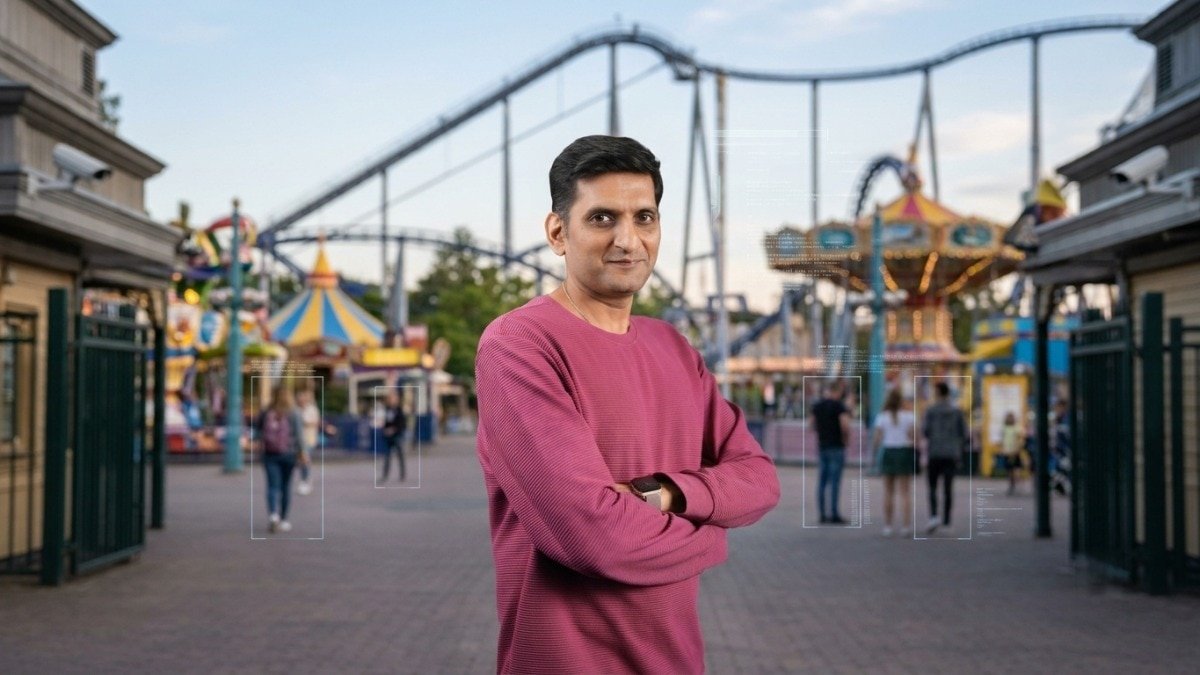
Source : INDIA TODAY NEWS
Imagine running a theme park that welcomes 50,000 visitors every day. You have 500 cameras watching the premises round the clock, yet people are still finding ways to enter without paying.
Your first instinct might be to install better cameras, hire more security guards or deploy artificial intelligence (AI) to catch trespassers.
But what if the biggest problem is not the people sneaking in, but the sheer amount of footage nobody can realistically monitor?
advertisement
That was the question Shivank Agarwal, an IIT Madras engineer and Head of AI and FDE Leader at Scaler, an AI-native technology education company, began investigating when he was approached by a European theme park eight years ago.
The project eventually helped the park save around Rs 70 crore annually by reducing the cost of its monitoring operation. And the surprising part? AI accounted for just 20% of the solution.
THE PROBLEM WAS NOT WHAT IT SEEMED
“The brief I received was just one line long: ‘People are entering our park without tickets. We don’t have AI. Can you help us?'”
The park had around 500 cameras operating 24 hours a day, generating nearly 12,000 hours of video footage daily. Security guards were employed to watch the feeds manually, making monitoring one of its most expensive security operations.
Before writing any code, Agarwal spent weeks speaking to the company’s top executives and security personnel.
He spoke to the CFO about where money was leaking, the CEO about previous attempts to fix the problem, the IT head about technical restrictions and the security chief about his worst working day.
The conversations revealed something important. The park’s problem was not simply people jumping over fences.
Some visitors would leave through exit gates and then turn around and walk straight back in. The guards stationed there did not check their tickets.
There was also a larger problem with unauthorised entry. But the park could not respond quickly enough because its security team was drowning in footage.
“The problem was not the absence of AI. It was the inability to process the overwhelming volume of video and convert it into actionable decisions for human intervention,” Agarwal explains.
HOW 500 CAMERAS AND AI CUT COSTS BY 96%
Instead of building a system that attempted to catch every trespasser, Agarwal focused on reducing the amount of footage humans had to examine.
The system broke the video feeds into smaller clips and passed them through an AI model trained to identify suspicious activity.
About 96% of the clips came back with nothing suspicious. These were discarded. Only the remaining few per cent were sent to the security room for human verification.
This meant security personnel no longer had to watch thousands of hours of footage. They could focus on a much smaller, filtered list of potential incidents.
The reduction in manual monitoring requirements brought down the park’s operational costs by 96%, translating into approximately Rs 70 crore in annual savings.
The financial calculation was based on the park’s existing security headcount, shift patterns and wage bill. Agarwal says the figures were validated with the CFO.
But getting the AI model to work was only a small part of the challenge.
THE 80% OF WORK THAT AI COULD NOT DO
The park’s cameras were 15 to 20 years old. Different cameras produced different video formats, and some generated footage so poor that it could not be reliably retrieved.
The system also had to function in rain, darkness, glare and heavy festival crowds.
Then there was privacy. The client did not want footage leaving its premises, not even for storage on a cloud server within Europe. The entire system had to operate on the park’s own hardware.
Even the way alerts were delivered needed careful thought. Security guards did not use smartphone apps. They carried walkie-talkies.
“The model is rarely the only point of failure. It is the 80% of the work that rarely makes it onto the presentation slide that often determines whether the solution succeeds or fails,” he says.
And there was one particularly memorable test.
After deployment, the system generated around 400 false alarms in a single night. It was foggy, and animals moving near the park’s boundary were being mistaken for people trying to enter.
The alerts went straight to security personnel’s walkie-talkies at around 2 am.
“We went in and fixed it,” Agarwal says.
HIS ADVICE TO PEOPLE BUILDING AI STARTUPS
For Agarwal, the project reinforced a lesson that he now applies to enterprise AI assignments and his work at Scaler.
Businesses do not necessarily know what is causing their problems, even when they know exactly what is bothering them.
He recalls another assignment involving an insurance company that wanted to use AI to speed up hospital claim approvals.
When his team observed employees handling claims, they discovered that the actual decision to approve or reject a claim took just four minutes. Gathering the necessary documents took another 42 minutes.
The company had wanted to automate the four-minute decision. The bigger opportunity was fixing the 42-minute information-gathering process.
“The customer knows their pain very well, but they often do not know what the underlying problem is. Those are two different things, and the gap between them is where the real business opportunity lies.”
His advice to aspiring entrepreneurs is to spend time observing customers before building a product.
In fact, if he were starting a company today, he would make one rule for his team.
“I would not let anyone on my team write code in the first few weeks.”
For an engineer who helped save a theme park Rs 70 crore without making AI the centrepiece, that might be the most important lesson of all.
– Ends
SOURCE :- TIMES OF INDIA