

SOURCE :- THE AGE NEWS
What in the World, a free weekly newsletter from our foreign correspondents, is sent every Thursday. Sign up to get the whole newsletter delivered to your inbox.
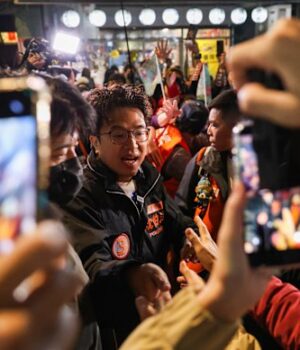
Taipei: On the streets of Taiwan’s capital, Puma Shen has somehow turned a mayoral race into a celebrity spectacle.
His supporters swelled into the hundreds, chanting his name and mobbing him for a photo as soon as he arrived for a street walk event on Wednesday evening in Taipei’s Shilin district.
It took the bespectacled academic-turned-politician 30 minutes to weave a path through the crowd and walk a few hundred metres to a nearby temple for a customary pre-polling day visit.
“I’m not a political guy, but I live in this neighbourhood and I have to tell Puma Shen I support him,” says Daniel Tseng, a 32-year-old manufacturing worker, who joined the crowd. “The way he is running – it’s unprecedented.”
Shen’s campaign team has dubbed this groundswell the “Ocean Current” and his supporters “water droplets” – and they could carry the 44-year-old candidate for the ruling Democratic Progressive Party (DPP) to an upset victory at Taiwan’s local elections on Saturday.
Across the strait, Beijing will be closely watching the Taipei race and the broader island-wide voting trends, as Taiwanese citizens elect more than 11,000 mayors and local officials in their home towns.
With just over a year until Taiwan’s next presidential election, in January 2028, it will be a pulse test of support for President Lai Ching-te and his DPP administration. Beijing denounces Lai as a “Taiwan independence separatist” and refuses to engage with his government.
The Beijing-friendly opposition party, the Kuomintang, has traditionally dominated local politics. Its party machinery is deeply embedded in local communities, with strong ties to public servants and military families that date back to the late 1940s, when KMT forces fled the mainland and set up in Taiwan after the Chinese civil war.
The KMT controls 14 of Taiwan’s 22 cities and counties, while the DPP has just five.
Shen will have to defy decades of history to defeat Taipei’s mayor, Chiang Wan-an, who is gunning for a second term under the KMT’s blue banner. Chiang’s campaign crowds have been much smaller than Shen’s, but the capital is a rusted-on heartland for the opposition and hasn’t elected a DPP mayor since 1994.
The polls show a race too tight to predict and almost everyone you speak to on the ground agrees.
“The DPP has run the strongest campaign in Taipei in decades. This is going to be a very tight race in Taipei,” says William Yang, a Taipei-based senior analyst for North Asia at the International Crisis Group.
Shen’s slick, upstart campaign has mobilised voters, especially younger ones, and provided a stark contrast with Chiang’s less showy and more scripted performances. Shen has combined traditional meet-and-greet events and a willingness to take audience questions on the spot with digital tools that have gamified interaction with his campaign.
Through his online platform on Taiwan’s LINE messaging app, supporters can live-track his events using GPS, submit questions and policy ideas, and collect online rewards that can be redeemed for his orange-and-white campaign streamers.
It has forced Chiang to put in the hard yards to woo votes after winning in a landslide in 2022. For up to six hours a day this week, the 47-year-old mayor has looped the city in an open-top Jeep Wrangler, clad in his signature red The North Face jacket as he beams and waves to supporters while his motorcade blasts re-election slogans.
“It’s durable and does its job to keep you warm. You don’t need a replacement, just like your mayor,” Chiang quipped when asked about the jacket while on the hustings.
Neither Chiang nor Shen has campaigned on China issues – the macro-ideological dividing line between the KMT and the DPP – sticking instead to bread-and-butter local concerns, such as elderly and child welfare, urban renewal, traffic congestion and the cost of living.
The candidates share some striking similarities. Both aged in their 40s and telegenic, they attended the same elite high school in Taipei, studied law at the US Ivy League’s University of Pennsylvania, have backgrounds as lawmakers in Taiwan’s national parliament, and are considered future presidential hopefuls.
But whereas Chiang claims a political pedigree as a descendant of the KMT’s long-time dictator, Chiang Kai-shek, Shen is renowned for his pre-political career as a campaigner against Beijing’s influence. In 2021, while working as a criminology professor, Shen co-founded Kuma Academy, which runs civil defence courses and disinformation training designed to prepare Taiwanese civilians for conflict with China.
Beijing has branded Shen a traitor and sanctioned him for his work against China’s influence campaigns, while mainland police have opened a secession case against him in the Chinese city of Chongqing.
“Puma Shen had a bit of a turnaround in his political branding,” says Wen-Ti Sung, a Taipei-based political scientist at the Australian National University’s Taiwan studies program.
‘The DPP has run the strongest campaign in Taipei in decades. This is going to be a very tight race.’
William Yang, International Crisis Group
“His brand was essentially anti-Chinese interference in Taiwan politics. But during this election, those factors rarely surface in his pitch to the voters. He correctly noted voters saw this as a local race in which candidates’ personal profile and their vision of city affairs are what matters more.”
This has also helped Shen appeal to swinging voters turned off by the polarised, often caustic public contests between the DPP and KMT.
But for some, Shen’s background as a staunch defender of Taiwanese identity is the drawcard.
“I don’t want someone who is from a super-Beijing-leaning party to be my mayor,” said Jerry Kao, a 45-year-old metro worker, as he waited on the street to see Shen’s motorcade in Taipei’s Songshan district on Wednesday afternoon.
“Remember how Cheng Li-wen met [Chinese leader] Xi Jinping and how close she was to him?” says Kao, referring to the KMT chairwoman’s visit to Beijing in April, which made her the first sitting opposition leader to make such a visit in a decade.
Micky Chu, an artist, says the impact of Beijing’s national security law crackdown on Hong Kong, which crushed political freedoms in the city, has influenced her vote.
“I don’t want Taiwan to be the second Hong Kong. Look at how much has changed over there. It’s just shocking and terrifying,” Chu, 40, says.
“Some of my Hong Kong friends told me to vote for the right person and protect the values and freedom we still enjoy here in Taiwan. I have to vote for Puma Shen.”
In a speech in Beijing this month, Chinese leader Xi Jinping again promoted the “one country, two systems” model applied to Hong Kong as the pathway for unifying Taiwan with the mainland. China regards Taiwan as its territory and has vowed to bring it under its control, even though the Chinese Communist Party has never governed the island.
The KMT has officially rejected the “one country, two systems” model while promoting better relations with Beijing. Chiang too has explicitly rejected it, saying “Taiwan is not Hong Kong”. But the DPP has made opposing the model a core part of its meta narrative in asserting its view of Taiwan’s status as an already independent and sovereign country.
Most Taiwanese citizens want the deliberately vague status quo arrangements – no formal declaration of independence and democratic self-government – to continue, regular polling shows.
Meanwhile, Shen’s momentum has rattled some of his opponent’s supporters.
“It’s 50-50. I still think Chiang is going to win,” says Tony Chen, a 27-year-old IT worker, at a street rally outside a KMT office on Tuesday evening when the mayor’s motorcade stopped to thank volunteers.
His voice is hoarse from leading Chiang supporters in chants of “Taipei encore!” where he is a youthful face among a more senior crowd, reflecting the older demographics of the KMT base.
“Game over,” he says of the prospect of Shen winning. “Imagine the capital of Taipei being taken down by the DPP.”
At a KMT office in Taipei’s Datong district, manager Louise Chung is preparing snacks for drop-in visitors. She concedes the Shen team’s campaigning strategies have been impressive, but says you can’t discount the quiet, less visible KMT voters who reliably turn out each election.
“There are grandpas and grandmas who approach us and gently whisper, ‘We’re going to support him. Please let them know that we love him’,” Chung says. “That’s the way we run elections. The humble, subtle way.”
Some analysts think KMT’s historical hold over Taipei will see Chiang hold on, but even a close loss for Shen would energise Lai’s presidential re-election bid, as the DPP looks to secure a fourth term at the helm in 2028.
“If Puma Shen can get 45 per cent or even more votes, that’s going to generate a strong enough momentum for Lai Ching-te’s re-election campaign,” says Yang, from the International Crisis Group.
How the KMT fares across the island will also shape who secures its nomination for the 2028 race – something Beijing will be keeping a close eye on.
“Beijing wants to see a stronger, Beijing-friendlier opposition field in Taiwan politics, one that has viability in winning the 2028 presidential election, and a poor showing at a local election race will significantly put a dent in that prospect,” Sung, from the ANU, says.
Whether it’s a setback or a victory for Shen or Chiang, both men are presumed to have bigger dreams beyond the mayoralty. The Taipei race may prove a dress rehearsal for a presidential match-up in 2032 and beyond.
Get a note directly from our foreign correspondents on what’s making headlines around the world. Sign up for our weekly What in the World newsletter.
 Lisa Visentin is the North Asia correspondent for The Sydney Morning Herald and The Age based in Beijing. She was previously a federal political correspondent based in Canberra.Connect via X or email.