

Source : INDIA TODAY NEWS
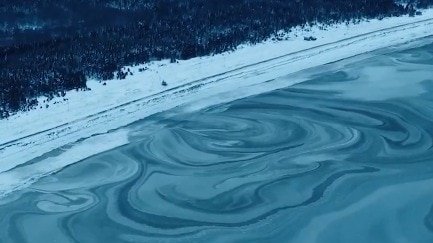
The Sea of Okhotsk off Russia’s Far East coast resembled a giant cup of coffee, with delicate white swirls and marble-like patterns spreading across its dark blue waters, in videos doing rounds on social media.
The unusual patterns, which have been compared to latte art, are not digitally created or an AI-generated visual spectacle. They are natural ice formations produced by a combination of freezing temperatures, wind and ocean currents.
advertisement
The phenomenon occurs as the sea begins to freeze during autumn and winter, creating a thin layer of ice that is constantly pushed and rearranged by moving water.
WHAT CREATES LATTE-ART IN THE SEA?
When temperatures fall, tiny ice crystals begin forming on the sea surface.
These crystals gather into a soft, slushy material known as grease ice or shuga. It looks like a layer of oily patches or small, spongy ice clumps floating on the water.
As winds and ocean currents move across the surface, they push and pull this loose ice in different directions.
The movement stretches the patches into long, curved lines, swirling shapes and intricate patterns that resemble designs made in a cup of coffee.
The Sea of Okhotsk provides favourable conditions for this process. Located off Russia’s eastern coast, it is one of the southernmost seas in the Northern Hemisphere to experience extensive seasonal freezing.
Cold air flowing from Siberia helps lower temperatures, while freshwater flowing into the sea from rivers also plays a role. Freshwater freezes at a higher temperature than salty seawater, helping ice form more readily in areas where the two mix.
When the ice remains thin and broken into smaller pieces, winds and currents can easily rearrange it, producing the striking patterns seen in the videos.
A RECURRING WINTER PHENOMENON
These formations are not unusual for the region. Similar patterns appear during winter and early spring, particularly when the sea ice is thin and constantly moving.
Satellite images captured by Nasa over the years have also documented comparable formations, especially during periods when larger ice sheets begin breaking apart.
The latest videos, reportedly filmed around mid-November, show the seasonal freezing process getting underway.
However, the designs do not last. Changing winds and currents continuously reshape them before the loose ice eventually freezes into larger sheets or melts as temperatures rise.
What looks like a meticulous work of art is, in reality, a natural interaction between ice, wind and water.
– Ends
SOURCE :- TIMES OF INDIA