

SOURCE :- THE AGE NEWS
Taipei: Taiwan’s ruling party failed to win the coveted post of Taipei mayor, but made strong gains across the island in tightly fought local elections that President Lai Ching-te will seek to capitalise on ahead of an expected re-election bid in 2028.
The Democratic Progressive Party achieved its best local election result since 2014, winning at least nine of Taiwan’s cities and counties, compared to the 10 won by the China-friendly Kuomintang opposition.
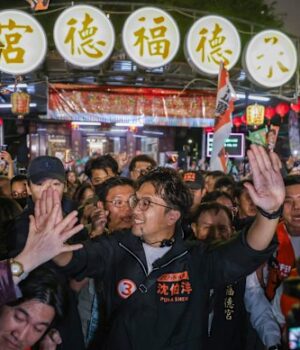
But 44-year-old DPP candidate Puma Shen could not wrest the Taipei mayoralty from Chiang Wan-an, whose re-election affirmed the strength of the KMT’s stronghold on the capital.
The DPP has not won Taipei in more than 30 years, but Shen mobilised thousands of supporters at his rallies and events, while polling suggested the candidates were neck and neck. It fuelled the party’s hopes of flipping the seat and generating momentum for President Lai Ching-te’s re-election campaign.
DPP supporters were also hopeful that an upset victory would send a message to Beijing, which has sanctioned Shen and denounced him as a “diehard Taiwan independence separatist” for his advocacy against China’s interference in Taiwan affairs.
“This certainly takes the wind away from Lai’s re-election sails, even though it was one of the best losses the DPP could hope for,” said Lev Nachman, a political science professor at National Taiwan University.
“For the DPP, it’s now a matter of trying to frame this in a way that helps Lai launch his re-election campaign.”
Ultimately, Chiang was comfortably re-elected, with almost 54 per cent of the vote to just under 46 per cent for Shen, in an outcome that stunned some DPP supporters and left the party with the task of managing deflated expectations.
In a concession speech before a large outdoor crowd on Saturday evening, Shen urged them to accept the verdict as some of the crestfallen supporters sobbed.
“I know there are some doubts about the result, but please, everyone, believe in Taiwan’s democracy,” Shen, 44, said, evoking his background as a campaigner against disinformation.
“The results are real. We can lose an election, but we can never lose Taiwan’s democracy.”
Before becoming a lawmaker in Taiwan’s parliament and running for Taipei mayor, Shen co-founded Kuma Academy, a not-for-profit that trains citizens to prepare for potential conflict with China.
“I’m really surprised at the result. I don’t know what happened,” said Jimmy Chen, a 49-year-old computer hardware campaigner who was among the throngs of subdued DPP supporters at Shen’s event on Saturday.
Lai also addressed Shen’s rally in Taipei, apologising for the loss, while praising Shen for having “exceeded all our expectations”.
At the KMT’s election party headquarters, Chiang thanked Shen and said they had completed a celebration of democracy, while his supporters cheered his victory.
“I am overwhelmingly happy with Chiang being our mayor again. I’m so happy. No words can describe how excited I am,” said Emily Sheng, 60, a retired salesperson.
The Taipei mayoral race was one of 22 cities and counties decided at Saturday’s island-wide elections.
Beijing was expected to closely monitor the election results, tracking voting patterns of support for the KMT, which advocates for a closer relationship with China. Its chairwoman, Cheng Li-wun, met Chinese President Xi Jinping in April.
“China will be breathing a sigh of relief that the KMT holds on to Taipei and New Taipei City, but they will be alarmed by the DPP’s ability to significantly shrink the gap,” said William Yang, a North Asia analyst at the International Crisis Group.
China regards Taiwan as its territory, and has vowed to take control of it, despite the Communist Party having never governed the island.
The DPP also fell short of flipping New Taipei City after its candidate took an early lead, but it secured a surprise win in Taichung, Taiwan’s second-largest city and won a number of smaller KMT-held areas.
Meanwhile, Taiwan’s Ministry of National Defence reported 33 Chinese warplanes encircled the island on Friday, while Chinese state media renewed its attacks on Shen, accusing him of being backed by the US.
Earlier in the campaign, Taiwan officials alerted Meta to thousands of accounts that they suspected were part of a Chinese information warfare campaign seeking to influence the election. Beijing rejected the accusation as “completely fabricated”.
Get a note directly from our foreign correspondents on what’s making headlines around the world. Sign up for our weekly What in the World newsletter.
 Lisa Visentin is the North Asia correspondent for The Sydney Morning Herald and The Age based in Beijing. She was previously a federal political correspondent based in Canberra.Connect via X or email.


