

Source : the age
By Martin Boulton and Tony Way
MUSIC
Jacob Collier | Djesse World Tour ★★★★
Margaret Court Arena, December 13
Four brightly coloured trees glowed on stage and amped up a festive mood in the air, as Jacob Collier bounded into view wearing loose-fitting multicoloured pants and a radiant orange jacket.
Multi-instrumentalist Jacob Collier performs on stage at Margaret Court Arena in Melbourne during his Djesse World Tour on December 13, 2025.Credit: Richard Clifford
The lanky 31-year-old Londoner barely stopped bouncing about in his bright yellow Crocs for the next two hours, as his five-piece group shifted from silky jazz grooves to funky beats, classical flourishes and Collier’s self-styled gospel harmonies.
In the 345th and final performance of his epic Djesse World Tour, Collier frequently thanked the audience and showered affection on Melbourne, where he originally played in 2018 – the same year he released the first of four albums in the Djesse series.
Along the way, he’s won seven Grammy Awards, been hailed as a modern-day musical genius, and collaborated with the late composer Quincy Jones and Coldplay.
Original compositions Wherever I Go from Djesse Vol. 4, and Heaven (Butterflies) from Collier’s new and relatively stripped-back acoustic guitar album The Light For Days were hugely popular among the sold-out crowd.

Jacob Collier has been hailed as a modern-day musical genius.Credit: Richard Clifford
It’s anybody’s guess how legendary folk duo Simon and Garfunkel might feel about Collier’s deconstructed, spikey version of their 1970 song Bridge Over Troubled Water, but it typifies his bold approach to re-interpreting the classics.
A wonderful medley featuring Queen’s anthemic We Will Rock You, Louis Armstrong’s What a Wonderful World, and The Beatles’ Blackbird featured the best example of Collier’s renowned, multi-part crowd harmonies, complete with joyous communal chirping.
In solo mode, inventive vocalist/guitarist and Hiatus Kaiyote frontwoman Nai Palm brought oodles of good cheer and cool vibes to her opening support slot and relished this hometown performance.
Delivering a heartfelt farewell to Melbourne, Collier shared a group hug with his bandmates, and closed out his remarkable Djesse phase with a rousing rendition of Queen’s Somebody to Love.
Reviewed by Martin Boulton
MUSIC
Handel’s Messiah ★★★★
Melbourne Symphony Orchestra, Hamer Hall, December 13
As popular as ever, this year’s Christmas outing of Handel’s Messiah by the Melbourne Symphony Orchestra was reinvigorated by Swedish-born conductor and choral specialist Sofi Jeannin. Clarity and elegant assurance hallmarked her direction, underpinned by her constant encouragement of the performers.
Using Handel’s orchestration, the MSO was pared down to some 30 players, matched with about 80 singers from the MSO Chorus. From the opening notes of the Overture, Jeannine cultivated a historically sensitive approach to the playing in the context of manageable tempos to which, on the whole, the orchestra responded well under acting associate concertmaster Tair Khisambeev. Jeannin was a sensitive accompanist, ensuring that the vocal elements were never overwhelmed.
Amongst the soloists, baritone Morgan Pearse stood out for his dramatic stage presence. Impressively singing all his solos from memory, he stole the show with a riveting account of The trumpet shall sound (thankfully presented in its entirety) matched with master trumpeter Shane Hooton.
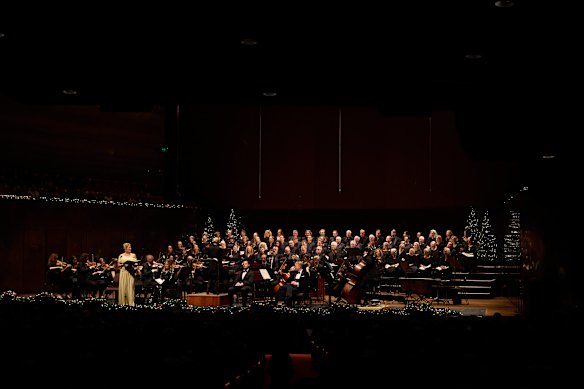
This year’s performance of Handel’s Messiah was reinvigorated by Swedish-born conductor and choral specialist Sofi Jeannin.Credit: Laura Manariti
Tenor Andrew Goodwin’s honeyed tone, as ever, was a delight, especially in an affecting performance of Behold and see. The sweet voices of soprano Samantha Clarke and mezzo-soprano Ashlyn Timms proved well matched in He shall feed his flock.
Jeannin’s extensive vocal experience bore excellent fruit in the chorus work, eliciting fine diction and emphatic ensemble, particularly in the second and third parts of the oratorio. Apart from the usual choral highlights such as Surely he hath borne our griefs and the celebrated, triumphant Hallelujah, an added bonus came with a memorably intense rendering of He trusted in God.
Even though the concert lasted over 2½ hours, time seemed to pass quickly. Responding with an enthusiastic ovation, the audience not only acclaimed one of the more enjoyable presentations of this evergreen classic in recent times, but Handel’s engaging, enduring creativity. Hallelujah!
Reviewed by Tony Way
The Booklist is a weekly newsletter for book lovers from Jason Steger. Get it delivered every Friday.