

source : the age
To submit a letter to The Age, email letters@theage.com.au. Please include your home address and telephone number. No attachments, please include your letter in the body of the email. See here for our rules and tips on getting your letter published.
We cannot say we were not warned by educators, academics and students about the growing use of artificial intelligence in educational institutions. In the article by academic Kylie Moore-Gilbert (“I’m an academic, but I’ve told my stepdaughter to think twice about going to university”, 27/05), she has not only outlined her concerns about the devaluation of qualifications, but she has firmly hit out at the cognitive offloading by students through the use of AI instead of using their brains. I fully support her in her sentiments. I’m a secondary school teacher, and I see it every day where students are enamoured by the use of AI and what it can do. We should all be concerned by this. The intrusion of AI into all our devices and search engines is something we didn’t really ask for, yet technology companies are trying to make it seem like it’s some kind of technological panacea. At what cost to our higher order thinking? AI should be seen as a tool, not a solution. I accept that AI can be useful for synthesising information and that students can use it to make that part of their learning more efficient. Yet I can also see where AI can be a hinderance to learning as we have to check and re-check the information it produces. Perhaps a return to some basics might be appropriate – actual books and handwritten assignments would be a start.
Jeremy de Korte, Newington
Academic integrity is still intact
Dr Kylie Moore-Gilbert’s opinion piece on the takeover of AI in universities misses some important points. Many university degrees now have practical components including Zoom recorded assessments and, in later stages of degrees, placements that quickly sort out the fakers from those who have absorbed knowledge. As a mature age master’s student returning to a Group of Eight university for the first time since last century, I was encouraged by the mandatory academic integrity module all students undertake before being officially enrolled in a course. This module covered the unacceptable use of unacknowleged AI, contract essay writing and plagiarism. I am confident that my university would take these issues seriously, if only from a reputational risk standpoint. I dispute Moore-Gilbert’s claim that gaining a high distinction through AI is easily achievable, especially in universities that pride themselves on academic rigour. In a world of fake news and AI dominance, academic integrity remains a legitimate aspiration.
Sara McMillan, Frankston South
Teach the basics before digital literacy
Students’ digital literacy is declining (“Students hit new low in digital literacy”, 27/5) despite their reliance on digital devices for just about everything. University students’ intellectual and analytical skills are declining (“AI has destroyed value of a degree”, 27/5). Talking to many has become anathema: they prefer to text (“I don’t make phone calls”, 27/5). It seems we are losing what makes us human: our ability to use our own brains and to communicate meaningfully with others. Put the devices away in primary school and teach children reading, writing and ’rithmetic in their early years – and not on a device where the platform can hamper learning. Teach digital literacy later, when some basics have been learnt. Concentrate more on individual invigilated exams and oral presentations at university. We should be in control of AI, not the opposite.
Louise Kloot, Doncaster
The perils of surrendering to technology
What an excellent article by Kylie Moore-Gilbert. Why are our governments and universities buying into the AI industry sources so enthusiastically? Is this very shortsighted, with the possible consequences of switching off critical thinking and people being educated to rely on this source in order to qualify for careers? Are we all at risk here? Once you switch off the power of the mind and surrender to this technology we can be very vulnerable to manipulation.
Christine Baker, Rosanna
Lack of skills alarming
I can’t help but wonder if there is a link between the issues discussed in different articles in The Age recent days. The inaccuracies and misinformation spread by AI-generated memes in relation to the recent budget, exposed by David Swan (27/5) and others; the pervasive use of AI in university assessments and teaching criticised by Kylie Moore-Gilbert (27/5); and the apparent poor performance of school students in digital literacy reported by Caroline Schelle. It is frightening that non-human players have an increasingly significant role in our everyday lives but real humans may not have the awareness and skills to understand what is going on.
Judy Williams, Beaumaris
Stick with librarians
The term “digital native” has long been contentious, often conflating confidence in consuming information with the deeper ability to effectively navigate, evaluate, and use it (“Students hit new lows in digital literacy”, 27/5). As a librarian, I see that new students can indeed develop information and digital literacy skills quite readily; however, this only happens with clear guidance and dedicated time spent building those capabilities. The assumption that students inherently possess these skills is misguided. Librarians, as digital and information and literacy experts, must be actively integrated into educational settings at all levels if we want the next generation to develop the skills needed for the workforce, contribute to informed debate, and engage meaningfully with the world.
Carl Buttler, Delacombe
THE FORUM
Allan’s shortsighted shot
Jacinta Allan’s shortsighted decision to cave into the powerful gun lobby in rural Victoria will be detrimental to her support base across the state in the November elections. Every conscientious citizen who values the safety of the whole community over recreation will be appalled by this rejection of Albanese’s gun buyback scheme and proposed limits on firearms (“Allan at odds with PM after rejecting gun buyback scheme and limits on firearms”, 26/5). Have we not seen enough violence in society of late? Now is the time to limit the number of Category A and B firearms as a safeguard against individuals who engage in domestic abuse, racist attacks, drugs and alcohol abuse, terrorist acts and a disturbing disrespect for fellow human beings and the law. The potential loss of Jacinta Allan’s East Bendigo seat must be at the heart of her regrettable stance. But nothing will save the Victorian state government from the loss of credibility if they ignore the recommendations of former police commissioner Ken Lay. The time for real leadership on gun control is more important than ever.
Nick Hale, East Malvern
Deadly consequences
In once again siding with the shooting industry and hunting fraternity over the safety and interests of Victorians – both human and animal – Jacinta Allan may have finally shot herself electorally in the foot. Sooner or later, Allan’s defence of guns and gun culture will be at the expense of mass gun violence. When that day arrives, Victorians will remember exactly who chose her personal political aspirations over public safety.
Helen Round, Donvale
‘Wants’ are not ‘needs’
There’s a difference between “wants” and “needs”. How can anyone have a “compelling need” to own up to 10 guns? I want to write this letter, and I may feel compelled to, but I don’t need to. Why is the government pandering to the “wants” of gun owners at the expense of public safety and contrary to the recommendations of former police commissioner Ken Lay’s review?
Jenifer Nicholls, Windsor
Emissions failures
Elizabeth Knight identifies the two government schemes most pertinent to mining company decisions about emissions reduction (“BHP’s pledge to lead capitalist pack on green shift has turned to an empty promise”, 27/5) as the Safeguard Mechanism and the diesel rebate. The former she rightly describes as “an epic failure”. For its part, the latter is “a disincentive for the company to migrate its energy sources away from fossil fuels to renewables”. In effect we are stuck with a triple failure. The government has failed to formulate and enforce effective emissions reduction policies. By giving priority to short-term investor returns, companies such as BHP have failed to take responsibility for exacerbating global heating. The third failure is the capitalist system itself, which reduces nature to a resource to be plundered. We all need to open our eyes and see that humans can only flourish when the world’s ecosystems are treasured and maintained in good health. It’s the key to reversing our failures and continuing to thrive.
Tom Knowles, Parkville
No integrity
I have been a Bombers supporter for 65 years, but what the club did to Brad Scott is the end. The board’s failure to stay true to the course they themselves agreed upon with the coach – a strategy to rebuild slowly and thoroughly through the draft – is as weak as the proverbial. Every serious football observer knows rebuilding through the draft is difficult, that it is a road fraught with pain as the losses mount. But those same football brains will tell you rebuilding with youth is the best way to build an honest football culture – one that lasts. To me, Brad Scott has conducted himself with a steely determination, always focussed on the job at hand. Even last year when Essendon had an horrific spate of injuries that left him struggling to even get a team on the park he never sought excuses. To the club president and chief executive, I ask: does the word “integrity” mean anything to you?
David Turnbull, Wamboin, NSW
Stay in the zone
One small way to help ease the housing crisis would be for councils, with the support of the state government, to ban the use of houses for commercial purposes. Walk along thousands of suburban streets and you will see what was once a residential dwelling now set up for business. Whether it be for a medical or dental practice, a legal practice or taxation agent office, a beauty parlour, massage clinic or nail shop, it is taking a liveable property away from its original purpose and depriving people of a place to live. With many multi-storey residential developments getting closer to commercial and industrial areas, surely it’s time that clear demarcation lines were drawn and houses kept separate and solely for residential purposes. Make commercial operations use commercial zones and keep house for residential use.
Stan Thomson, Sandringham
Keep investors out
Your correspondent (Letters, 27/5) suggests Australia should not allow investment entities to dominate the housing market at the expense of individual investors. I question why any investor should be allowed to participate in the housing market at any level. A major reason why residential property prices have exploded over the past two decades is the residential property market has been allowed to become an investment vehicle, where the investor, almost always with more than adequate funding, is able to drive up the price beyond the capacity of the new generation of would-be buyers who aspire to become owner-occupiers. It is time that there was immediate legislation to limit the acquisition of individual residential properties to individual Australian resident citizens who commit to the intention of living in the property. No more self-managed super funds, trust arrangements or investors, on-shore or off-shore, participating in the market. Limit the residential housing market purchasers to intending owner-occupiers. The original ethos of home ownership in this country was that Australians should be able to buy and reside in their own homes – not be pawns to an avaricious investment market. It won’t happen of course – investment capital (and greed) carries an excessive amount of influence in the corridors of political power.
Brian Kidd, Mt Waverley
Avoid the snooze button
The Australian Strategic Policy Institute forecasts “cascading” climate-related disasters, including more lethal heat and humidity (“Humidity issue could hit millions in our region”, 27/5). Andrew Forrest described this as a “wake-up call for policymakers”. Just how many more wake-up calls are needed?
John Hughes, Mentone
Introspection, please
Jane Buncle (Opinion, 26/5), a member of the Liberal Reform Commission, believes Millennials and Generation Z are turning to One Nation because of the failures of the major parties. As a member of a commision that apparently seeks reform of her party, one issue she needs to address is why her party failed these generations so badly in the decade they were in power up to 2022.
David Fry, Windsor
One at a time
Diction failing on radio, yes. Fast talking preventing understanding, indeed (Letters, 27/5). Just as irritating, on both radio and television, are programs which have three or more people on a panel. Why must they talk over each other, usually to their own amusement, but with listeners or viewers in the dark? Do they not appreciate it is only possible to listen to one speaker at a time?
Alan McLean, Queenscliff
Impossible dream
US President Donald Trump wants Arab nations to recognise the State of Israel as part of a peace agreement with Iran. It would be a brilliant idea if he could simultaneously get Israel to recognise the State of Palestine.
Danny Cole, California Gully
AND ANOTHER THING
Phones
There is nothing more annoying to this old guy than seeing people texting rather than making a phone call. It is so much easier to resolve any questions with one simple phone call than using a dozen text messages and still having some issues unresolved. And apart from that, I hope nobody ever needs you in an emergency.
Michael McKenna, Warragul
It is obviously a generational thing but being a Boomer, I far prefer to actually talk to someone rather than text them. In fact, I often text people with the message “Call me when convenient”.
Neale Woods, Wattle Glen
Guns
Premier, could you give me one reason why one person would need more than four firearms?
Peter Randles, Pascoe Vale South
The boast you’ll never hear from a state Labor politician – Victoria will soon have the weakest gun ownership laws in Australia (“Police backed gun limit before Allan shot it down”, 27/5).
David Cayzer, Clifton Hill
Furthermore
I’d like to commend your economics writer Millie Muroi. For those of us who are not trained economists her articles are a joy to read. Clear, concise and with real life examples. And no jargon!
Sue Tuckerman, Kew
If a capital gains tax is only due on selling an asset, why the backlash by start-up businesses? Seems like a pretty short-term start-up.
Peter Baddeley, Portland
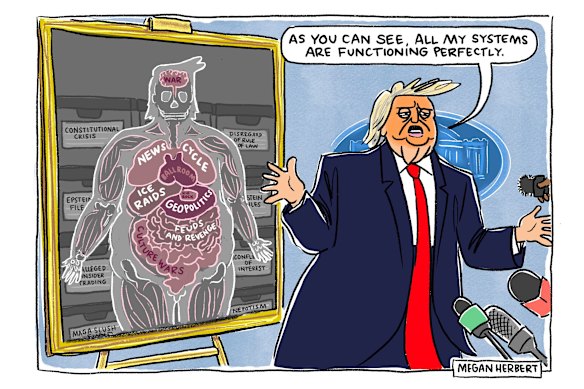
Is Donald Trump planning to invade Cuba? That should take people’s minds off his pointless Iran war, the cost of living, the price of oil, the death of American democracy, and the Epstein files.
Tim Durbridge, Brunswick
“One-term Tony” giving advice to “No-term Taylor” sounds like a plan.
Bill Walker, St Andrews Beach
Finally
Albanese and Chalmers remind me of a quote from Groucho Marx: “The secret of life is honesty and fair dealing: if you can fake that you’ve got it made.”
Michael Madden, Chum Creek