

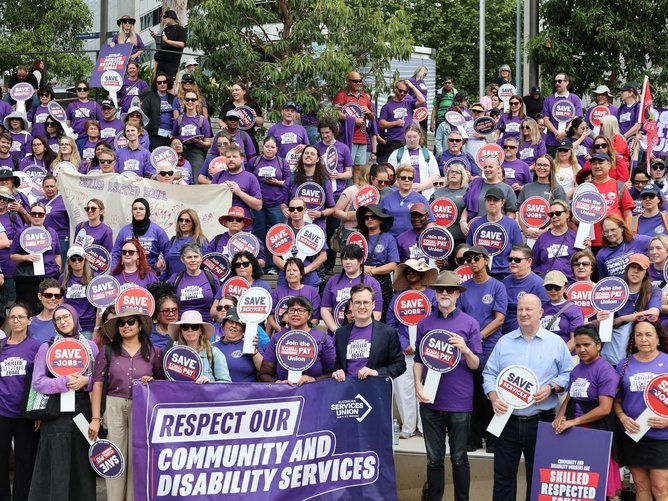
Source : Perth Now news
One of Australia’s biggest trade unions is pushing for a historic pay rise for thousands of support workers across the country – marking the sector’s biggest wage push in more than a decade.
The Australian Services Union (ASU) will push for a 35 per cent wage increase for community and disability support workers.
Such a claim would make the sector’s biggest wage claim in more than 14 years.
The union will present their case to the Fair Work Commission (FWC) on Wednesday, arguing that base wages should be lifted to reflect the increasingly complex and demand the nature of the work.
ASU NSW & ACT secretary Angus McFarland said the proposed pay rise would ensure support workers feel valued for the work they do.
“Community workers are being squeezed but their wages don’t reflect the workload,” he said.
“Over the past 14 years, their work has become more complex, intense and demanding.
“Workers are supporting more clients with increasingly complex needs, and managing heavier workloads with fewer resources.

“Our members are the glue that holds communities together in NSW and the ACT. Community workers support people through crisis, trauma, poverty and disadvantage, helping them get through the worst periods of their lives.”
The ASU, which represents about 185,000 workers in the support, transport, travel and IT sectors, estimated the average annual wage of full-time workers impacted would be about $80,000.
However, that figure would be lower for the many part-time and casual workers in the women-dominated sector.

The case comes as the Fair Work Commission restructured the Social, Community, Home Care and Disability Services (SCHADS) Award last week, which closed a wage theft loophole in the NDIS.
Mr McFarland said the proposed pay rise would help to increase employment and retention in the sector.
“Workers are leaving the sector because they’re undervalued and underpaid. This sector is a leaky bucket with one of the highest staff turnover rates,” he said
“It’s putting pressure on remaining workers and costing employers time and money as they constantly replace staff.
“Fair pay will mean better outcomes for the people of NSW and the ACT. It will mean secure jobs, less staff turnover, better services and stronger communities.