

Source : THE AGE NEWS
Boneless fish, filleted cuts of meat, 4pm dinner reservations and smaller portions of protein and fibre-rich dishes – the era of the silver economy is well and truly flourishing, businesses across the country are proving.
The share of Australians aged over 60 has never been higher, as butchers, bakers and restaurants through to the largest supermarket chains begin to shape their offerings to better cater to the burgeoning, lucrative demographic.
“Sixty is the new forty, and with about a quarter of the population over that age, there’s business to be made.”
Michael Whitehead, director of food, beverage and agribusiness insights at ANZ
Australia’s ageing trajectory has been clear for some time, with about 23 per cent of the population now aged 60-plus. By contrast, about 18 per cent of the country is aged under 15.
The growth, while steady, has been pronounced. About 17 per cent were over 65 years old in 2024, up from about 13 per cent in 2005.
Not only is the older cohort a larger customer base, they’re increasingly healthy and active, with plenty of free time during the day and higher on average spending potential than the rest of society, says Michael Whitehead, the director of food, beverage and agribusiness insights at ANZ.
“Sixty is the new forty, and with about a quarter of the population over that age, there’s business to be made from them,” Whitehead said.
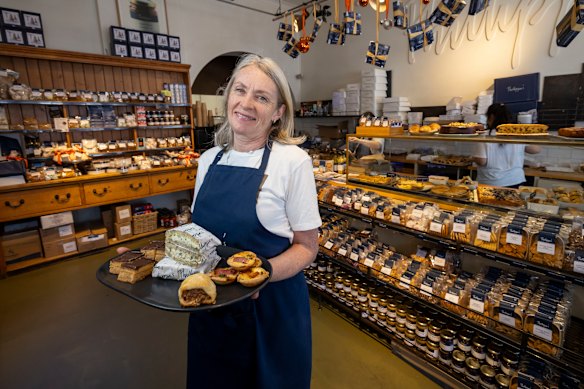
Phillippa Grogan, founder of Phillippa’s Bakery, has begun changing her menu to better suit older Australians with smaller appetites.Credit: Wayne Taylor
In its latest Food for thought supply chain report, ANZ has noted the emergence of two distinct cohorts of older consumers: empty-nesters in their late fifties through to seventies who are staying active longer and want food that supports strength and energy, and those in their late seventies and older who value comfort, safety, uncomplicated food preparation and easy to chew and digest textures.
Regardless of which bracket they fall into, Australia’s older consumers are broadly interested in convenience and smaller serves, geared towards dining out for lunches over dinners, and are put off by products that resemble “medical food” or are tagged as being “for seniors”, the ANZ report said.
“The kids have left, the mortgage is paid off, you’re getting older and don’t need to keep buying as much food because it’s going to go off, you also may be looking to treat yourself and want to eat healthily but you don’t want to have to chop, cook, and clean up a huge meal,” Whitehead said.
As a result, hospitality and food retailers are subtly tweaking their menus and innovating how they operate.
Half portions, smaller appetites
In Melbourne, Phillippa’s Bakery, a wholesaler making baked goods, pre-made meals and hampers in addition to two retail locations in Armadale and Brighton, is among those catering to the trend.
Founder Phillippa Grogan said that while the stores are in family-dense suburbs and have sold larger than normal loaves and packets of biscuits accordingly, “we also notice our older customers whose appetites are decreasing”.
The bakery now offers much of its menu in half sizes, such as its chocolate brownies and biscuits. Packs of party pies are also popular with older customers with smaller appetites.
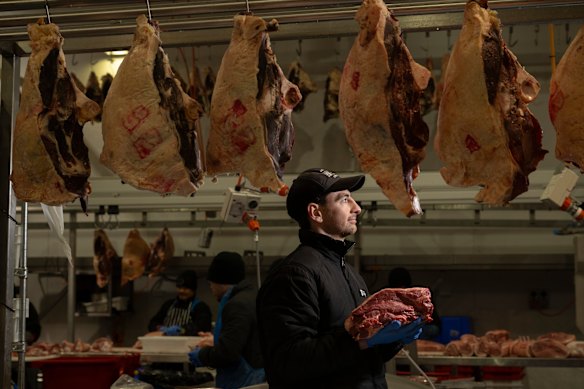
Rob Greenhalgh-Ward with a bolar blade for slow-cooking – something popular with the increasing number of older customers – at the Australian Meat Emporium in Sydney.Credit: Janie Barrett
Its chicken sandwiches, while a hit with tradies looking for a filling lunch, were too big for many older customers. They now offer a half portion.
Phillippa’s has also begun doing more take-home meals, designed to be familiar, easy to eat and gourmet, and freezable.
“When you get to 60, you’ve done as much cooking as you want to do in your life, especially as much shopping, cooking and washing up as you ever want to. These customers just want to heat something up in one portion and have a glass of wine.”
The business’ meal offerings are designed to be a cut above those traditionally found in supermarkets. “Everything we make is exactly like you’d make it at home. It’s what older customers would have grown up with their mothers or grandmothers making, it takes them back,” Grogan said.
While older customers expect consistency, they also appreciate new and exotic items, Grogan said.
“They can get a coq au vin or beef burgundy and be transported to France, it’s the luxury they deserve,” Grogan said. “It’s important to recognise your customers are ageing, which is inevitable. They will stay with you, but you need to change too.”
Seniors’ dairy formula, 4PM restaurant bookings
Changes are being felt across the supply chain.
Both Coles and Woolworths have ramped up pre-washed and pre-cut vegetables, salads, ready meals and half loaves of bread, as well as home delivery services. In stores, the chains are lowering music for a calmer shopping experience during weekday “quiet hours”.
Dairy formula designed to boost bone density and nutrients for seniors is also booming, rivalling the infant market, Whitehead said.
Many restaurants are also finding lunchtimes, and earlier dinner sittings, are stronger than ever.
Seated dining bookings for 4pm-5pm saw the greatest year-on-year increase of any hour in 2025 in Australia, up 25 per cent, followed by 5pm-6pm which was up 20 per cent, according to data from restaurant booking platform OpenTable.
Early sittings and dining spots with ambient music would be among the leading trends in 2026, according to an OpenTable survey. It also found that 26 per cent of Baby Boomers plan to dine out early, between 4pm-6pm, in 2026, compared to 20 per cent of Millennials.

Wilmer Ropero cutting a pork leg for a osso buco at the Australian Meat Emporium. Meat that can be slow cooked until tender is in demand among increasingly an older clientele. Credit: Janie Barrett
Drew Bowering, a senior director at OpenTable, said restaurants are capitalising on the trend “from offering and promoting early bird menus to optimising operations during this window”.
Whitehead said lunch service is becoming more important for restaurants.“Hospitality and quick service restaurants are reshaping offers to match a daytime rhythm, with lunch now the main social meal for many older diners.”
”Menus lean toward smaller bundles and mains that deliver meaningful protein without heavy salt, with sides that balance comfort with fibre,” he said, adding that boneless fish and slow-cooked pulled meats were increasingly common.
Butchers, supplying customers and also restaurants and caterers, are taking notice.
“More of our customers are buying very tender, premium cuts such as boneless wagyu,” said Beatrix Kirkland, from the family-run Australian Meat Emporium in Sydney’s Alexandria.
In addition to the rise of boneless, Kirkland also said there had been more demand for bone-in but traditionally cheaper “secondary cuts” which “become tender and flavoursome when cooked over a long period of time”.
“Our older customers are also more open to longer cooking time periods as they are not always as time strapped as young families, who tend to target more convenient cuts,” Kirkland said.
While price is a consideration for older customers, preferences are more likely to be for service and convenience, not small discounts, Whitehead said.
Ultimately, there are benefits for all consumers beyond businesses cashing in. Restaurants, for example, capitalising on boosted demand for lunch and early dinners, can turn over more tables, with more availability for younger diners visiting later, Whitehead said.
“It’s better for the whole sector, to have more customers coming through the doors,” he said. “The everyday consumer may not notice the difference, but this is a smarter way for businesses to operate, and it’s not at the expense of younger consumers.”
The Market Recap newsletter is a wrap of the day’s trading. Get it each weekday afternoon.


