

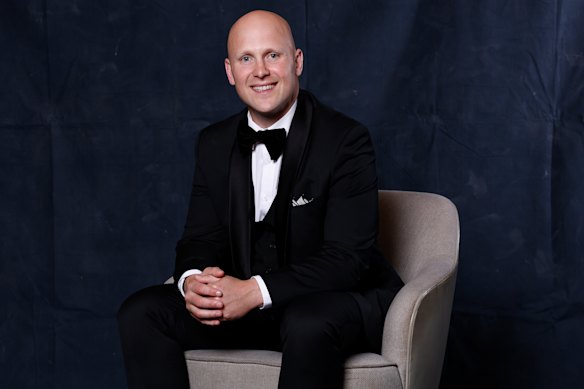
Source :- THE AGE NEWS
Back in 2018, I sat down with a genial Gary Ablett, who by then had achieved so much on the field that it was no longer necessary to affix “junior” to the back of his name.
The interview, a couple of weeks before the 2018 season, was tied to the son’s return to Geelong after his seven years in Tibet – in exile from football’s main street, on the Gold Coast, where he had maintained his standing as the game’s most accomplished midfielder for four or five years, taking a second Brownlow and two further gongs as the players’ most valuable player.
Ablett was relatively relaxed, perhaps because he was happy back home in Geelong. A self-described introvert, he did not feel that he had been closed off from the public.
“I think I’ve always been a pretty open person,” he said. “I’d say I’m an introvert. I like to get to know people on a deeper level and really invest into a relationship. I’m not going to give you everything when I first meet you.”
One could gain small glimpses of a private public figure from talking to him, such as his adherence (then) to an organic diet that leaned paleo, and that he trained in runners rather than footy boots.
I had been told, some years earlier, that Ablett junior (as he would remain to older media who’d covered his storied father) developed cold feet about leaving Geelong following the 2010 season, but that the die was cast – he’d accepted the offer from the Suns (effectively the AFL’s) and had to go north.
“I think that’s better kept in-house,” he said.
It was impossible not to ponder what lay behind the gentle, super-polite persona of Ablett, if there was any torment and, if so, what had steeled him to achieve. In decades of speaking to footballers and sportsmen, it was rare to find one who had managed to straddle affability and inscrutability, without giving up anything that was contentious, emotional or fully revelatory.
So, we never learnt exactly how Ablett had coped with the immense burdens and trauma of being the son of Gary Ablett, a player who was worshipped like no other in the ’80s and ’90s, who seemed to challenge the laws of physics, yet who was also a troubled soul who found serious trouble in his football afterlife.
We did not find out how he had steeled himself, what he had learnt from his feted – and ill-fated – father, besides the need to keep his feet in a contest.
Only a couple of footballers in the game’s history, Ted Whitten jnr and maybe Paul Hudson (son of Peter Hudson), would have dealt with the level of pressure that Ablett not only felt, but surmounted, riding it like a heavy bump and keeping his feet. Unlike Don Bradman’s son John, who changed his name to Bradsen as a younger adult, Ablett just rolled with it.
Those Geelong people who knew him pretty well were astounded by his achievements – to match his father as a player of the ages, deploying a different set of skills and abilities (Junior a relentless ground-level midfield champ, his father a forward who soared and made the freakish routine).
“Not only was he a son of a gun, he shared the same name,” said Tom Harley, Ablett’s captain at Geelong and now one of the AFL’s most senior executives.
But more impressive to other close observers over the journey was Ablett’s ability to stay grounded as a person, to be emotionally stable and fundamentally decent, when he had every excuse for failing on those fronts.
The price, it seemed to quite a few people around him, was that a part of him was unknowable – that anything personal from his family, and especially his father, was fenced off, and that he did not trust easily. Understandably.
It says something about the burden of the Ablett name – and that weight was greater for the fact of sharing dad’s very Christian name – that the first question on everyone’s lips at the Australian Football Hall of Fame was always going to be: Is his dad in the house?
Unsurprisingly, Ablett snr was not at the function, where his son was the standout name in the ranks of those admitted. But Gary jnr’s media-averse and quiet brother Nathan, a gifted key forward who walked away from footy, was in attendance, as was their mother Sue. Zac Smith, a former Gold Coast ruckman and teammate of Gary jnr’s who shared his Christian faith, was also there.
“He was born with some talent, but he worked like a pro from the start,” said Harley of Ablett jnr’s career. “I sensed he viewed his career as a 20-year career, he almost paced himself early days, [and] then he obviously got on an amazing run and played arguably as good a football as anyone’s played over that sort of period of time.
“[He is a] very humble guy, very grounded in his family, [and] very tight with his family.
“I suspect he would say one of the highlights was playing with his brother for those couple of years … you really saw how much he cared for his brother.
“He was a private guy, I wouldn’t say difficult to get to know.
“I think he had the right balance between the different and competing priorities in his life. But, you know, [he is a] remarkable person and [had a] remarkable career.”
Ablett’s career is divided into four parts. Part one was his early Geelong years, 2002-2006, as a highly talented, but somewhat sporadic half-forward who could take turns in the midfield.
Over the post-season of Geelong’s under-performing 2006 (which netted Joel Selwood in the draft), the players had honesty sessions. In one, Ablett was encouraged to work harder. He was told, words to the effect (as Harley confirmed), “We think you can be as good as Chris Judd, or even better”.
And he was, to borrow from Talking Heads.
Part two involves the two flags, in which he was the top Cat; a Brownlow; and three Leigh Matthews trophies for MVP. These are the glory days.
Then he takes the irrefusable offer from Gold Coast, having been paid unders at Geelong as a result of a contract he signed before he morphed into the unstoppable force. Harley said some believe he was “even better” at the Suns, performance-wise.
His captaincy was subject to criticism, which was fair in the sense that he was not a leader in the Harley, Cameron Ling or Luke Hodge category. My guess, based on what came from those within the Suns, was that he was a super professional, not dissimilar to meticulous, highly disciplined tennis champions such as Roger Federer and Novak Djokovic, that to survive and thrive had taken enormous self-focus. Taking others on board for the ride was asking too much of an introvert who had done so well to self-manage.
The final act was the homecoming to Geelong, which didn’t bring a third flag, but did see Ablett play his final game in the pandemic 2020 grand final, at the Gabba, when he hurt his shoulder, played on valiantly and ended with a second runner-up medal.
In that last game, Ablett’s greatness was referenced by a player whose reticence put Ablett in the shade – Dustin Martin, who turned the game and duly took his third Norm Smith Medal.
Martin, not one for over-praise – or for public utterances about any subject – called “Gaz” simply “the GOAT”.
Whether Gary Ablett’s career was the greatest in the AFL, or merely just one of the best this century, is a matter of conjecture.
While one cannot know if his father, due to the tragic death of a young woman in his company in 2000, will ever become a Legend in the same hall of fame, we know that the son will be elevated to that station one day, and without rancour or debate.
Keep up to date with the best AFL coverage in the country. Sign up for the Real Footy newsletter.
 Jake Niall is a Walkley award-winning sports journalist and chief AFL writer for The Age.Connect via X or email.