
Source : the age
It had been a perfect summer’s evening, the type that’s so special to Sydney. The dusk was dusty pink, the ocean glistened, and the beach was bustling with surfers and swimmers and sandcastles. As the city slid into holiday mode, Bondi Beach felt festive. There were street parties and picnics. Up on the grass above the beach, barbecues and balloons celebrated the first night of Chanukah, the Jewish festival of lights.
Josh Pulford listened to the party from his van in the Campbell Parade car park. There was music, chatter and the squeals of children, who were delighted by the free donuts and the goats in the petting zoo. Then, through the door of his van, Pulford saw two men, dressed mostly in black, walk to a concrete bridge barely 15 metres away. They were carrying guns. “They marched towards the event,” he said, “and opened fire.”
Within seconds, this joyous afternoon became Sydney’s darkest day. Scores, maybe hundreds of bullets, ripped through that party. They killed at least 11 people, injured many more, and traumatised a whole community. And they shattered Sydney’s innocence. We hoped and believed such a thing could never happen here. It can, and on Sunday night, it did.
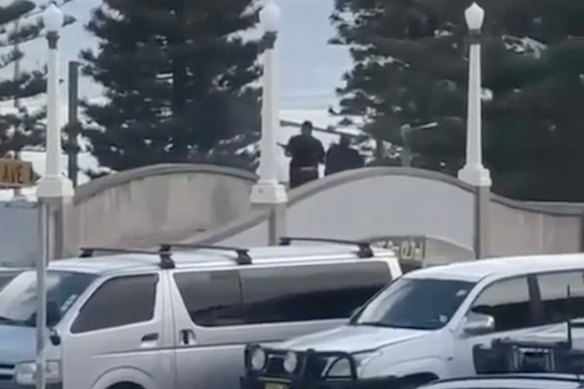
The alleged shooter on a pedestrian bridge behind Bondi Pavilion.
Shortly after 6.30pm, two gunmen walked onto the pedestrian bridge over the beach car park behind Bondi Pavilion. They fired, over and over again. Bodies slumped. One shooter stayed on the bridge, and a second gunman walked towards the gathering. As he pointed his gun towards a target, Ahmed el Ahmed, a Sutherland Shire fruit shop owner, tackled him from behind, pulling the gun from his arms.
As the shots rang out across the beach, there was a panicked scramble. Some threw themselves beneath parked cars, their bodies covering their children. Some ran into strangers’ apartments or hid in restaurant bathrooms. An elderly couple took refuge in Pulford’s van. “It was an absolute massacre,” said one man, who had moved to Sydney after surviving the 2023 attack on Israel by Hamas. “I saw children falling to the floor. I saw elderly. I saw invalids.”
At the Bondi Pavilion, guests at a bar mitzvah heard the shooting. “All of a sudden, the kids started running and saying, ‘There’s gunshots, there’s gunshots’,” said Jodi Benjamin. “And then my own children scattered. I lost them for 15 minutes. We all hid in a room, in lockdown.”
Sach Fernando, who had been swimming with his daughters, rushed south towards the Icebergs swimming pool. “I kid you not, the fear in the policemen’s eyes,” he said. “You can tell they were scared themselves.”
Vladimir Kotlyar, a Jewish chaplain for the State Emergency Service, was at the party with his son. As he saw the gunmen, he dropped to the ground, covering his boy with his body. The man next to him slumped on top of them; he had been shot in the shoulder. Kotlyar helped where he could. Then, as paramedics arrived, he staggered away, in a daze. He had blood on his shirt and on his hands. “This is not the Australia I know,” he said.
After what seemed an eternity, one gunman was shot, the other caught. The massacre was over in less than 10 minutes.
When the shots stopped, Pulford – who had joined the panicked throng that ran towards the surf club – returned to his van. He saw carnage. Bodies lay prone. Many of them could not be revived. He saw a man with a gunshot wound to his arm walking away with his young daughter. Many of the victims seemed elderly; perhaps they could not run as fast as the others. His voice thickened as he talked. “There were just sort of like, 15, 16 bodies littered around,” he said.
Russell Port rushed to the scene from a nearby street party and found chaos. “There was no organisation. Everyone was trying to do what they could,” he said. “There just weren’t enough resources for the horror of the situation. Ordinary people helping, putting pressure on people’s chests. I was cutting people’s shirts off. Making bandages.
“There weren’t enough stretchers to take people to the ambulances. The surf lifesavers arrived. They were putting people on surfboards to carry them out. There was an old lady crying over someone close to her, [who] passed away. There was a sheet over her.”
One man, who wanted to be known only as B, was sunbaking on the beach when he heard gunshots. He ran to help and saw two young children, aged about five or six, cowering beneath a car. “They said, ‘my mum, my mum’,” he said. He pulled their mother from under the car and realised she had been shot twice, once in the back of the neck and again in her shoulder. “I had to apply pressure for about 20 minutes,” he said. “Big wounds. I had my fingers in the hole. Then paramedics took over. Forty-five minutes later, the ambulance arrived.” The little girl gave him her dad’s number before volunteers took the children into the surf club, away from their bleeding mother.
A man crouched on his knees, his head in his hands. He knew some of the injured. “I was covering bodies,” he said. International student Rahemath Pasha witnessed the shooting and helped the injured. “It was the first time I saw a human killing in front of my eyes,” he said.
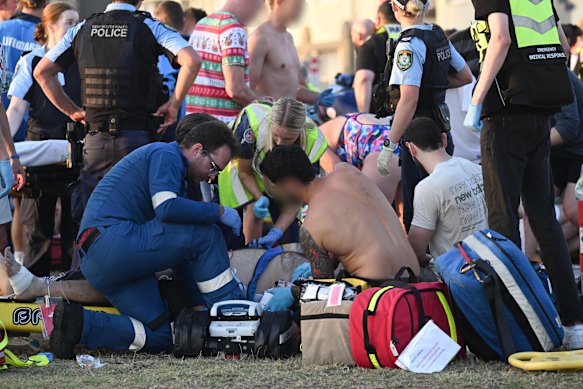
Emergency Services attend to wounded at the site of a multiple shooting at Bondi Beach.Credit: Janie Barrett
Soon, sirens roared through the eastern suburbs; ambulances, police cars, Public Order and Riot Squad trucks. Helicopters circled, and one landed on a nearby sporting oval to take victims to hospital. Lifesavers washed blood off their kayaks.
On every face – victim, witness, paramedic, police officer – there was stunned disbelief. One of Australia’s most iconic beaches, loved for its beauty and as a symbol of freedom, was now stained with the trauma of terrorism.


