

SOURCE :- THE AGE NEWS
The teen social media ban is not the only “world first” Australia has just introduced. Canberra also slipped into play an unprecedented sanctions framework against the Taliban. It includes listing some of the most horrendous abusers of women’s rights, such as Afghanistan’s “chief justice” Abdul Hakim Haqqani. The man whose family name is synonymous with torture and hanging bodies from powerlines.
The International Criminal Court has issued a warrant for his arrest. So, Australia banning him from entering the country is really a no-brainer. Nevertheless, the package of new autonomous sanctions goes further than any other country has dared. Or bothered.
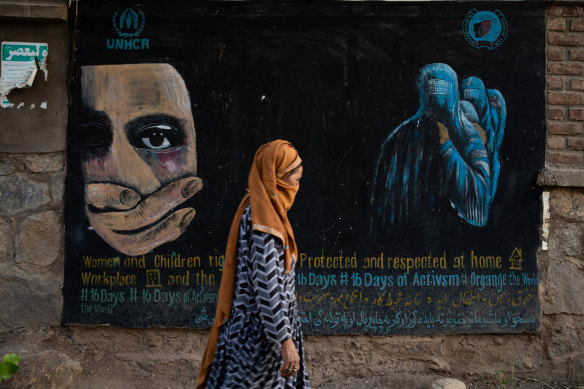
A woman walks past a mural calling for women and children’s rights in Bamian, Afghanistan.Credit: Getty
Afghan women traversing the globe as advocates since the fall of Afghanistan in 2021 are weary of pleading with the world to not turn away. One of the most vocal is Dr Sima Samar, a Nobel Peace Prize nominee and former vice president of Afghanistan’s interim administration and minister for women.
In Australia to address the diaspora at federal parliament on Sunday, Dr Samar is adamant: “Afghanistan is a collective failure.” She says every nation shares a collective responsibility to stop the gross inhumanity and gender apartheid crippling women and girls in her country.
Our news feeds have been heavy with talk of violence over the past couple of weeks, during the 16 Days of Activism Against Gender-Based Violence – a global annual campaign, but the sort of violence Samar speaks of is beyond imaginable for most of us. It is a story of violence the world of activism has forgotten.
There is no reliable data on sexual violence in Afghanistan. Women’s refuges have been closed, and the Taliban doesn’t allow research on women. But Samar is under no illusion. She frames the entire Taliban project as structural violence against women.
“Violence is not only rape,” she says. “When they ban women and girls from learning, it is violence. When they ban them from working and having a public life, it is violence. When they silence women and ban their voices from being heard, it is violence.”
Public floggings and executions of women who won’t conform to “vice and virtue” laws are legendary. The Taliban claim religion drives their 100 or so “decrees”, which steal women’s freedom and erase them from view. Samar says religion has nothing to do with it. “It is not our religion,” she says. “It is not our culture. It is about power.”
But what should be alarming the rest of the world right now is what Samar calls a “new form of modern slavery”. Forced marriage and child brides have always been a vexed feature of Afghan culture, but the situation has worsened badly as more families are pushed into poverty. When I visited Afghanistan at the height of the war against the Taliban, the legal age for a girl to marry was 16. Now much younger, pre-menstrual girls are sacrificed.
Samar bristles at the description of “marriage”. “It is slavery,” she says, “when a 12-year-old girl is given in marriage she has no control over her life. She is a tool to be used.”
Unsurprisingly, suicide rates and depression are reportedly skyrocketing among women and girls. The violence meted out to women is so extreme, so comprehensive that the world of politics is dumbfounded by how to stop it. So, it doesn’t.
Instead, nations turn a blind eye. Thirty-nine member states of the United Nations quietly provide de-facto legitimacy to the Taliban by allowing them to take control of embassies. Others, such as China, Russia and Uzbekistan, have broken rank with the UN and accepted the terrorist Taliban as the rightful rulers of Afghanistan and do business with them.
Australia’s position on this is complicated. Despite an endearing respect for the Afghan ambassador in exile, Wahidullah Waissi – who was appointed by the government ousted by the Taliban – Australian officials have notified him that his diplomatic credentials will not be renewed. Given the Taliban refuses to acknowledge any passports, visas or documentation issued in Australia, the embassy has become a lame duck.
But in a bold move, Australia has joined Canada, Germany and the Netherlands in prosecuting a case against the Taliban in the International Court of Justice for its gross violation of women’s rights. It’s a long shot, but something Australians can be proud of.
Samar is hopeful Australia’s will use that courage and commitment to force others to stop pulling down the blinds on the world’s most egregious, large-scale abuse of women.
She saves her sharpest criticism for the men of Afghanistan and their total lack of resistance to the nationwide violent crackdown on women. Unlike neighbouring Iran in 2022, where men joined women-led protests – “Women, Life, Freedom” – Afghan men simply rolled over. “It doesn’t have to be resistance with gun and violence,” Samar says. “They could use civil disobedience to demand girls’ right to education.”
Meanwhile, with about 63 per cent of the Afghan population aged under 25, the Taliban is busy churning boys through madrasas, schooling them in an ideology of hatred for women, and the West. “They radicalise them and they are raising a future generation of jihadis,” Samar says.
And yet, still, the world turns away.
Virginia Haussegger is a Canberra-based writer. Her new book, Unfinished Revolution: The Feminist Fightback, was published last month.


