Source :- THE AGE NEWS
There was a time when the World Cup was considered soccer’s ultimate shop window; when a single performance or two in the global spotlight was enough for a player to catch the eye of a top club and earn an opportunity they otherwise wouldn’t have gotten.
It doesn’t quite work like that any more. Too many clubs have been burnt over the years by vanity deals for players who looked good for those few weeks, but didn’t quite fit once they’d settled into their new surrounds. These days, recruitment departments have access to so much data, intel and footage that there are no longer any major surprises to discover.
But for Australian players who operate on the fringes of those scouting radars, there is still something to be gained from a good World Cup. It can still change their lives. And this transfer window, which closed 8am AEST on Wednesday morning, is proof. If one of the determining success factors in international soccer is the level in club soccer that a nation’s players operate at, this one could be remembered as transformative for the Socceroos.
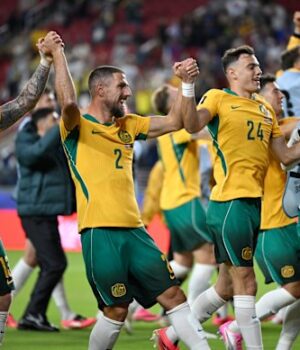
Eleven members of Tony Popovic’s squad who were knocked out in the round of 32 by Egypt have parlayed their experiences in the United States (and Canada) into contracts at new clubs – an unprecedented level of Australian movement in a post-World Cup window. Before it, only 28 such transfers in total had been made by players named in the Socceroos’ previous World Cup squads, the vast majority of them being free transfers.
And while not all the moves made in this window could be regarded as career progression – Jackson Irvine, Awer Mabil and Ajdin Hrustic are, respectfully, all on the way down – the majority of them involved younger players making positive moves. Those players have the chance to climb the ladder, exposing them to scenarios that will enhance their capabilities, and enable them to bring that growth with them when they next wear the green and gold.
Three deals in particular stand out above the rest: Lucas Herrington’s much-heralded transfer to the Premier League’s Hull City, and Alessandro Circati and Nestory Irankunda’s moves to Benfica and Sporting Lisbon respectively, putting the Socceroos teammates on either side of Portugal’s biggest rivalry. If you count add-ons, they all broke the record set by Harry Souttar when he went to Leicester City for $23 million after the 2022 World Cup, becoming the most expensive Australian soccer player sold.
If we are counting those add-ons, then Herrington, Circati and Irankunda went for a combined total of $91 million. While precious little of that money will come back to Australia – aside from the 5 per cent of all transfer fees that is to be distributed proportionally to the clubs that trained and educated the player between the ages of 12 and 23, under FIFA’s “solidarity mechanism” – it was spent, at least in part, because of what those players displayed at the World Cup. It is up to them to prove they were worthy of the price tag.
Two other transfers – Patrick Beach to Troyes, and Paul Okon-Engstler to 1.FC Koln – are rare examples of Australian players moving directly from the A-League to a top-five European league and playing immediately upon their arrival. Popovic was roundly criticised for some of his selection and tactical decisions at the World Cup, but here, at least, he deserves some credit for the role he played in getting them there.
Before it began, Beach was externally regarded as the third-choice goalkeeper for the Socceroos; some believed Sydney FC’s Harrison Devenish-Meares should have been picked ahead of him. But the 23-year-old was regarded by Popovic as Australia’s best option with the gloves, a shock decision that saw legendary skipper Maty Ryan relegated to the bench. Beach has since hit the ground running in France’s Ligue 1, and looms as the Socceroos’ long-term goalkeeper.
Okon-Engstler, meanwhile, was first selected for a Socceroos camp mid-last year, before he had played a minute of senior club soccer. Popovic was accused of nepotism because his assistant coach was Paul Okon snr. In retrospect, it was inspired; Popovic saw something in Okon-Engstler that few others could at the time, but everyone else eventually did at the World Cup.
Not everyone got the moves they wanted. Despite a disappointing tournament on a personal level, there was big interest in Mohamed Toure, but $28 million was not enough to prise him out of Norwich City, where he has begun this season as he finished the last: on fire.
Injuries at the World Cup to Jordan Bos and Jacob Italiano scuppered the possibility, at least in the immediate term, of transfers, with clubs in Germany’s Bundesliga interested in them.
Souttar, meanwhile, is stuck in League One with Leicester City, with no bids for him that met his club’s valuation.
It remains to be seen who will coach the Socceroos after January’s Asian Cup in Saudi Arabia; Popovic’s short-term contract extension expires with Australia’s last kick of the ball. Whoever is in charge for the next cycle, though, will have at their disposal the strongest, best-positioned pool of players in recent memory.
News, results and expert analysis from the weekend of sport sent every Monday. Sign up for our Sport newsletter.