

Source : the age
When Darryl Cardona asked the Transport Accident Commission for an extra $110, he thought it would be a tick and flick exercise.
Instead, he claims, the agency spent nearly $12,000 fighting tooth and nail against releasing the money.
In 2013, Tamara Tesseyman and her son were hit by a car while walking to Bunnings.
She said that over the following decade, her experience with the state’s road accident insurers was a bureaucratic nightmare where treatments recommended by her doctor were contested and clinicians refused to work with the agency.
“TAC systematically stack the cards against claimants,” she said.
Tesseyman and Cardona are among the horror stories presented over the past month to a parliamentary inquiry initiated by Libertarian MP David Limbrick in a bid to improve the current system.
The TAC says 95 per cent of the 100,000 treatment requests it received last year were approved, worth almost $1.9 billion, and paid out.
But Tesseyman and Cardona say they represent the other 5 per cent, a group that believes the TAC has been overly combative with their claims and caused them further distress.
“While most clients have a positive experience with the TAC, this inquiry has heard from people who have at times faced delays, disputes, and difficulties accessing treatment or navigating the system,” TAC chief executive Tracey Slatter told the hearing.
“We take the issues raised very seriously, and they reinforce the need for us to continually improve … We are sorry, and we will do better.”
‘TAC systematically stack the cards against claimants.’
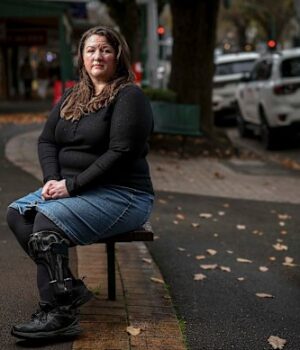
Tamara Tesseyman says she has trouble getting support from the TAC
Cardona told the inquiry he felt like a victim of the commission after he was partially paralysed below the waist in a 2010 car crash which made it impossible to do his job as the general manager of a dairy company.
He said the TAC had spent $1.3 million on his multiple surgeries and other costs, but another $500,000 on legal costs – a quarter of which he estimates went to medical examiners and lawyers, rather than himself.
“I’ve had cases where I’ve put objections in that have taken three years and four years to resolve over stupid items,” Cardona said.
One of these disputes was over oral surgery that cost $110 more than the TAC had pre-approved because part of Cardona’s tongue had to be removed.
Cardona said he eventually won the court case for the extra money, after $12,000 in legal fees were spent fighting the bill. The TAC had to cover its legal costs and Cardona’s after his victory.
Another dispute involving home upgrades took three years to resolve, and Cardona said he had to live with black mould during that period.
Under the TAC’s legislation, the commission can only fund benefits related to transport accidents. If it accepted an ineligible claim, the agency would have to accept similar cases in the future.
However, this means that in complex cases such as Cardona’s and those of others who have given evidence at the state inquiry, the TAC undertakes extra reviews, which can cause delays and can ultimately distress the people the commission is supposed to help.
Tesseyman told The Age she struggles to find clinicians who will take her on as a TAC client because their decisions about her care can be reviewed or denied.
“They pay less than the standard rates for all sorts of things, and they require a lot of administration,” she said.
“Even though a surgeon will say this is a recommended treatment and it’s caused by the accident [and] that this person needs to have a surgery, TAC will argue with that and send it to their clinical panel.
“Essentially, our GPs, our clinicians [and] the experts that we trust, they get questioned by just an invisible panel who we don’t know.”
Tesseyman, who has required regular bouts of surgery alongside her son, said that despite 13 years of seeking support from the TAC, the process could still be overwhelming.
“I have a bunch of receipts that I’m supposed to put into them, but every time I even just sit down to write an email or call them, I feel sick,” she said.
“I shut down, and that’s the experience for a lot of people.”
When these stories were related to Slatter and other senior TAC executives at the inquiry, the chief executive said it was the commission’s priority to make it easier for providers, clinicians and other services to deal with the agency.
Slatter said the TAC had improved its payment systems, increased fees and subjected them to a rolling review to encourage more services to provide client support.
Slatter said one of the things that had frustrated her staff was the current IT system used to manage claims, which the commission’s board has now approved for an upgrade.
She said case managers were being bogged down in manual work and lodging individual transactions, but she said the new system would automate as much as half this work.
“What that will do is increasingly free up the case managers’ time to do even more proactive case management, and for more clients to receive dedicated case management,” Slatter told the inquiry.
Last year, 70 per cent of TAC claim decisions were made within 10 days, and 92 per cent were made within 30 days.
Limbrick said the stories presented to the inquiry were harrowing, and Victorians deserved care after spending half their registration on insurance paid to the TAC.
“Unfortunately, many injured and traumatised people are in no position to take on the bureaucracy,” he said.
“The accident victims who are speaking up need to be heard because they are also speaking for the voiceless.”
Limbrick said it was a bad look for the state government to continue to collect dividends from the TAC, with more than $1 billion due to be paid in 2026-27, while patients struggled for support.
Kath Gobbi, the TAC’s executive general manager for clients, said the commission had made a range of improvements over the past two years to address the problems outlined in the review.
“Our focus remains on helping clients with their claims and delivering appropriate care and support,” Gobbi said.
The inquiry continues and MPs will prepare a report later this year.
Start the day with a summary of the day’s most important and interesting stories, analysis and insights. Sign up for our Morning Edition newsletter.