Source : INDIA TODAY NEWS
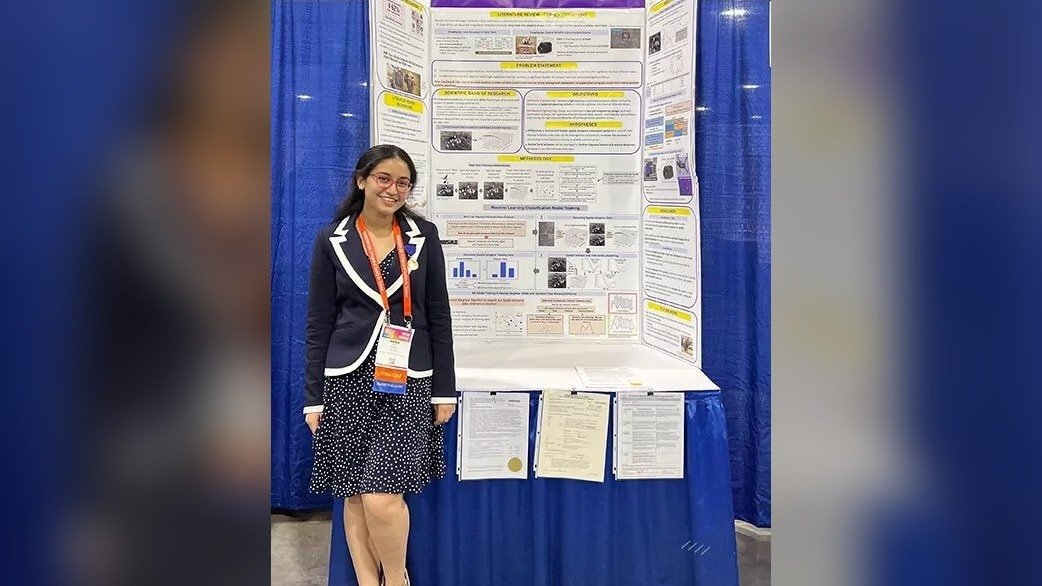
At 17, Anika Puri developed an AI-based system aimed at helping wildlife rangers detect potential poachers without relying entirely on manual surveillance. Her project, ElSa (Elephant-Savior), analyses movement in thermal infrared drone videos to distinguish humans from animals. The Indian-American student’s work earned her a USD 25,000 scholarship as a 2022 Davidson Fellow.
Puri, who is from Chappaqua, New York, developed the system to address a persistent challenge in wildlife conservation: identifying potential poachers in vast protected areas after dark.
advertisement
Her project combines artificial intelligence, drone technology and movement analysis to improve detection while keeping development costs low. As per the report by Society for Science and the Davidson Institute, the project explored how machine learning could help conservation teams interpret nighttime thermal footage more effectively.
HOW DOES ANIKA PURI’S AI SYSTEM DETECT POTENTIAL POACHERS?
Monitoring wildlife reserves at night is challenging, as humans and animals can appear similar in thermal images captured by drones flying hundreds of feet above the ground. Analysing hours of footage also increases the risk of human error due to fatigue.
Puri developed ElSa, a machine learning system that analyses movement patterns, speed, turning radius and herd behaviour to distinguish humans from animals in thermal infrared videos.
Tested on the BIRDSAI thermal infrared video dataset, which contains footage from four African national parks, ElSa achieved 90.9% accuracy in detecting humans. According to the findings cited in her research, this was approximately four times the accuracy of the existing methods used for comparison.
However, detecting a human does not automatically establish that the person is a poacher. Instead, the system could help rangers flag potentially suspicious activity for further investigation.
WHY DID SHE BUILD A USD 300 CONSERVATION TOOL?
Affordability was a key consideration in Puri’s project. Advanced thermal imaging equipment can be expensive, with high-resolution thermal cameras costing around USD 4,800. In comparison, Puri developed the ElSa prototype using commercially available components for approximately USD 300.
The significant cost difference highlights the potential of her approach to make automated wildlife monitoring more accessible to conservation teams working with limited budgets. Across Africa and Asia, where vast protected areas must be monitored with constrained resources, lower-cost technology could offer a practical advantage.
By identifying people in nighttime drone footage, ElSa could reduce the burden of manually reviewing hours of surveillance recordings, allowing rangers to focus on footage that requires closer examination.
However, the prototype’s cost should not be confused with the total expense of deploying a complete operational system. Its effectiveness in real-world conditions would also depend on footage quality, operating environments and its ability to distinguish suspicious activity from legitimate human movement.
Nevertheless, the project demonstrates how artificial intelligence can be adapted to address environmental challenges and support existing wildlife protection efforts.
FROM A CHILDHOOD INTEREST IN ROBOTICS TO WILDLIFE CONSERVATION
Puri’s interest in technology began early. According to the Davidson Institute, she presented a Lego Mindstorms robot at Maker Faire before developing an interest in drones and earning a commercial drone pilot licence.
Her interest in wildlife conservation grew during visits to India, where she noticed ivory jewellery and statues being sold in Mumbai markets. This prompted her to explore the problem of poaching, its impact on endangered species and the technologies that could help protect wildlife.
She later discovered that although thermal-equipped drones were being used to monitor wildlife reserves at night, analysing the footage remained a challenge. ElSa was her attempt to address this gap by combining engineering with conservation.
Her work earned her recognition as a 2022 Davidson Fellow and a USD 25,000 scholarship, recognising the technical work behind her project and its potential application to wildlife protection.
Anika Puri’s ElSa project shows how artificial intelligence can be applied to wildlife conservation. By analysing movement in nighttime drone footage, her system offers a potential way to help rangers identify human activity more efficiently.
While the technology cannot independently confirm poaching, its reported 90.9% accuracy in detecting humans highlights its potential as a monitoring aid. Further testing and real-world deployment will determine how effectively such low-cost AI tools can support wildlife protection efforts.
– Ends
SOURCE :- TIMES OF INDIA