

Source : INDIA TODAY NEWS
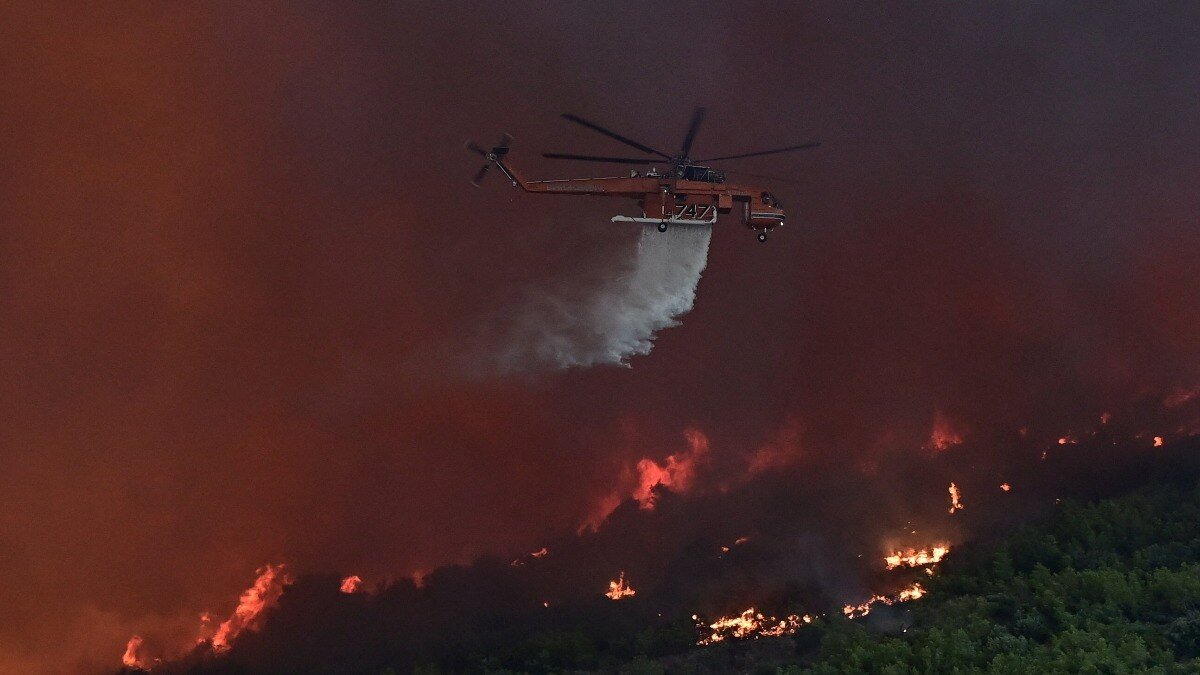
Two firefighting helicopters collided while battling a wildfire in the Psatha area west of Athens on Sunday, as Greece continued to grapple with devastating blazes that have scorched thousands of hectares and destroyed more than 100 homes.
The crash occurred during an aerial firefighting mission over the Psatha area in Attica, where hundreds of firefighters, aircraft and heavy machinery have been deployed to contain one of the country’s largest wildfires this summer. In a statement, Greece’s Fire Service said the two Bell firefighting helicopters, each carrying a crew of two, crashed during operations after taking off from Elefsina military airport.
advertisement
“During the aerial firefighting operation, two (2) BELL helicopters, leased by the Fire Department, with a crew of two (2) people each, crashed in the wider area of Psatha, Attica. The helicopters had taken off from the Elefsina military airport. The search and rescue operation is underway. A further update will follow,” the Fire Service said.
ONE CREW RESCUED, SEARCH CONTINUES FOR SECOND
Authorities said initial reports indicated that the two crew members aboard one of the helicopters had been rescued. Local media reports say communication had been reestablished with the rescued aviators, who informed the operational centre of their condition and shared their location after the crash.
Search teams continued efforts to locate the second helicopter and its two crew members, with officials yet to release any information about their condition. Authorities said further updates would be issued as the rescue operation continued.
GREECE FACES INTENSE WILDFIRE EMERGENCY
Scorching temperatures, powerful winds and dry vegetation continued to fuel multiple fast-moving wildfires across Greece. The blaze near Porto Germeno, about 60 kilometres northwest of Athens on the Gulf of Corinth, has emerged as one of the country’s most destructive fires this year. Authorities said the wildfire has destroyed more than 100 homes and burned through vast stretches of forest and farmland.
Although gale-force winds that initially drove the fire eased on Sunday, flames crossed a mountain ridge and spread towards the settlement of Veniza and a nearby military firing range, raising concerns over unexploded ordnance in the area. Greek newspaper Protothema reported that firefighters were mounting a major effort to stop the blaze from advancing towards the coastal town of Megara, with more than 10,000 hectares believed to have already been consumed by the fire.
Nearly 500 firefighters, backed by firefighting aircraft, helicopters, heavy machinery and emergency vehicles, have been deployed to battle the flames. Greece has also received firefighting assistance from France and Romania under European emergency cooperation mechanisms.
EVACUATIONS EXPAND AS FIRES SPREAD
The wildfire emergency has spread beyond mainland Greece.
Authorities ordered overnight evacuations in several settlements on the Ionian island of Kefalonia after another wildfire broke out in the Pastra area in the island’s south.
Emergency services remain on high alert as weather forecasts warn of continued high temperatures and dry conditions that could trigger additional outbreaks.
EUROPE STRUGGLES THROUGH EXTREME SUMMER
Greece is among several European countries facing severe wildfire conditions following weeks of record-breaking heatwaves and exceptionally low rainfall. Scientists have repeatedly warned that climate change is increasing both the frequency and intensity of extreme heat and wildfire seasons across southern Europe.
Elsewhere in Europe, authorities in France reported only minor flare-ups in the Gironde and Var regions after major blazes showed signs of easing.
In Spain, firefighters brought most large wildfires under control but continued tackling flare-ups, including in the western province of Caceres, where about 800 residents were temporarily evacuated. The prolonged drought has also disrupted daily life across central and eastern Europe. Water levels on major rivers, including the Danube and the Rhine, have fallen sharply, affecting shipping, tourism and power generation.
In Hungary, authorities were forced to shut down the country’s only nuclear power plant for the first time in more than four decades after critically low Danube water levels reduced cooling capacity. Serbian officials also reported that low river levels had slashed output at the country’s largest hydropower plant to about 20% of normal capacity.
– Ends
With inputs from agencies
SOURCE :- TIMES OF INDIA