

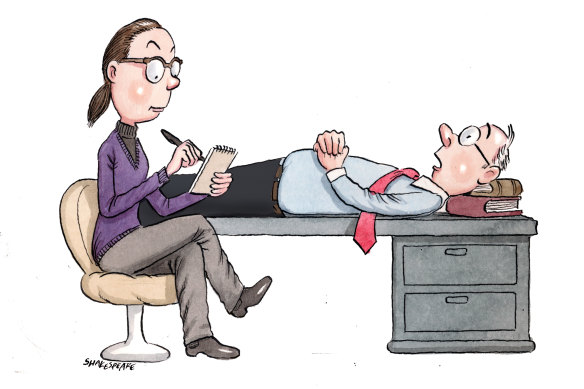
Source : THE AGE NEWS
I am deeply sceptical about seeking support or guidance from the human resources department to help address behavioural issues with a boss. Poor behaviour is often tolerated or even encouraged.
HR is not and never will be an employee advocate. They are there to represent the best outcomes for the business and in most cases management. This results in many responses from HR deflecting, denying, deferring and seeking any path possible for the outcome with the least negative impact on the business for the smallest use of resources.
These two factors mean employees should be circumspect at best about the help they will get from HR. Are there any independent studies that speak to this issue?
Your question is an excellent one, but it’s also a can of worms. There is no way of summing up every relevant element in a column of this length. So, apologies in advance that this is very much an abridged version of what I know and what I learnt as I dug deeper into your question.
I think your scepticism is warranted. And it can only have been exacerbated by the fact you’ve clearly encountered a below-average HR team in your own work life.
I know excellent HR professionals who would find some of what you’ve described in your question (and in our private correspondence) horrifying. Instead of tarring all HR managers with the same brush, I want to concentrate on the structural problems you’re pointing to.
Not all HR teams are the same. And not every HR manager reflexively sides with management.
I ran your question past Dr Hongbo Guo, a postdoctoral research fellow at the ANU College of Business and Economics. He researches and teaches human resources management – both its functional role in supporting organisational performance and its critical role in reproducing or challenging workplace power relations.
He confirmed two things that you alluded to in your question. The first is that most modern HR teams operate under a “dual mandate”: they are asked to support employees while protecting the organisation from legal, reputational and operational risk.
The second is that an HR team should not be confused with an independent employee advocate. One of the reasons for this common misconception is what Guo identifies as a historical tendency to use a language of care and support when talking about HR, leading some to assume it is “a refuge for employees”.
That’s a role better fulfilled by a union, while Fair Work, lawyers, external regulators and professional associations also have their parts to play.
Guo told me that he understood your perspective and said it would be wrong to dismiss your concerns as mere cynicism. On the contrary, he told me that when workers say they don’t trust HR, they are often informed by a “fairly sophisticated diagnosis of organisational power”.
“HR is structurally located inside the organisation. It is employed by the organisation. It reports through organisational hierarchy. Its authority, budget and legitimacy are often shaped by senior management,” Guo explained. Because of this, he said, even when HR is staffed with well-intentioned professionals, it is rarely flawlessly independent.
“In a hierarchical and, more specifically, power-laden workplace, supposedly neutral processes can at times protect the existing hierarchy.” And, answering your specific question, yes, there is ample research showing that this happens time and time again.
When I asked Guo what HR teams can do to overcome the pull of these huge systemic magnets, he said that there was no single remedy. “HR is deeply contextual and there is rarely a universal HR template that works across all organisations.
“I think the most important better-practice principle for HR is to recognise the tension and the power imbalances embedded in it,” he says.
“Procedural fairness and evidence are, of course, important, but a good HR professional would also ask if an employee who made a complaint is protected from retaliation, if their manager still has control over the employee – workload, performance review, contract, promotion – while the matter is being investigated. [They need] to ensure the process is both legally defensible and experienced as fair by those involved.”
Not all HR teams are the same. And not every HR manager reflexively sides with management. But most are constrained by a broadly similar framework.
That means that when you (or any employee) goes to HR to raise a problem about your boss, whether you should feel confident that you’ll be treated fairly can’t be answered with a simple yes or no. As Guo said, it’s more like “sometimes, but not always”.
“[You] can trust HR only when the organisation has built conditions that make trust rational,” he says. “Until then, ‘go to HR’ is nothing but an ambiguous instruction.”
Send your questions through to Work Therapy by emailing jonathan@theinkbureau.com.au
Get workplace news, advice and perspectives to help make your job work for you. Sign up for our weekly Thank God it’s Monday newsletter.
 Jonathan Rivett is a writer based in Melbourne. He’s written about workplace culture and careers for more than a decade.