

Source : ABC NEWS
There’s a saying you surely know that goes: “A jack of all trades is a master of none.”
You may not know the extended iteration, which finishes with something like: “… but that’s better than a master of none.”
And so we come to the goal of every athlete with a numerical prefix at the front of their title — biathletes, triathletes, tetrathletes, pentathletes, heptathletes, decathletes, icosathletes and so many more.
But for Olympian Tori West, seven is plenty.

West matching it with two-time world and Commonwealth Games champion Katarina Johnson-Thompson. (Getty Images: Patrick Smith)
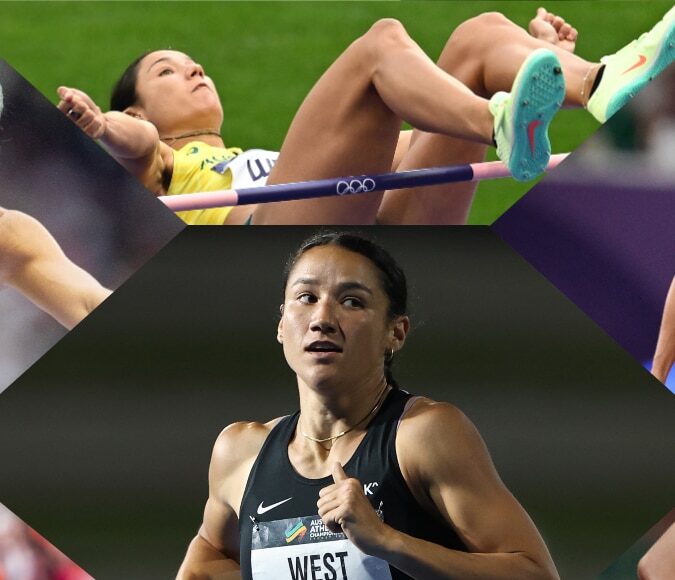
The 30-year-old Queenslander is a two-time national champion in heptathlon, a track and field event encompassing the 100m hurdles, high jump, shot put, 200m, long jump, javelin and 800m.
“People have been saying ‘Oh, do girls want to do decathlon?’ Nope,” she said.
“There’s a lot of history in the event, and if we add stuff on I think it’s gonna ruin it for a few generations.”
As Australian athletics enters a golden era, these multi-sport events may be the purest form of track and field.
“It’s just a good showcase of athleticism. It’s a beautiful event,” West said.
“I think it’s perfect.”
When is enough enough?
West grew up trying everything from basketball to tennis to boxing, but never heptathlon.
From a young age, she had some aptitude in high jump and javelin — “an interesting mix”, according to West — and it was her arm speed that caught the eye of a coach when she was 16.
A strange marriage of skills started West’s heptathlon journey. (Getty Images: Sam Mellish)
When the Commonwealth Games were heading to Queensland in 2018, West was adamant she could make the Gold Coast team despite one small barrier.
“At that stage I hadn’t done [a heptathlon],” she said.
“But I just thought I could because I’ve always had that slight delusional nature about self-belief, which is necessary, I find.”
Despite going from unranked to second in the country in the space of a year, West fell short at the trials and learned a hard lesson about the sport’s unique challenges.
Elite track and field athletes tend to have one end goal in mind — get faster, get fitter, jump higher, throw further — but it’s not so simple when you’re juggling septuplets.
Loading Instagram content
An extra day putting the shot at training might get you 10 more centimetres of distance, but cost you time in the 800m. Working on your high jump launch could take away from perfecting your technique in the javelin.
“There is no such thing as balance, unfortunately, in heptathlon training,” West said.
“You’ve always got to give and take from somewhere.”
Everything is about compromise and patience, and West revels in being a true “all-rounder”.
Once she started heptathlon training, she realised she was a “decent runner”, but was still brand new to hurdles and 800m.
She speaks about the different energy systems required for the incredibly varied events — from explosive power to speed endurance to stamina.
Finishing with an 800m after two days of events seems cruel. (Getty Images: Cameron Spencer)
“Every week, we touch on every single event and every single energy system. I call it microdosing events,” she said.
“And as you do that consistently, it compounds, and then you get big breakthroughs. The process is constant.”
That’s why West believes truly mastering heptathlon is a 10-year pursuit, and she’s only about halfway through her journey.
“My scores speak for themselves; I’m the highest scoring heptathlete in Australia for the last 18 years, and I’m still getting better,” she said.
“When you’re improving, and you’re enjoying the process, that’s all you need.”
Unique event days
Before a race, you might see a 100m runner walk out with a little polyester drawstring bag and dump their belongings into a tub behind their starting blocks.
When West and her ilk rock up, they look ready to set up a bivouac in the middle of the arena and settle in overnight, so full to bursting is the pack on their backs.
West (left) and Camryn Newton-Smith (right) were Australia’s first Olympic heptathletes in 16 years. (Getty Images: Andy Cheung)
“I have a big roller bag,” West said.
“I have a pair of shoes for every discipline, I have a pair of shoes to warm up, I have a spare pair of spikes, I often have little balls I use for javelin warm-ups [I throw them against a wall], I have [resistance] bands, a water bottle, eskies for all the food and carbohydrates I need to have through the day, trigger-point balls, spare set of clothes, towels.”
By her own admission, it’s “a lot of stuff”, but hardly surprising considering the way the sport is set up.
At any major meet, heptathlon lasts two days — day one will feature 100m hurdles, high jump, shot put and 200m, with day two encompassing the remaining long jump, javelin and finishing with the exhausting 800m finale.
The scenes after a heptathlon are dramatic. (Getty Images: Patrick Smith)
Performances in each event are then assigned a points score, and the final combined number is tallied up, making for some tricky mid-event calculations.
At the Paris Olympics, both days started at 10am and wrapped up around 9pm.
“If you’re a [100m] sprinter, obviously it’s the blue ribbon event, but they’re out there for tops 25–30 minutes in an Olympic stadium with their competitors. The moment happens, you move on,” she said.
“Heptathlon, I’m in an Olympic stadium feeling that atmosphere for nine hours. It’s a pretty cool experience.”
Almost 22 hours of competition in two days makes for a unique bond between athletes.
Cedric Dubler became instantly synonymous with fellow Australian Ash Moloney when Dubler expertly and selflessly paced his teammate to Olympic decathlon bronze at the 2021 Tokyo Olympics.
Cedric Dubler (left) made sure Ash Moloney (right) ran the 1,500m time needed to secure bronze. (Getty Images: Patrick Smith)
But the connection goes beyond teammates.
If you’ve ever seen the scenes during, and particularly after, a heptathlon or decathlon at a major meet, you’ll see athletes from all around the world chatting away and embracing like family, all while gasping for air.
West says there’s an innate camaraderie and respect between competitors that comes from battling through one of the most taxing events on the program, often with very little recognition.
“We know how hard it is, and we also know how overlooked it is because people don’t understand the athleticism and training required to be that good across the board,” she said.
“Some people think you do a heptathlon because you’re not good enough for one event. The truth is … it’s ridiculously hard.”
Heptathletes share a bond after spending so much time together. (Getty Images: Tim Clayton/Corbis)
And there have been times when that has been recognised.
Jessica Ennis-Hill was perhaps Great Britain’s biggest star as she won heptathlon gold at the 2012 London Olympics, and Caitlyn Jenner made it onto the Wheaties box and was proudly declared “the world’s greatest athlete” after winning the decathlon at the 1976 Montreal Games.
And Australia has had its own icons of heptathlon.
Australia’s history of heptathletes
Considering Australia’s all-encompassing preoccupation with sport, it makes sense that there would be some pedigree in such an all-encompassing event.
From the moment women were allowed to contest the heptathlon, with 200m and javelin added to the five-event pentathlon, Australia’s Glynis Nunn was one of the world’s best.
Glynis Nunn won gold at the 1984 Games with a thrilling 800m run against US great Jackie Joyner Kersee. (Getty Images: Disney General Entertainment Content)
After winning gold at the 1982 Commonwealth Games in Brisbane, Nunn won a thrilling contest at the 1984 Olympics in Los Angeles against US great and future world record holder Jackie Joyner by just five points, thanks to a stirring finish in the 800m.
At those Games, she also competed in the 100m hurdles, missing a medal by 0.14 of a second, and finished seventh in the long jump.
After Nunn pivoted to focus solely on track events, Jane Flemming took up the green and gold combined-event mantle, and her silver at Edinburgh 1986 marked the second of seven straight Commonwealth Games with at least one Australian woman on the heptathlon podium.
Flemming won a gold and two silvers from 1986 to 1994, and her 6,695 points at Auckland 1990 (when she also won the long jump) remain a Games record.
West has mined her fellow Queenslanders for their knowledge and insight.
“They’ve been very generous with the tips and information they give me,” she said.
“When you’re walking on this journey, it absolutely makes sense to reach out to people who’ve done it. You get the clues to hopefully get there faster in some aspects and also hopefully go further.”
But our heptathlon history doesn’t end with Flemming.
Jane Jamieson won gold at the 2002 Manchester Commonwealth Games, four years after picking up silver in Malaysia, while Sharon Jaklofsky (Auckland 1990) and Kylie Wheeler (Manchester 2002 and Melbourne 2006) have stood on the second step of the podium.
All told, that’s nine Australian medals from seven straight Commonwealth Games between 1982 and 2006.
But, after Wheeler finished ninth at the 2008 Beijing Olympics, no Australian woman competed in an Olympic or world championship heptathlon until the Paris Games in 2024.
As Australia enjoys a new golden era on the track and in the field, West and fellow Queenslander Camryn Newton-Smith marked Australia’s return to the global stage in the seven-pronged sport.
They followed up their appearance in Paris with an outing at the world championships in Tokyo last year, Australia’s first such representatives since Wheeler 18 years prior, but both were pipped to automatic qualification at this year’s national championships by Mia Scerri.
Twenty-one-year-old Mia Scerri stunned the heptathlon field at the national championships. (Getty Images: Cameron Spencer)
West won her pet javelin event, finished second in three events, and mixed in two thirds and fourth, but fell just 13 points short of Scerri.
The 21-year-old recorded personal bests in the first six events and, unsurprisingly, a personal best score of 6,175 points as she pulled off one of the biggest upsets of the meet.
West’s 6,162 will likely be enough to earn her a passage to the Glasgow Commonwealth Games, but she can guarantee her spot with a 6,200 at upcoming meets.
And that quest continues this weekend at the Götzis Hypomeeting in Austria.
If she books her ticket, she and Scerri will have two days to end two decades without an Australian medal in the heptathlon.