

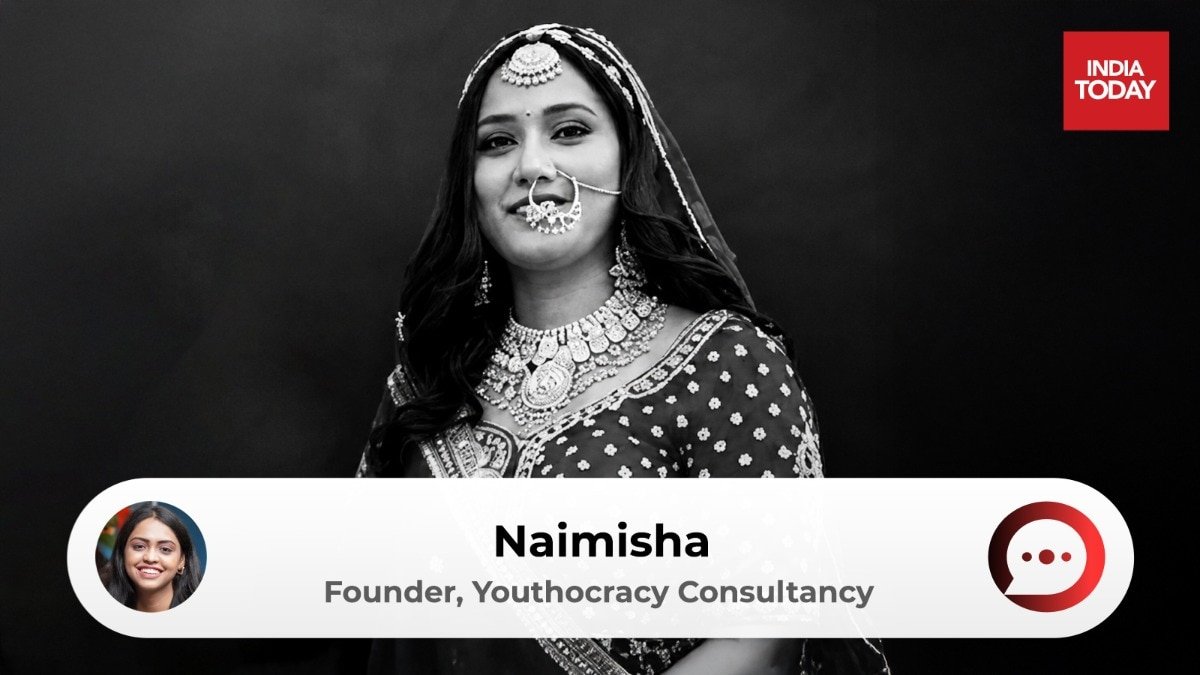
Source : INDIA TODAY NEWS
My two buas (aunts) never returned. A friend who I couldn’t meet again after college. A generation of brides learnt how to smile while quietly disappearing inside homes they were told to preserve at all costs.
My bua’s body was found near a riverbank, decomposed and almost unrecognisable, allegedly murdered. The family called it a tragedy. Tragedy is a softer word. She was the second aunt I lost to marriage. The first died by suicide.
advertisement
No one in my family ever fully explained what happened to either of them. Women in Indian families often disappear without complete sentences.
Growing up, I was not allowed to wear sleeveless clothes. Not because of modesty in any meaningful spiritual sense, but because I was told my brother may not like it and my father may disapprove. The lesson arrived long before feminism or gender politics ever did: your body exists in relation to male comfort.
Dress accordingly. Sit accordingly. Behave accordingly.
Lipstick too carried morality. Red lipstick especially. “Good girls don’t wear that.” I still remember a roommate from western Uttar Pradesh wearing bright red lipstick once, only for her mother to tell her she was “asking for it.” Years later, when senior journalist Preeti Choudhry was trolled online for wearing makeup and red lipstick on television, I realised geography changes faster than mentality. Villages, metro cities, newsroom studios, or social media platforms, the language modernises, but the policing remains identical.
And then there are memories that remain buried inside the body even when the mouth never learns to articulate them.
There was a neighbourhood uncle, nearly seventy years old. I was a child. He touched me in a way that was wrong. Children know the violation before they know vocabulary. I said nothing. Not because I didn’t want to, but because somewhere, even at that age, I already understood the consequences of speaking.
I would be questioned. Restricted. Watched more carefully. Perhaps blamed. That is what years of “be a good girl,” “stay gentle,” and “don’t create chaos” does to a child. It teaches her that her own violation is somehow a disturbance she caused herself.
Do I blame my family entirely? No. Most families are not consciously manufacturing oppression. They are transmitting survival manuals handed down across generations. Mothers teach daughters endurance because endurance once kept women alive. Fathers police daughters because society taught them control is protection.
According to the National Family Health Survey (NFHS)-5, nearly one in three women in India has experienced physical or sexual violence. More than 30 percent of ever-married women have experienced spousal violence. India still records close to twenty dowry deaths every single day. And these are only the violence we can count.
Statistics cannot measure fear, emotional erosion, psychological humiliation, or the number of women who stay silent because returning home feels more shameful than suffering.
Twisha Sharma’s case entered my news feed nine days ago and has refused to leave. Perhaps because I am twenty-seven. Perhaps because I, too, stand at what society calls “marriageable age.” Every element felt horrifyingly familiar: the press conferences, the character assassination, the dissecting of a dead woman’s choices before cameras.
The mother-in-law spoke of expectations unmet, of a daughter-in-law who denied the family a grandchild months into marriage. The internet joined immediately. Pregnancy became public property. Reports of abortion surfaced and strangers debated her capability as a woman.
I write this as someone who plans to freeze her eggs not because I reject motherhood, but because I want the freedom to decide when my body is ready. That decision should belong to nobody except me.
Then came another accusation.
Prescribed medications Etizola for anxiety and Flutrue for depression were called evidence of addiction. That stayed with me, because I, too, have been prescribed anti-anxiety medication during severe panic attacks. Would today’s social media psychologists call me an addict? Maybe.
India remains deeply uncomfortable with mental health unless suffering stays invisible. I am proud of Twisha for seeking help. The tragedy is not that women seek therapy. The tragedy is that women often require therapy to recover from people who desperately needed it themselves.
The script that follows women after death is painfully repetitive. “She married him for money.” “She was unstable.” “She was too modern.” “Our son is innocent.” Notice what remains absent: the son himself. Present everywhere, accountable nowhere.
Society then asks: if she was educated and independent, why didn’t she leave? Because psychological abuse is erosion. It dismantles selfhood slowly enough that the victim starts negotiating against herself.
Women stop speaking because explaining becomes exhausting, because families insist every marriage has rough phases, because eventually even the victim wonders whether she is “too much.”
There is an uncomfortable truth that must also be acknowledged. Yes, there have been cases where women misused legal protections. The case of Atul Subhash was tragic and deserves serious legal attention. But there is now a visible category of men’s rights activists online no longer interested in fairness.
The simplest question: would you feel comfortable if your daughter married someone exactly like the man you are defending? If the answer is no, this was never about equality.
I cannot stop thinking about Twisha’s parents either. Not because I believe they did not love her, but because I believe they loved her inside a system that trained them. A broken marriage becomes a permanent stain people believe society will never forget. So parents repeat what generations before them repeated: “adjust a little more,” “things will improve,” “every marriage has problems.” This is how generational conditioning survives, not always through cruelty, but often through fear.
I am afraid of getting married. Not because I think every marriage ends in violence, and not because I believe love is fake, but because I am terrified of what happens to women who choose themselves loudly. I am afraid of becoming the woman society describes as difficult, emotional, dramatic, too modern, too ambitious, too unwilling to adjust. I am afraid that the same society which lights candles for dead women will isolate living women who refuse suffering.
Perhaps that is why so many women today are obsessively building financial independence, emotional regulation and private escape routes before marriage. Not because we hate commitment, but because we have watched too many women disappear inside it.
We light candles for dead women and then return home to police the living ones. We mourn Twisha Sharma on X and then tell our daughters to adjust at the dinner table. That contradiction is not accidental. It is the entire system working exactly as designed.
I refuse to be mourned. I choose to be inconvenient instead loud, boundaried, financially independent, emotionally unwilling to disappear on demand. If that makes me a difficult woman, I will wear it on my sleeves. Freely. Without apology.
– Ends
SOURCE :- TIMES OF INDIA