

Source : the age
RISING FESTIVAL | MUSIC
Lil’ Kim ★★
Festival Hall, May 30
That Lil’ Kim could guest on Nine’s Today Extra breakfast show – the woman who once rapped “can’t wait to show my girls he sucked the p–s out my p–y (ooh)” on Suck My Dick – says a lot about how far female sexual empowerment has been mainstreamed since her 1996 debut album, Hard Core. In large part, that’s because of artists like Kim, and those she’s inspired: Nicki Minaj, Cardi B and Megan Thee Stallion.
Kim’s touring Australia for the first time in 15 years, headlining Vivid and Rising festivals. The shows are sold as celebrating Hard Core and its follow-up, The Notorious K.I.M.
Hard Core opened to the sounds of Kim bringing a man to orgasmic submission, but her music’s always been about more than the sexual acts themselves – it was about turning misogyny on its head (pun intended) and embodying female power. In the drinks queue, I meet Sophiya, a rapper from Sydney. “I’m both masc and femme,” they say. “We’re both Cancers and she inspired me to explore my fluidity.”
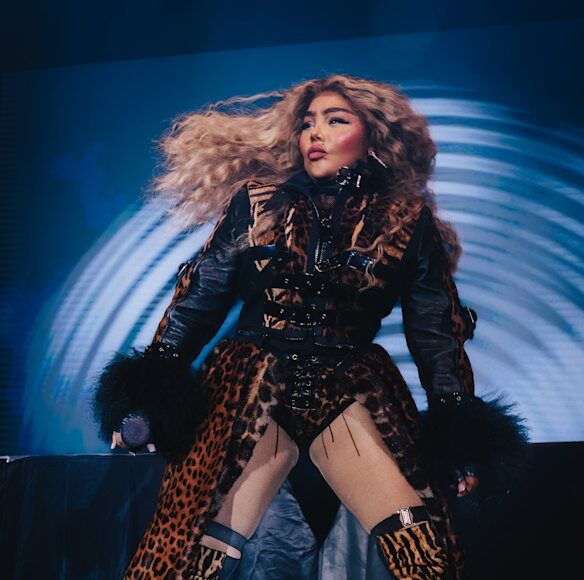
DJ sets from Soju Gang and Dutty Worldwide, impressive pole-dancing acrobatics, and a short mega-mix of top-40 pop and rap by Kim’s DJ have the crowd primed to lose it. She arrives in a leopard-print ensemble, flanked by dancers and laughably staunch security guards (a foreshadowing of the male buzz-kill that follows). Now 51, Kim’s “Queen Bitch” demeanour has softened, but she still has the charisma to rip through truncated versions of The Jump Off, Magic Stick, Big Momma Thang and Get Money.
But the wheels start falling off when Kim’s “hubby” arrives onstage: Tayy Brown, a 26-year-old rapper and singer with whom she has had an intermittent romantic and professional relationship. Brown faintly sings over a backing track, and Shazam returns a savage “no result” on the song. Betrayal ripples through the crowd; it’s as if this young man taking their matriarch’s spotlight has undone decades of feminist progress. There are boos. It’s rough.
Kim almost gets things back on track with How Many Licks, Lady Marmalade and Not Tonight (Ladies Night Remix), but another mega-mix of other artists’ music ends the night on a whimper.
Kim hasn’t played a single song from her enviable catalogue to completion. There’s so much love in the room for the woman on stage, but many in the crowd, who’d paid up to $149 per ticket, are incredulous at how little they’d heard of the world-changing music they’d come to celebrate.
Reviewed by Nick Buckley
RISING FESTIVAL | MUSIC
Dry Cleaning ★★★★★
The Forum, May 30
Dry Cleaning performs in front of a huge painting of vocalist Florence Shaw having her eye washed out. It’s the cover of the band’s latest album Secret Love, and it sums things up – intimate, visceral, direct, and grimy.
The band is best known for Shaw’s fragmented lyrics and her sonorous, spoken-word delivery. Once you hear one Shaw-ism, you hear them everywhere – unremarkable, mundane even, but incisive. “The people in the house at the moment are renting,” she says in Blood, “so it’s all good, anytime, we can move in.” In The Cute Things: “I admire you and your family vibe; and I’m sorry that you got attacked by a dog.”
It’s a 2020s inner monologue. “I can watch this TV show for however long.” She’s a poet of conversational inertia.
A lot of these lyrics are lost tonight, with Shaw’s dulcet hum camouflaged in the mix – which feels right, because they’re part of a whole. Have I mentioned how great the rest of the band is too? Her words give the band depth. The band gives her words gravity. Occasionally, a beautiful line pokes its head up: “I just wanted to tell you, I’ve got scabs on my head.” “… carcinogenic, but it didn’t put me off.” “I like it when you can see inside houses.” Same.
The Forum is the perfect size and setting for the band, once I find the sweet spot in the middle, where the bass can breathe. Shaw, with naval-length straight hair, shakes a single maraca, upside-down, like a bottle. “That was very, very nice,” she says, complimenting our dancing. “You looked like a lovely ocean or something.”
The middle of the set holds their best songs. Anna Calls From the Arctic has an irrepressible baseline. Cruise Ship Designer tells of a naval architect who doesn’t really care for cruises, but it’s a job. “I believe in design,” she intones. “I am not an ambitious man.” Scratchcard Lanyard is as infectious and mysterious as when it came out five years ago. Evil Evil Idiot is searing. On Conversation, she trills a telephone sound into the mic. “Hello? Oh yeah, sure. That would be nice.” It’s all given shape by bassist Lewis Maynard’s post-punk bass.
The encore is their song-of-the-moment, Hit My Head All Day. “The objects outside the head control the mind. To arrange them is to control people’s thinking.” It’s lucid and memorable. Sheer post-modern poetry.
Reviewed by Will Cox
RISING FESTIVAL | DANCE
Exposure ★★★
Dancehouse, Carlton, season concluded
Does obsolescence have its own vitality? Can broken, abject and discarded objects be a source of energy and inspiration? The question is posed in a new collaboration between performance artist Latai Taumoepeau and Sydney’s Branch Nebula.
This slow, exploratory performance places before us a diverse field of rubbish: piles of foil glittering under red and blue lights, a microwave throwing lurid sparks, an old clothes dryer and the plastic cover for a car bumper. All of it miked up.
Two performers, Taumoepeau and Mirabelle Wouters, sort through the junk as though prospecting for wonder. They test whether these objects might still provoke humour, thought or even grace. The images they create are not always eloquent, but some are arresting.
In one passage, an old metal bed frame is suspended overhead. Wouters dances with it, tipping herself off axis and falling in behind its sway. Then she thrusts at the bed with her pelvis. Sparks fly, and the two pendulous globes slung around her neck light up.
In the final section, Taumoepeau covers herself in black, oily-looking liquid, then pours stones into her mouth. Nearby, Wouters coats herself in glue and tissues before being sprayed with brown liquid, looking like some creature from a festival drop toilet.
The publicity materials describe the show as a study of the ageing female body as a site of power. In some sense, then, the collection of kerbside junk that is placed before us is intended as an analogy for older women. It’s a plausible reading, but also a rather literal one.
Whatever interest Exposure has lies less, I think, in this social allegory than in the stranger, more open operations performed on the objects themselves. It’s in the matter-of-fact curiosity with which the performers handle their materials – always sensitive to the possibility of residual life.
Reviewed by Andrew Fuhrmann
RISING FESTIVAL | THEATRE
A Year Without Summer ★★★★
Arts Centre Melbourne, until May 31
I had mixed motives for joining the standing ovation for Florentina Holzinger’s A Year Without Summer.
The avant-garde feminist hellraiser has created another provocative and monumental total artwork – the ovation was perfectly sincere – but there was also fake diarrhoea dribbling down the back of my seat at the end of the show, and I’d be lying if I said I wasn’t keen to get away from it.
Artists have been known to smear critics with poo in Europe. In this case, the wet brown slurry wasn’t deliberately aimed, but part of an explosion of bodily fluids drenching the stage (with spillover) in a climactic scene, set in an aged care facility. It came after an intricate two-hour engagement with abjection, inspired by the writing of Mary Shelley’s Frankenstein, and the gross finale was totally aesthetically justified.
Of course, Holzinger’s work is designed to shock, and she seems to take pleasure in pushing the envelope of what’s possible to show onstage. Her previous work to appear at Rising, Tanz (2023), excavated body horror from ballet school, and included nude aerial performers with meat-hooks piercing their flesh, as well as dancers smoking bongs onstage.
A Year Without Summer isn’t gratuitously shocking, though. It’s an odyssey powered by a fascination with the abject – by that which we regard as monstrous, and which inspires fear or disgust because it sits outside, or violates the separation of, discrete categories of subject and object. Bodily fluids. Surgery. Orgies. Corpses. Childbirth.
All of these get worked into a playful response to Frankenstein – one that seems to be guided by theorist Julia Kristeva’s insight that the repression of the feminine, and the mother especially, is a key source of abjection.
So, after a short introduction to Shelley writing Frankenstein at Lake Geneva, in 1816, the piece immediately takes us down a rabbit-hole of repressed feminine sexuality: a slow dance of life and death that morphs by degrees, as the all-female cast disrobes, into a sapphic orgy of extraordinary explicitness and duration.
Having flirted with live porn, the performers arrive at Frankenstein’s lab – entering through a gigantic inflatable vulva – and we swing from physical to musical theatre, with a smattering of clowning and circus thrown in.
Parodies of songs from Little Shop of Horrors and The Sound of Music accompany an exploration of medical misogyny. Freud finishes masturbating and takes over the stage in a madcap comic takedown of “hysteria”; a duel takes place between Dr Mengele and Georges Cuvier over who’s inflicted more cruelty in the name of science.
Sources of horror shift from historical to futuristic, as biohacking, AI-powered robot dogs and the potential for human immortality all glide into the frame. Beauty does manage to skate on the edge of this abyss, even if visions of “progress” are at least as unnerving as all that has gone before.
A Year Without Summer is full of spectacle and grotesquerie and subversive comedy horror. It’s as ferocious and transgressive a feminist response to Shelley as, say, The Rabble’s Frankenstein, with much deeper pockets and ambition to match. Just avoid the two front rows if you can.
Reviewed by Cameron Woodhead
RISING FESTIVAL | DANCE
Glow ★★★★
Chunky Move Studios, Southbank, until March 31
When Glow premiered in 2006, it looked like a breakthrough in how artists and engineers might work together: a responsive environment, an immersive ritual, an artwork that evolves before our eyes. Nearly 20 years later, Gideon Obarzanek’s solo, made with German engineer Frieder Weiss, still feels exciting.
Can it really be so old? It remains very impressive. Yes, real-time body-tracking has advanced since then and perhaps the technology used in this show is fairly basic. But the arts rarely get this intimate with digital technology or engage it so productively. This is a spectacle but also a genuine encounter.
Performed by Sara Black, Melissa Pham or Layla Meadows on different nights, Glow takes place in a compact square, with the audience looking down from all sides. Infrared cameras track the dancer as she folds, twists, arches and extends. Projections from overhead then augment the space with simple but effective patterns.
The dance mostly stays close to the ground, close to the canvas, so we can read the body’s precise relationship with the light. Some effects outline it crisply. Others give it a soft luminous aura. In the most beautiful passages, the dancer seems painted in moving lines, her contours disclosed as she luxuriates, slowly coiling and uncoiling.
The night I saw it, Sara Black, one of the original dancers, was performing. She played expertly with the seductions of automation: the warmth of light, the sensuality of shadow, the pleasure of being watched by a machine that follows more closely and perhaps more forgivingly than any human eye.
Made today, I think Glow might be darker, more sceptical, more alert to the possibility of unseen crosshairs. Here, the overwhelming mood is one of optimism – even as it anticipates, in its final moments, the body’s removal and its complete substitution by the dancing light.
Reviewed by Andrew Fuhrmann
RISING FESTIVAL | THEATRE
We Come to Collect: a flirtation, with capitalism ★★★★
Arts Centre Melbourne, until June 7
Grim and unhinged the hegemony of the United States may be, yet the rogue superpower remains a prime source of protest and resistance. Many of the most penetrating critiques of the US come from America itself, and that’s certainly the case with Jenn Kidwell’s latest piece of performance art.
We Come to Collect is an irreverent slide into the mire of late capitalism that raises consciousness of a manifestly unfair system, and our complicity in it, as it taunts and inspires, subverts and entertains.
Melbourne audiences might have seen Kidwell in the extraordinary Underground Railroad Game at the Malthouse in 2019. That work combined a history lesson with sado-masochistic seduction and a provocation on race relations in the US, and it was light years ahead of the Australian stage at that time in the freedom, daring, and sophistication of the conversation it led on the complexities of racial inequality.
This time, Kidwell appears alongside Brandon Kazen-Maddox, who translates her spoken word into ASL (American Sign Language), and from the outset, an air of decadence wafts heavily over the stage.
We enter to find the pair splayed on a chaise longue dressed in leopard print and faux fur (Kidwell), or corsetry (Kazen-Maddox). The set is festooned with symbols of opulence – a chandelier, a taxidermic swine’s head – alongside enormous buckets of KFC. By the time the ancien régime costumes come out, the stage looks as if Colonel Sanders has hopped into a TARDIS to visit Marie Antoinette at the palace of Versaille.
Before the show detours into grotesque, “let them eat cake” comedy, there’s an earnest and galvanising takedown of work, as most working people currently experience it. Kidwell invests the philosophy behind the antiwork movement with eloquent simplicity, a personal dimension, and rhetorical skill reminiscent of spoken word poetry.
The humanising force of Kidwell’s monologue runs into a bold complication. About halfway through, the piece seems to cave in to the perceived inevitability of capitalist imperatives, and Kidwell proceeds to hustle the audience, through increasingly wild flirtations and participatory performance, into lightening their wallets.
The show isn’t called We Come to Collect for nothing.
Chaotic comedy takes in class, colonialism, racism, patriarchy, and socio-economic inequality. There are cartoons and video skewering the Trumps and the Musks of the world, and Kidwell’s shameless cash grab builds from teasing seduction into an uncomfortable gambit aimed at revealing our complicity in the system.
While this show isn’t quite as rich in ideas or as sharp in execution as Underground Railroad Game, it’s performed with remarkable charisma, intelligence and sass.
Kidwell doesn’t have all the answers – no one does – but her work disarms the audience, frames the problem, and steers us toward asking the right questions, offering empowerment and entertainment in equal measure.
Reviewed by Cameron Woodhead
RISING FESTIVAL | DANCE
Hard to be Soft: A Belfast Prayer ★★★
Malthouse Theatre, until May 30
Oona Doherty’s Hard to be Soft is short and serious in tone but artfully composed: a study in dance of the postures and habits – the swagger, volatility and comic self-display – of working-class Belfast youth.
It premiered in 2017 but continues to tour the world because its local materials refuse to stay local. They resonate wherever young people are conditioned to despise softness.
Set in a cage-like structure with huge white floor-to-ceiling vertical bars, designed by Ciaran Bagnall, the work is really an anthology of four smaller pieces.
In the first chapter, Ryan O’Neill imitates and then abstracts and transforms the gestures of disaffected young men: squaring up, pointing, jeering, preparing to strike or just standing around waiting.
Next, a troupe of eight girls from a local dance school performs a cool, street-inflected unison routine. They have their own swagger, but they’re also watchful. Doherty is here alert to the way resistance manifests differently across generations and genders.
In the third chapter, two large shirtless men crush themselves together in an absurdly long embrace, drawn out until it becomes something other than an embrace, something rather sad and desperate. Perhaps it is every hug that never was?
Finally, O’Neill returns, revisiting the fragmentary sketches of street life, but now working them into a pattern of grace, drawing them together as he transitions rapidly between a half dozen or so different portraits.
David Holmes’ music creates a wonderfully bleak church-like atmosphere. And there is extensive use of recorded Belfast voices, drawn from interviews and documentaries, which provide the material for the imitations.
Hard to be Soft has a sort of monumental attraction. It is – as the title suggests – like a great prayer. It’s a dream of communion with what has been damaged. And an earnest, though somewhat muted, appeal for change.
Reviewed by Andrew Fuhrmann
Want more arts? We’ve got you
 Will Cox writes fiction and arts criticism. He’s based in Merri-bek.