

Source : the age
THEATRE
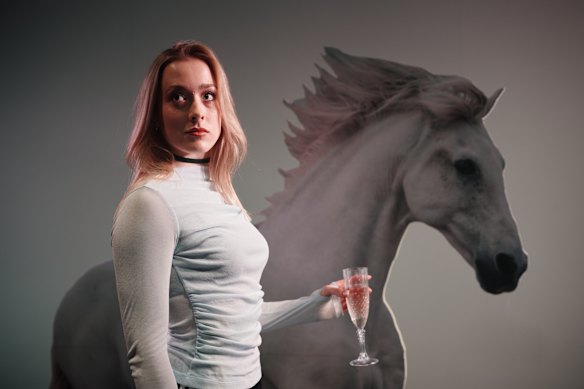
Anna X ★★★
Red Stitch Actors’ Theatre, until June 21
Women who lie, cheat and steal are of perennial fascination to our collective imaginations. Their rapid ascents to success and stunning downfalls have been endlessly re-envisioned for the screen, whether it’s medical fraudster Elizabeth Holmes, homegrown pathological liar Belle Gibson, or Anna Delvey aka Anna Sorokin – the famed Russian con artist who masqueraded as a German heiress and swindled many New Yorkers out of their fortunes.
Taking inspiration from Sorokin’s exploits in Anna X, English playwright Joseph Charlton’s stage show – making its Australian premiere at Red Stitch – necessarily confines Anna’s sprawling web of lies, deceit and waylaid associates to one fictional relationship: the burgeoning romance between herself and start-up Silicon Valley tech entrepreneur Ariel.
There’s nothing amorous about Anna and Ariel’s relationship. They’re almost never physically intimate, there’s no discernible chemistry between them, and they barely know each other. Each uses the other to further their own aims – Anna evidently wants money, while Ariel desires the cultural capital afforded by his association with Anna – but within such a hollow construction, the stakes never feel real, and the oddly detached saga leaves the play feeling distinctly unanchored.
However, the two leads wring everything from what they’ve been given, playing more than one character and switching between different accents, outfits and modes of being to bring a larger ensemble of people to life.
Becca Galvin struts in and out of Louisa Fitzgerald’s modular stage, enunciating each haughty word with the same pan-European accent that the real Anna is infamous for, even if the specifics differ. Garbed in the East European uniform of branded tracksuit pants, faux fur and heeled boots, Galvin’s Anna is flighty, cutting and ultimately unknowable.
Tom Stokes brings a palpable physicality to the character of Ariel, nervously gesticulating with barely suppressed anxiety and bounding around the stage, beseeching Anna for a modicum of affection.
Dressed in a muscle tee and gold chain that looks more gangster than coder, Stokes lends some much-needed coherence to an inexplicable character who curiously retains a veneer of decency despite essentially creating an exclusive members-only dating app.
Director Tait de Lorenzo brings some much-needed pizzazz to the unfolding of this story. Anna and Ariel’s drug-imbued first exchange kicks off the play – thrillingly reimagined in a rapidly projected back-and-forth on a central screen.
Under his direction, Lisa Mibus intercuts the flabbiness of Charlton’s overly expositional script with bold swatches of colour, and Grace Ferguson’s sound design seamlessly transports us from highfalutin party to art exhibition to verdant cemetery.
Galvin and Stokes physically overturn and rearrange the building blocks of Fitzgerald’s set, printed with different motifs, to aid in the transformation of an otherwise stark stage.
Can true wealth ever be accrued ethically? Is the difference between a self-interested scammer and a self-made success story a thin gossamer line? Is it heroic to steal from the rich if the only person who’s bettered is you? There are interesting moral tensions that could have been teased out from Anna’s rag-to-riches-to-prison trajectory in the “land of the free”, but while Anna X flirts with these ideas, it never fully leans into its arguably overdone premise.
Reviewed by Sonia Nair
THEATRE
Eurydice ★★
fortyfivedownstairs, until June 14
Shows inspired by the myth of Orpheus and Eurydice have been thick on the ground in Melbourne lately, with both the hit musical Hadestown and a production of the Gluck opera staged last year. Compared with either of those, Sarah Ruhl’s Eurydice proves a disappointment, I’m sorry to say.
A lauded American playwright, Ruhl has been nominated for two Pulitzers, but as with her take on the Victorian-era pathologisation of women’s sexuality, In the Next Room (or The Vibrator Play), I found some dialogue in Eurydice glib and superficial to the point that it left the actors flailing to land an effective performance style.
The play modernises the myth’s setting, though if the intention was to centre Eurydice (who’s something of a cipher in the original) then Ruhl’s twist is problematic.
Here, Eurydice (Aisha Aidara) is a bookish young woman torn between her new husband, Orpheus (Tomáš Kantor) and her dead father (John Voce). The latter – an invention of Ruhl’s – has been spared the waters of the Lethe, retains his memory in the underworld, and writes plaintive letters to his daughter above.
When sinister seducer Hades (Devon Braithwaite) lures Eurydice from her wedding party using her father’s correspondence as bait, Orpheus must sing his way into Hades to rescue her. Yet it is Eurydice, rather than Orpheus, who will doom her own ascent.
It’s hard not to have complicated feelings about a play that focuses the myth on Eurydice, only to squeeze her into a vicelike patriarchal grip.
Ruhl suggests a Eurydice who’s married to Daddy until she has a husband, and given the idiotic, besotted sheen of the scenes between the young lovers – it’s a crush; the self-absorbed musician and the curious young reader don’t seem to have much in common – the dice seem further loaded in favour of dear old dad.
Eurydice’s pursuit by the lord of the underworld works the ugliest elements of male entitlement into burlesque, including a tap-dancing routine. The contrast between such showmanship and Eurydice’s stark final choice – to be violated by Hades or to embrace oblivion – should be moving.
Unfortunately, a curious detachment sets in early, as the actors overcompensate for underwritten dialogue and clashing performance styles vie for attention, from a chaotic chorus of underworld stones (Joshua Gordon, Fran Sweeney-Nash, Miles Paras) to the intrusion of music that rarely rises above the level of drunken karaoke or a garage jam.
This Melbourne Shakespeare Company production does sport inventive design – making a portal to Hades from an old-school Telstra phone booth is a nice touch – and there are many talented artists among the cast and creative team.
They’re valiant under Gary Abrahams’ direction, but it strikes me as a misstep to choose Ruhl’s play over something more dramatically engaging, especially considering the increased ambition of the company’s programming in recent years.
Reviewed by Cameron Woodhead
MUSIC
Half Bent Music Festival
Various venues, Brunswick West, until May 31
Melbourne jazz lovers with long memories will affectionately recall the original Half Bent Music Festival, presented sporadically between 2005 and 2015. Founded by musicians Ronny Ferella and Gideon Brazil, it presented a fantastically diverse array of creative artists in unconventional locations, from Trades Hall council chambers to the Fitzroy Bowling Club.
The idea was to strip the music of prescriptive labels (including “jazz”) to make it more inclusive, and welcome audiences into community spaces rather than concert venues.
Now, after a long hiatus, Half Bent has returned – with a similar mission but a more specific geographical focus. Ferella and Brazil view this year’s event as an “offering” to their beloved (and creatively fertile) local community in Merri-bek.
Aided by a small but dedicated programming team, they curated a weekend-long event at multiple venues in Brunswick West – though one outdoor venue was ultimately discarded due to a gloomy weather forecast.
I attended the opening night on Friday, dashing back and forth between St John’s Anglican Church and the 4th Scout Hall in order to catch as many acts as possible. Admittedly, it wasn’t the most relaxing way to absorb the music, yet within minutes of taking my seat (or pew) for each concert – breathless from the 12-minute sprint between venues – I was totally engrossed in the unique artistic vision unfolding on stage.
Adrian Sherriff led his boisterous Oynsemble into the church from an adjoining hall, the sound of pulsating horns, gongs and drums reverberating as the players wound their way to the front of the room. This was quite literally music (and tradition) in motion, weaving elements of South and East Asian, Afro-Cuban and Balinese music into a boldly contemporary framework.
Sherriff switched from bass trombone to bata, piccolo to shakuhachi while using a gestural “sound painting” technique to conduct the adventurous 10-piece ensemble. Easy-listening? No. Thrilling? Absolutely.
Also in the church, Bhairavi Raman (on violin) and Nanthesh Sivarajah (mridangam) offered a beautifully intimate set that showcased their mastery of Carnatic (Indian classical) music, subtly shaping it into something more personal using loops and electronics to add humming vibrations, drones and harmonies.
In the Scout Hall, guitarist Matt Hoyne and his gorgeous Slow Poke trio loped and swayed through a mostly original set focusing on melody, texture and connection rather than displays of individual virtuosity.
Sahul Sakti were already ablaze when I crept into their show, with electric violin, bass and laptop effects surging over a throbbing, polyrhythmic pulse. Their music was heady and trance-like at times, hypnotic at others – and, as violinist Huich Goh explained, mostly improvised, “so what you just heard, you will never hear again”.
Music created in the moment, by local artists, to share with their community: the very essence of Half Bent, which hopefully won’t hibernate for another 10 years before returning.
Reviewed by Jessica Nicholas
NOTE: No star rating has been applied to the above festival review
THEATRE
1154 Days ★★★
Arts House, until May 31
How to render the worst 1154 days of your life, equivalent to three years and 55 days, into a play that attempts to make sense of that which is incomprehensible – punitive state surveillance and wrongful incarceration?
Catalogued in a 2025 memoir and documentary, the unfathomableness of Chinese-Australian journalist Cheng Lei’s predicament is encapsulated in throwaway lines peppered throughout 1154 Days that would be unbelievable if they weren’t bald statements of fact.
That she was apprehended by Chinese government’s state security agents for sending an eight-word text to a foreign journalist peer seven minutes before a media embargo was lifted, one she didn’t know about. That she spent a mere 10 hours in the sun every year. That she didn’t hear her two children’s voices for years.
1154 Days is strongest when it allows the space for these injustices to fester in the minds of its audiences, extrapolating Lei’s fate to paint a stark picture of those inhumanely incarcerated without cause in prisons around the world.
Lei’s budding stand-up career comes to the fore in the opening beats of the play. She undresses on stage to a jaunty bop and moves from one outfit to the next, demarcating the different roles she assumes in her life – mother, journalist, friend, lover of karaoke. But the normality is short-lived.
Pacing the stage against a backdrop of grandiose floor-to-ceiling red velvet curtains before her life is upended, Lei’s liberty is curtailed when she’s put into solitary confinement, permanently flanked by two prison attendants in a psychological torture technique known as “residential surveillance at a designated location” (RSDL).
In a simulation that recreates the mundanity of prison life, we bear witness to repetitious cycles of Lei sitting motionless, using the toilet and sleeping – the latter two acts that are so private that to be surveyed doing them is an utmost intrusion on one’s inner sanctum.
The curious decision to use the same child actors, Chloe Ma and Carlos Wong Yu, as both Lei’s aggressors and her offspring is interesting in that it compels us to humanise Lei’s captors, but it blunts the impact of the surveillance and abrogates accountability. Hearing Yu’s diminutive voice whisper “permission accepted” whenever Lei asks to use the toilet is heartbreaking in its own distinct way, though not for the reasons intended.
Employing a combination of multi-camera projection and recorded footage, video designer Romanie Harper evokes the claustrophobia of constantly being monitored, implicating the audience as they’re made to assume Lei’s positionality in difficult moments of interrogation and self-reflection. In one particularly transcendent moment, we see a visual culmination of a covert bond Lei shares with another detainee.
For all the work’s strengths, transitions between scenes can be clumsy, and the gargantuan stage often envelops the minutiae of a play that feels overwhelmed by its staging. 1,154 Days is bilingual, but not consistently – Lei speaks in Mandarin to her children, but the play is otherwise largely in English, begetting the question for whom exactly this play is for in an age when surtitles are commonplace and supremely effective at bridging chasms in language.
It’s in the technical aspects where 1154 Days shines the most. Emma Lockhart-Wilson’s light design oscillates between warm and tender, like when it’s bathing Lei in a rare strand of sunshine, and desolate and monochrome in moments of deep psychic distress. Co-director Emma Valente’s sound design personifies a similar approach, ratcheting upwards in moments of inner turmoil and tending towards asynchronous, like when Cyndi Lauper’s True Colours devolves into a discordant nightmare.
Lei is a talented and moving interlocutor of her own experiences, but 1,154 Days flattens the complexity of her ordeal into something that can be digested in 100 minutes by opting for neat ciphers, trite oversimplifications and a pat ending that feels particularly at odds with the difficulty detainees face in transitioning to regular life after withstanding such trauma.
Reviewed by Sonia Nair
JAZZ
The Others ★★★★
Melbourne Recital Centre, May 28
I was lucky enough to see The Others’ debut performance in 2017 at the Wangaratta Jazz Festival. The unlikely trio (teaming Spiderbait drummer Kram with jazz titans Paul Grabowsky and James Morrison) presented a free-spirited, fully improvised show that became an instant festival highlight.
Since then, The Others have performed only a handful of times, each outing a rare reunion. Last year a new chapter began when yidaki virtuoso William Barton joined the group. On Thursday night, this new iteration of The Others performed in Melbourne for the first time.
As Kram explained to the audience, once the trio had played with Barton, it was impossible to imagine the group without him. It wasn’t hard to understand why. Here was another musician equipped not only with prodigious technique, but also wide-open ears – and heart – and a willingness to dive into the unknown.
Like The Necks (another renowned improvising ensemble), The Others arrive on stage without a repertoire or an imagined outcome. They simply start playing. On this night, it was Kram’s rumbling toms that set the scene, creating a muted backdrop for Grabowsky’s graceful piano and Morrison’s hushed flugelhorn, as Barton’s yidaki thrummed quietly beneath them.
Over the next hour, many musical stories unfolded, each emerging organically from the last. There were passages of enchanting, folk-like lyricism in which melodic fragments emerged from the piano, trumpet or flugelhorn, adorned by Barton’s haunting, wordless vocals. There were outer-space escapades filled with trippy effects from Grabowsky’s keyboard and analogue synthesizer; detours into dark abstraction or deliciously earthy, gospel-tinged soul; and urgent late-night chases propelled by Kram’s polyrhythmic gallop and the bass-like pulsations of the yidaki.
In a second, shorter piece Morrison used a Tibetan singing bowl to produce ringing overtones, accompanied by barely there cymbals from Kram, before a relaxed pulse emerged. As Grabowsky uncovered a minimalist piano motif, Morrison switched to conch shell, its trombone-like timbre merging with the yidaki. Gradually the beat became more insistent, the mood more boisterous, before the storm subsided and melted into silence.
The audience leapt to its feet, cheering, and The Others looked equally thrilled, their spontaneous group hug mirroring our pleasure at having shared this enthralling journey.
Reviewed by Jessica Nicholas
Want more arts? We’ve got you
 Sonia Nair is a contributor to The Age and Good Food.
 Jessica Nicholas is an arts and music writer, specialising in contemporary jazz and world music.