

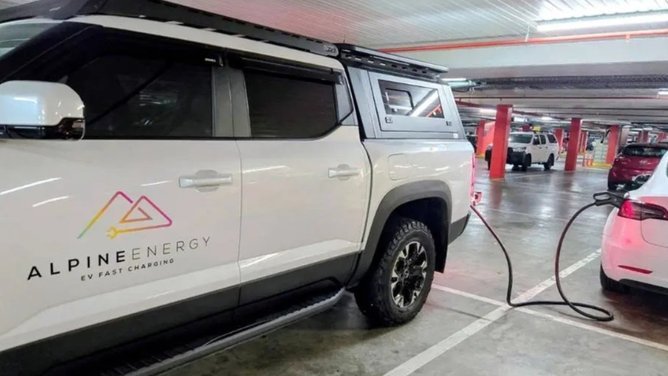
Source : Perth Now news
An Australian company has unveiled a first-of-its-kind direct EV-to-EV charger aimed at rescuing electric vehicles that have run flat.
Melbourne-based Alpine Energy says the technology will be used to help stranded motorists on regional roads and on remote worksites and mines.
“Until today, charging an electric vehicle has meant bringing the vehicle to the infrastructure,” Alpine managing director and founder Mark Wexler said.
“The MGEN M40 is built to do the opposite, to bring rapid charging to the vehicle, wherever it is.
“The cases that drive us are the hardest ones: getting a stranded driver moving again when there’s no charger for kilometres and keeping fleets running where the grid simply doesn’t reach.”
Officially launched on May 26, the company is now taking applications from roadside assistant companies and fleet operators to be involved in trials.
There are some vehicle-to-vehicle EV charging options but not up to “fast charger” speeds. The NRMA dispatches vans across Sydney and Canberra with purpose-built 4.8kWh battery packs to help stranded EV drivers; Alpine says its tech can pump out 40kW from the battery of its petrol/electric BYD Shark.
Some companies are putting batteries on the back of utes to charge stranded EVs or trucking around generators to recharge flat electric vehicles.
But Mr Wexler says the company has proprietary hardware and software to use their vehicle’s stored battery power to charge a secondary EV.
“There is real field-validation work ahead,” Mr Wexler said.
“But a mobile, vehicle-to-vehicle approach points to a genuinely new way of delivering energy where it’s needed most.”
The company’s managing director told NewsWire that Alpine had received inquiries from major Australian roadside assist companies, and towing companies, about trialling the technology.
The initial prototype delivers power output equivalent to 65km of driving range from 15 minutes of charging. The system includes the CCS2 plug that is standard in Australia, the older CHAdeMO plug, and 4G and satellite connectivity.
Perth-based industrial automation firm EXOR Oceania is involved and making connections between Alpine and the mining sector.

EXOR founder Carlo Sportiello said the charger was an “innovative approach to mobile energy deployment and EV charging infrastructure, particularly in environments where conventional charging solutions may not be practical”.
A battery from Bulgarian manufacturer Ampernext is used in the Alpine charger. Ampernext founder Vasil Merdzhanov said direct current (DC) vehicle-to-vehicle (V2V) charging was needed.
“V2V charging is exactly the kind of application our DC-DC technology was built for, and Alpine Energy is approaching it with the engineering rigour the category needs,” Mr Merdzhanov said.
“The MGEN M40 takes mobile fast charging into a genuinely new operating envelope. We’re proud to support what we believe will be a global product as it moves into pilot validation.”
Electric vehicle use in Australia accelerated in the first half of 2026, as surging fuel prices prompted motorists to switch to battery electric.
The Federal Chamber of Automotive Industries’ latest report shows one-in-six new cars sold are now battery EVs. The used market is surging too, with 27.5 per cent of light vehicle sales in April being electric, plug-in hybrids or hybrids; up from 23 per cent in March and 14 per cent 12 months ago.
The federal EV subsidy will fall from April 2027. Eligible EVs will still be exempt from import tariffs though.
Australian government figures surmise the Electric Car Discount subsidy prompted 64,000 additional EVs to be sold in Australia in the three years to December 2025.