

Source : INDIA TODAY NEWS
Few exams in India are as competitive as the Joint Entrance Examination (JEE) Advanced. This year, Delhi zone students secured the top three ranks.
Five students from the Delhi zone were among the top 10 rank-holders, while 29 made it to the top 100. An analysis by India Today’s Data Intelligence Unit shows that this year’s result is part of a larger trend.
advertisement
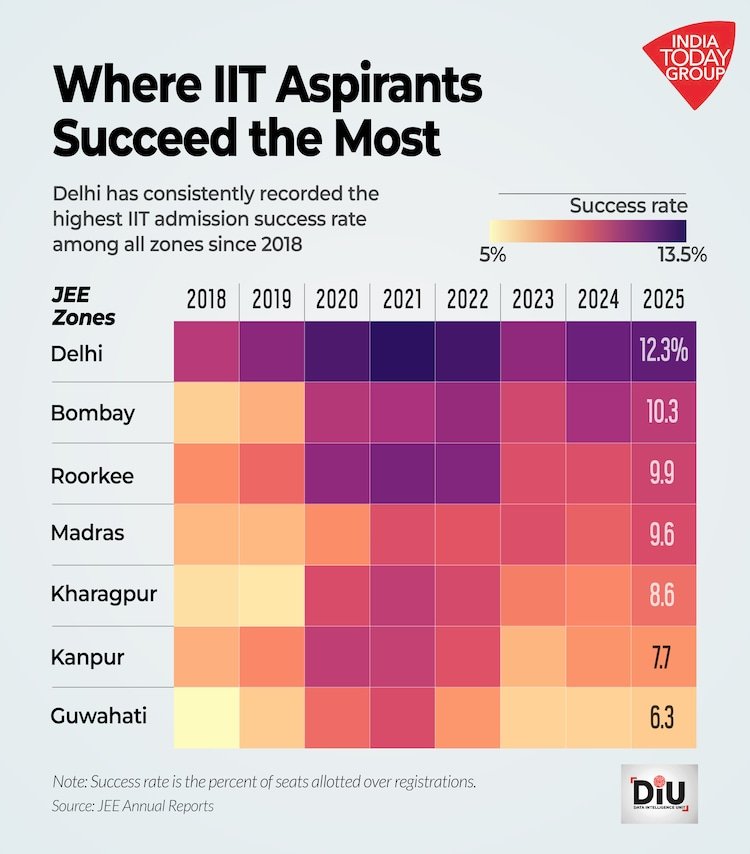
The zone — Delhi, the National Capital Region, Rajasthan, Jammu and Kashmir, and Ladakh — has consistently maintained a strong presence at the top of the merit list over consecutive years, with four students in the top 10, and 31 in the top 100 in 2025.
Since 2018, the Delhi zone has consistently recorded the highest success rate. On average, around 12 of every 100 registered candidates from here eventually secure admission to an Indian Institute of Technology, a slightly better conversion rate than other zones. One of the reasons for the zone’s high conversion rate could be an extensive coaching network spanning Delhi-NCR and Rajasthan’s Kota.
The data shows that a higher number of registrations does not always lead to greater success. In 2025, Madras, which is the country’s largest registration zone, had over 45,000 candidates. In comparison, Delhi had approximately 34,000 candidates. Despite this, a larger percentage of aspirants from Delhi successfully secured admissions to IIT, allowing the zone to maintain its long-standing lead.
Our analysis also found a changing gender ratio in IITs. Women now account for roughly one-fifth of all IIT admissions, up from around 15 per cent seven years ago. In 2026, the share of girls qualifying for the exam reached an all-time high of 25 per cent.
In 2018, around 1,800 girls were admitted. By 2025, that number had nearly doubled to more than 3,600. During the same period, the number of female candidates registering for the examination rose by about 30 per cent, but admissions increased by almost 99 per cent. Over the same period, male admissions increased from 10,115 to 14,524.
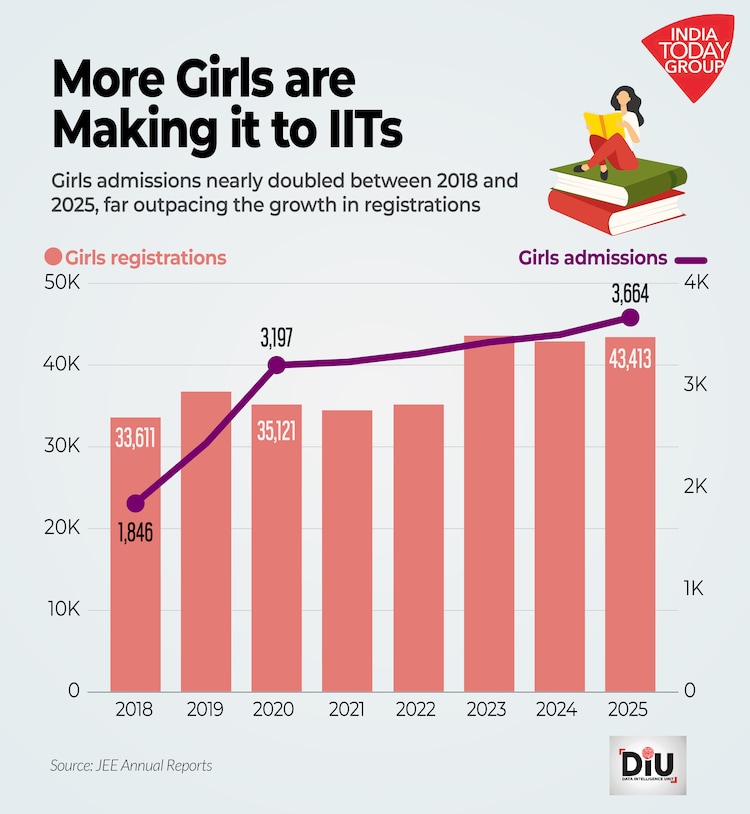
The increase could be because of the measures introduced by IITs to improve gender balance on campuses, including the creation of supernumerary seats for women. While male students continue to account for the overwhelming majority of IIT entrants, the gap is slowly narrowing one seat at a time.
– Ends
SOURCE :- TIMES OF INDIA