

Source : the age
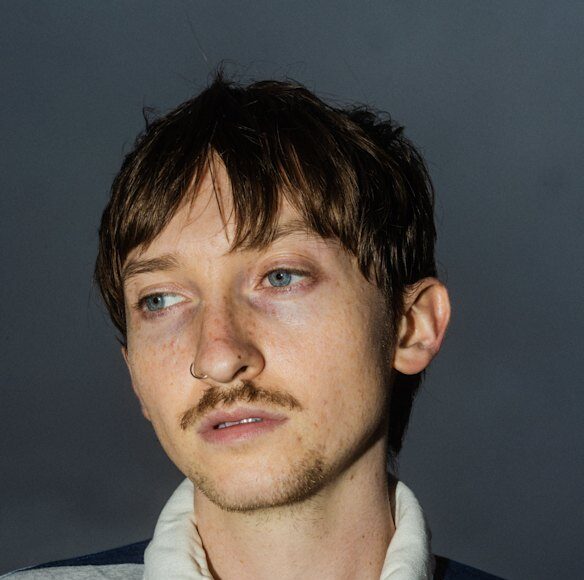
Alone onstage at Sydney’s Oxford Art Factory, Hudson Freeman quietly strums his viral hit If You Know Me. He’s barely halfway through his set when the song’s familiar bent notes start ringing – at first more desolate than on the recording, before it builds to a crashing crescendo.
As he finishes, he nods to the gathered crowd and says, “I guess you can all go home now …” The audience laughs at the quip, a knowing jab at the song’s outsized popularity and the ludicrous journey it’s taken over the past year.
It was in late August last year that the Texan-born/Brooklyn-based indie-folk singer posted an Instagram of himself performing the then-unreleased song in the middle of a field in Indiana, with the crickets chirping and the sun beaming like a Thomas Kinkade painting.
“I posted the video immediately after I filmed it in that field on this drive from Indiana to Chicago, and it blew up on the way there,” Freeman says. “I had this gut feeling that it was going to happen. It was just too beautiful outside – the clouds, the sky. I’d been using that heavy metal font and I knew if I just put it in the blue and then with the green of the field … It just looked perfect.”
The song hit the algorithm lottery. “It was the right place at the right time,” Freeman says. “The internet’s really arbitrary, but maybe part of what got people’s attention is because it seems so real in this time when there’s a real fear about AI and stuff.”
Sipping coffee by the poolside bar at his hotel on Sydney’s Oxford Street, his wife and creative partner Sophie Brown by his side, Freeman recalls the song’s success with the bashful wonderment of someone who lucked out at a pub raffle. At 28, he’s boyish in a gas station shirt and a nose ring (online he’s called himself “the Eric Forman of indie-folk”, a sardonic shot at his resemblance to Topher Grace’s character in That ’70s Show).
He’s in town as the support act for Mumford & Sons’ arena tour of Australia and New Zealand, the biggest shows he’s ever played beyond a two-night stint in Hollywood with Kings of Leon in April. “It’s intimidating to open an arena by yourself, but I just stay cool and collected,” says Freeman. “It’s been unusually nostalgic for me. I was introduced to folk and Americana through Mumford & Sons when I was, like, 13, so this feels like a dream from when I was younger.”
Instagram and YouTube are now filled with part-time guitarists doing their own versions of If You Know Me’s iconic riff. Even guitar-god John Mayer gave it a go. In Freeman’s Instagram comments, Limp Bikzit’s Fred Durst posted to praise the song, as did bluegrass phenom Billy Strings. Hollywood star Jack Black got in Freeman’s DMs.
”A huge one for me is a comedian we’re fans of, Tim Robinson,” adds Freeman. “He followed me and I messaged him and he messaged back. I definitely have a dream that he directs a music video.”
The attention came at just the right time. Last May, Freeman released his third album, Is a Folk Artist, to little noise and, after 11 years of struggling to sustain a music career – in Brooklyn, Freeman worked day jobs as a line-cook, Brown as a nanny – he was on the brink of tossing it in.
“We were taking it year by year in New York. I released the album and it felt like I was finally finding a musical community, so it was enough to make us go, ‘OK, we can do another year and let’s re-evaluate after that,’” Freeman recalls. “But I’ve been releasing music since I was 17, and I’m 28 this year and I hadn’t found much of an audience up until six months ago, when that video went viral.”
Major labels came calling, but he signed with the US indie Mom + Pop Music. ”We did flirt with major labels, just to see what it was about, get a fancy dinner, but my gut was telling me to stick to my guns,” Freeman says. Ever the indie kid – he’s even carrying a tote bag bearing Mom + Pop’s logo as we speak – he was wary of major label promises.
“I was really struck by how the major labels wanted to take the majority of the cut of whatever the next project was going to be, even though I had already done all this work and had essentially broken myself. I don’t understand that,” he says.
“It would be one thing if they were trying to sign me before people had discovered me, but for them to want to take all the royalties for a project that I had already self-marketed, I was so uninterested in that, even if there was potential for a bigger advance. I just would rather make the album I want to make.”
There was also a lingering fear around his breakout hit. “I have a lot of anxiety about how to show that I’m more than just that song, and I’ve been trying to figure out how to not let this just be a one-hit wonder,” he says. “I was worried that if I went with a major label, they would make me camp out on If You Know Me.
“I’ve seen it with some artists – someone like Noah Kahan, who basically had to do Stick Season for years – and I didn’t want that to happen to me. I wanted to find a label who wanted to push me and see me do something different. So I’m not really dreading making the next album. I’ve been waiting for this moment to actually have a recording budget and give it my all.”
He’s been hard at work on a new album, and its outré premise comes from a strange response he kept hearing in the wake of If You Know Me. “People would come up to me like, ‘This song reminds me of The Last of Us’,” says Freeman of the dystopian video game-turned-hit TV series. “It got me thinking, what if I leaned into that and made a post-apocalyptic folk album?”
Oddly enough, the apocalypse carries personal resonance for Freeman. His parents are Pentecostal missionaries and he – and his wife Sophie – grew up in the Assemblies of God, the evangelical denomination that our ex-prime minister Scott Morrison is part of (neither had heard of ScoMo, even though he features prominently on the Assemblies of God’s Wikipedia page).
From 13 to 17, Freeman and his three younger siblings lived in Eswatini – previously Swaziland – as his parents pursued missionary work. “It was a lonely experience, to be honest,” he says. “In some ways, it was very normal and it was very much a community that I have fond memories of. And in other ways, there are obviously conservative elements of [the church] I don’t really identify or align with. But it certainly was an interesting experience being in a family that viewed their life’s mission as calling them to another country. They took it very seriously.”
He was homeschooled there, which was why he got so into music and playing guitar. “I was just avoiding doing schoolwork all day,” Freeman says. “My only social outing was church and playing in the church worship band.
“My mother was a worship leader and her father, my grandfather, was also in the church, playing organ and playing bass. He taught me guitar. I always say, it’s a very positive way to learn music: you get the chance to play in front of people every week and the audience has to clap after every song. You really learn how to perform.”
As a teenager, was he fully onboard the family’s decision to migrate to Eswatini? “I was at the time, but I fell out of love with it very quickly,” he says with a laugh. “The denomination we were part of, they get you really excited about being a missionary kid. They get it in your head that you’re just as important as your parents are and that you’re just as much doing the mission as they are. But when we got there, I remember just being like, ‘Oh, I actually don’t feel like I should be here’.”
Freeman’s parents are now based in South Africa, where they’ve been “essentially pastoring a church” for the past eight years, he says. Amid the uncomfortable intersection between colonialism and evangelism, Freeman has complicated feelings about their missionary work.
“I think the work my father did was helpful in that it was pretty comparable to humanitarian work that you’d see non-religious organisations do. He was helping to build wells and orphanages. At the time, Swaziland had the highest HIV/AIDS rate in the world, nearly 50 per cent; there was an overwhelming sense that every other person you met was HIV-positive. There was a huge economic and humanitarian crisis happening that I think my parents believed their work was helping.”
Brown, who moved from the US to Jamaica at age nine, where her parents ran an orphanage, jumps in. “Sorry, it’s not my interview,” she says, laughing. “But I will say, similarly to Hudson’s family, I feel like my parents had a really big heart for people and I think they did good work, but at the end of the day that comes out of sacrifice for your family, the way that you grow up in a different place and feel different and out of place and lonely, and I think those were defining things for our lives, being so young.”
“That’s really well put. I appreciate you saying that,” Freeman says.
Growing up evangelical, Freeman had a lot of fear about the end of the world. “The rapture, we’d call it, the end of days. And because of my country’s actions, I continue to feel anxious about the end of the world. And so the next album kind of plays with that, my childhood anxieties and my anxieties now about the state of the world. It’ll be my post-apocalyptic road trip album.”
Hudson Freeman’s Is a Folk Artist and Adult Contemporary, his collaboration with The Bedroomer, are out now.