

Source : the age
There are plenty of excited faces as our ship pulls into Alesund, the gateway to the Geirangerfjord, one of Norway’s most celebrated scenic spots. Many of my fellow passengers have booked excursions to explore the fjord and are eager to get going. I, however, am staying put. Norway has plenty of fjords, but only one Alesund.
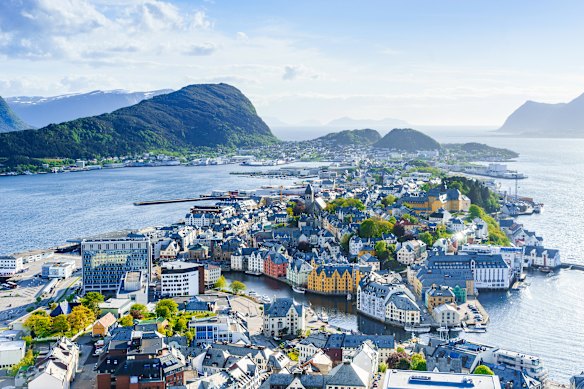
Ask any Norwegian which is the country’s most beautiful city, and the name Alesund will pop up almost immediately. The city’s collection of art nouveau architecture is unmatched in Norway, perhaps even in Europe. It is all the more remarkable given Alesund’s remote location, 370 kilometres from Oslo as the crow flies, and more than 500 kilometres by road.
It is not just Alesund’s architecture that intrigues me, but also what it reveals about the city’s remarkable cycle of boom and bust and boom again.
Established in 1793, when the government sought to create more trading hubs along the coast, Alesund initially became rich from catching and processing fish.
In 1872 a visiting writer, Magdalene Thoresen, described Alesund as a classic boomtown. “You get the impression that it was built in a hurry, built up by chance and the mood which comes with a fast, dangerous profession. Here, no … calm deliberation goes through anything; even the large, dizzying warehouses and individual magnificent buildings speak only of the rapid rise of profit and the boldness of large speculations,” she wrote.
That all came to an abrupt halt on January 23, 1904, when a factory fire, fanned by a winter gale, spread across the town. More than 800 timber houses burned to the ground, leaving only about 230 houses standing. Ten thousand of Alesund’s 12,000 people were left homeless. Remarkably, there was only one fatality – a woman who returned to her house to reclaim some left-behind possessions. According to legend, hers was the house closest to the fire station.
News of Alesund’s fate spread across Europe, and many of the wealthy visitors who had enjoyed summer holidays in the area stepped up to help. Chief among them was German emperor Wilhelm II, who had often sailed through the area on his yacht, Hohenzollern. He sent five ships laden with food, medicine, blankets and building materials.
Incredibly, the rebuilding effort was completed in just three years, largely because so many local tradesmen had no other work. A number of young Norwegian architects were given commissions to design the buildings, with one strict caveat – no wooden buildings were allowed in the town centre.
Inspired by the latest design trend, Jugendstil – also known as art nouveau – as well as their Viking heritage, these young architects created something extraordinary. Walk through Alesund, built on a series of islands linked by short bridges, and every corner brings another striking detail. Some of the buildings, painted in pastel shades from blue to yellow, have arched windows framed by ribbon-like detailing; others have reliefs of elaborate vines and tendrils unfurling beneath the roof line.
Ornate buildings are made even grander through lashings of golden trim; simpler structures are made eye-catching through details such as a single delicate painted wreath stretching all the way along the facade. There are pointed roofs and curved balconies, spires and turrets – oh, so many turrets.
Today Alesund is once again prosperous, thanks to a mix of industries including seafood and maritime technology. Tourism is also a steady earner, so it would be nice to see a few more information plaques around town. I have to go online later to discover intriguing snippets such as the fact that the stone-clad sliver of a building at Kongens gate 10B is so narrow that access to the upper floors is through the neighbour’s front door.
Of course, you could always seek out more information at the city’s Art Nouveau Centre, housed in a lovely building, formerly a pharmacy. I pass the Art Nouveau Centre not long after starting my stroll and resolve to come back later to explore inside. With so many streets to wander down, however, it is four o’clock by the time I return and the museum is closing. At least now I have another reason to return to Alesund.
THE DETAILS
CRUISE
Cunard offers seven-day Norwegian Fjord itineraries aboard the Queen Anne departing from Southampton and stopping at Alesund. Fares from $4598 per twin share for an ocean-view suite. See cunard.com
MORE
See visitnorway.com
The writer travelled as a guest of Cunard.
 Ute Junker is a freelance writer and editor who has been covering travel for more than 20 years.