

Source :- THE AGE NEWS
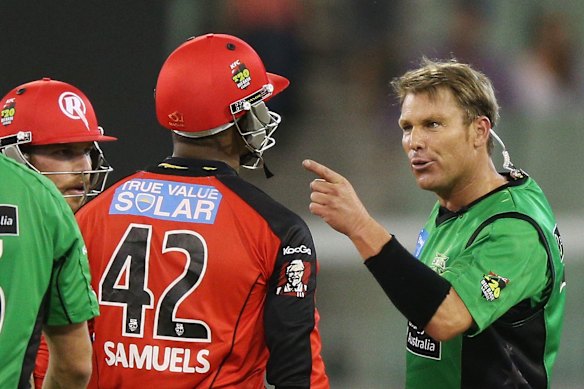
NSW, South Australia and Queensland have requested an urgent meeting with Cricket Australia about Victoria’s shock decision to merge the Melbourne Stars and the Melbourne Renegades, as Victoria prepares to sell a second “clean” Big Bash League licence to private owners.
The merger caused major reverberations on Wednesday, leaving players such as Glenn Maxwell in limbo, as former Stars impresarios Eddie McGuire and John Wylie questioned the wisdom of retiring the glamour club’s brand after 15 years.
A source close to the state associations told this masthead Victoria’s move was “reckless, chaotic and careless”. A second source, also not prepared to speak publicly before the crisis meeting, said: “What a cluster.”
NSW, SA and Queensland, the three states not yet in favour of selling stakes in their teams, had been gearing up for a June 15 meeting with CA and the other states to work through their options, but were compelled to hold a separate call on Wednesday and have requested a joint meeting with CA on Thursday.
Cricket NSW chair John Knox and chief executive Lee Germon said in a letter to their members on Wednesday night that,“This announcement came as a complete surprise to us.
“We have contacted Cricket Australia to request an urgent meeting to see clarification about this matter and to understand the path forward.”
The Australian Cricketers’ Association argued the merger had caused “confusion, uncertainty and anxiety” among Stars and Renegades players who include Maxwell, Marcus Stoinis, Will Sutherland and Nathan Lyon.
The Stars will be rebranded for the coming BBL season, while the Renegades will play as the Renegades unless they are sold and rebranded beforehand.
McGuire and Wylie, who served as president and vice-president of the Stars between 2011 and 2019, said it would be challenging to rejig the identities of the two Melbourne teams.
Wylie, the CEO of Tanarra Capital and former chair of the Australian Sports Commission, supports private ownership in the BBL because of the fresh voices and ideas it would bring, but questioned the logic of extinguishing the brands before going to market.
“At face value it’s a strange and retrograde step in my view,” Wylie told this masthead. “There’s 15 years worth of brand development that’s gone into developing the Stars and the Renegades and the history of commercial sports franchises shows that these things have value.
“So to blow that up and start again is an interesting move.
“I don’t think it’s axiomatic with foreign ownership that if that’s the way the Renegades go, would turn Melbourne into a one team town. Look at the English Premier League, foreign ownership of Manchester City made the club more popular.”
McGuire stressed that he would still support a team wearing Victorian colours, but was unsure about the decision to bin the Stars and Renegades brands.
“I’m saddened the name has now gone to sporting history,” McGuire said. “I’m hugely proud of how we started the competition and filled the MCG.
Asked whether he believed there was a financial crisis for cricket that had forced CV’s hand, McGuire noted the irony.
“I don’t know the books, but it was started originally because of the finances of Cricket Australia, and now it has ended because of the finances of Cricket Australia,” he said. “It was a business move by CA, and it was hugely successful, it’s made a truckload of money for them, and now they go to the next step with it, and that’s where it’s at.
“It’ll be an interesting rebranding. They’re hard to start, these things, and we’ve seen with the AFL and sport it is hard to start from scratch.”
Australian captain Pat Cummins, who plays in the IPL for one of the ownership groups linked to a possible bid for the Renegades, said people should be “open-minded” about privatisation.
“Cricket Australia and obviously a few of the states are quite keen to make it happen. I think there’s some really good arguments there around what privatisation can unlock,” he said. “It does feel like it needs a little bit of a change but obviously I’m at arm’s length because I haven’t played BBL in a while, so it’s probably less relevant to me.
“But I think it’s awesome to see so many people want to get involved in the BBL. My experiences overseas have been nothing but excellent.”
ACA chief Paul Marsh stressed that without agreement with ACA on player payment terms, no privatisation was possible.
“Cricket Victoria’s (CV) announcement about a merger between the Stars and Renegades with the introduction of a new, privately owned club has created confusion, uncertainty and anxiety amongst players. Whilst this may or may not happen at some point in the future, we reiterate that there is a process to play out here before this can occur,” Marsh said.
“As it stands, Australian cricket is not unified on a way forward and as a result, we are a long way off a solution.”
At their peak, the Stars and Renegades fought a derby in front of more than 80,000 spectators at the MCG.
The Stars had big names like Shane Warne and Kevin Pietersen but the closest they came to winning a title was when they surrendered a winning position to the Renegades in 2018-19. The Stars women, powered by Meg Lanning, also have never won a WBBL trophy.
Cricket Victoria chief executive Nick Cummins was unapologetic about the decision.
“We’re not doing this for the love of anything other than accepting it as a financial necessity,” Cummins said. “We’re supporting Cricket Australia in what they believe are the steps that need to be taken to help Australian cricket.”
In a statement on Wednesday, Cricket Australia CEO Todd Greenberg said: “We continue to work with the states and ACA to explore options for private investment in the Big Bash Leagues. There’s still plenty of work to be done and nothing has been decided or approved as yet.
“We are aware of Cricket Victoria’s intentions, which would still mean there are two teams in Melbourne.
“As I’ve said before, private investment would involve some changes to the Big Bash Leagues and the clubs as we look to secure the future of Australian cricket.”
Just nine months ago, CV had been the most vocal opponent of selling stakes in BBL clubs because it wanted to protect the “things that matter,” as CV’s chair Ross Hepburn declared to a room full of cricket powerbrokers at CA’s AGM last October.
But as Nick Cummins recalled, the numbers being presented by CA’s financial forecasters got grimmer and grimmer until he and the CV board decided to change course. Early estimates of CA requiring around $90 million to balance the books in coming years blew out to somewhere closer to $400 million.
Other states contacted by this masthead disputed the $400 million figure on Wednesday. Cricket Australia declined to comment on confidential financial numbers.
“The first phase when we didn’t want to sell at all was when we believed the gap was manageable,” Cummins said, “because we believed there were a whole lot of other ways where if we needed to find that money in the balance sheet that would be easily achieved.
“It then became clear that that figure is far larger, which then started to narrow down the things we could do.
“Once I’d made all the suggestions about expansion, selling a percentage in the league, and they were not producing the numbers they needed, and the reality of the sizes of the funding cuts we would be facing, we went, ‘Well, OK’.”
That decision was made in the final two months of 2025, before conversations shifted to matters of transition. By Cummins’ estimate, CV was ready to go forward with plans to rebrand the Melbourne Stars and place the Renegades in “caretaker mode” ahead of selling the licence by February.
But objection to CA’s BBL sale plans by other states, namely NSW, Queensland and South Australia, slowed the process.
“If we want to sell 100 per cent of one of our teams, we as CV need to structure our organisation accordingly,” Cummins said.
“We can’t have a group of people working for a team and then all of a sudden, that gets sold from under them to a different entity.
“What will happen, and we’re starting to see this happen, is staff will start leaving because there’s no certainty. So we needed to aggregate everyone into one team where they have certainty, and then make the other licence free so we can sell it to someone who can put their own stamp on it – name, colours and so on.
“The complication is one, we need a caretaker to look after the other team until it is sold. There’s still a CA board meeting and there’s the ACA negotiations, so there’s a couple of bridges that need to be crossed before the sale goes ahead.”
The strongest team identities in the BBL have tended to come from one-team states, the Perth Scorchers being the leading example. Cummins wants the CV-owned Melbourne team to have that level of popularity.
“It’s important to us that the sponsors and the members and fans, they’re Cricket Victoria fans, so we want them to have somewhere to live,” he said. “So if they lost their team they don’t have to go, ‘So now who am I going to support’, we will provide them with a viable option.
“They can support the new [privately owned] team, but also have an option with strong links to Victorian cricket.”
Equally, Cummins made it clear that he had spoken in detail to CA about how to manage the sale and rebranding. He added, moreover, that he had informed other state chief executives of CV’s intentions.
Though he and a group of other CEOs recently returned from a trip to India where they met with potential investors at a function hosted by the Raine Group in Mumbai, Cummins stressed that there was no shortlist of preferred buyers.
“The most important thing to understand is that if we continue to operate under the uncertainty, we wouldn’t actually have any clubs left,” he said. “We can’t sell uncertainty to sponsors, we can’t sell uncertainty to players, we can’t sell uncertainty to staff.
“So we need to be able to give a very clear picture to people about what it’s going to look like. That became clear, so the delays have made that harder and harder, and now we’ve committed to this path and we want to see it through.”
Cummins said retiring the Stars and Renegades was a question of survival.
“Of course, they’re 15 years old, both of them,” Cummins said when asked if he had any qualms about “retiring” the team names. “But the reality is if we were selling 100 per cent of one of them, chances are that their name was going to change.
“So as soon as we made the decision to sell 100 per cent, we were taking the decision to cede control of the name to someone else, and even if they didn’t change the Stars name or Renegades name, we wouldn’t own it any more.”
News, results and expert analysis from the weekend of sport sent every Monday. Sign up for our Sport newsletter.
 Daniel Brettig is The Age’s chief cricket writer and the author of several books on cricket.Connect via X.