

source : the age
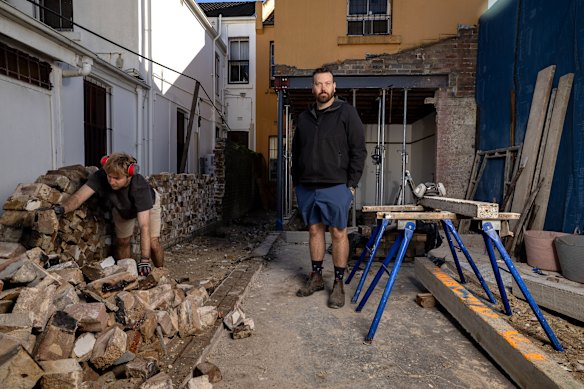
Architect Alexander Symes’ renovation of his family’s 120-year-old terrace in Sydney’s Camperdown has one rule: “Nothing leaves the site”.
To eliminate all waste, everything will be repurposed, from construction materials such as lime mortar, timber, glass, tiles, clay pipes and bricks, to even the takeaway coffee cups brought on-site, in what will be a warm and healthy home.
The exceptions include hazardous waste, like asbestos and lead, and materials with established recycling programs, such as cardboard, steel or concrete.
Symes realised how difficult it would be to achieve no waste when he was cleaning paint (which is notoriously difficult to recycle) from brushes.
“I was like, what are we going to do with this spoil? Now, it’s going in a bucket and it smells absolutely putrid. I have no idea what we’re going to do with it but we might mix it in … and have speckled concrete.”
Another challenge is the pink bathroom suite with matching grey, pink and white tiles. He is considering a Japanese-style kintsugi (“golden joinery”) repair job. Or it could be crushed for the terrazzo they plan to make from leftover materials.
Symes has built a range of award-winning passive housing and environmentally friendly homes. But this is a new frontier.
He and his wife Elizabeth bought the former boarding house after COVID. When they moved in they discovered it was cold and mouldy, and their two sons got sick.
Facing north across Camperdown Park’s fig trees, and next door to cafes, the home has Sydney’s best front yard, Symes said.
His goal is that his home will become an educational resource for neighbours: “We can show how they can use resources in a creative way that means we have less waste.”
The project is not about saving money but about establishing systems to more efficiently and economically use limited resources. Symes said his research would identify ways to save waste in projects in the future. “We have got all these materials that are coming into our building. If we don’t have an end-of-life solution then we’re not being very good stewards.”
For now, the home resembles a waste-sorting station. A small whiteboard controls the flow of materials – metals next to the shed, for example.
Pre-construction, the house became a laboratory for a year to measure internal temperature, relative humidity and mould levels that now inform the renovation.
The Green Building Council estimates that the average building project wasted 141 kilograms of material per square metre – about the size of a fully stocked fridge. This included expensive materials that were over-ordered, mishandled or discarded during installation, and showed that better planning could reduce waste.
Shahar Cohen, a co-founder of Second Edition, which specialises in using recycled materials and leftover construction waste, said Symes’ project was “very radical”.
Most projects like this were by owner builders who were “doing a full reno, making everything out of bits. They usually don’t use an architect.”
Reusing materials often required additional labour. When she bought some discontinued tiles on Gumtree for her own bathroom, she discovered many had defects. “While the tiles were basically free, we spent two days sorting them into the ‘yes’ pile, ‘no’ pile and ‘repairable’.”
Her practice tries to identify parts of a project that allow old materials to be repurposed, and find processes that can be replicated.
Builders and clients were usually willing to reuse timber and bricks, she said.
Some clients are willing to experiment for interesting bespoke highlights, such as the render made from crushed marble waste used at the award-winning project Love Shack.
“The salvaging of any materials takes more human effort than using a commercial material but the outcome is unique,” she said.
Symes said trying to recycle was more important than success. “To uncover something that is a potential long-term scalable reuse pathway, then the project has been a success, but if we hadn’t tried to do something innovative, then that’s not shifting the dial.”
Note to visitors: please bring a keep cup and leave your rubbish at home.
Start the day with a summary of the day’s most important and interesting stories, analysis and insights. Sign up for our Morning Edition newsletter.
 Julie Power is a senior reporter at The Sydney Morning Herald.Connect via X or email.


