
Source : the age
Manila: At least four people have died and more than 200 are injured after a magnitude 7.8 earthquake rocked the southern Philippines early on Monday, damaging buildings and a key access bridge in a large southern city and setting off a one-metre tsunami that washed ashore on nearby coasts.
President Ferdinand Marcos Jr urged people to go to higher ground in Philippine areas vulnerable to a tsunami, and Indonesian and Malaysian authorities also issued warnings to their nearby coastal areas.
The Pacific Tsunami Warning Centre said the threat of a tsunami had largely passed about five hours after the 7.37am (9.37am AEST) quake. But it still urged people to stay alert and to heed warnings from local authorities.
The strongest earthquake to hit the Philippines this year was centred at sea about 13 kilometres south-west of General Santos, a city of more than 700,000 people that is a hub for tuna processing and other commerce in the southern Mindanao region of the archipelago nation.
Marcos said disaster response agencies were on standby. “The national government is moving and we will not leave Mindanao behind,” he said.
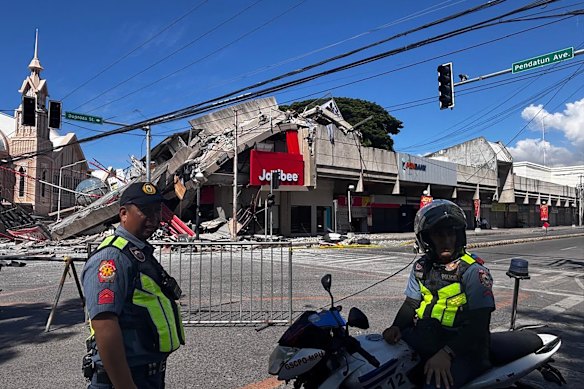
At least three people were killed and 130 others were injured in General Santos, where at least a few small buildings partially collapsed and several structures, including a key access bridge, sustained dangerous cracks, Rod Sosmeña, regional director of the Office of Civil Defence, said.
The Department of Health said another person died in Davao Oriental province due to the quake.
There were no immediate reports of people being trapped in partially collapsed structures in General Santos due to the quake, said Sosmeña, who was being driven to work when the ground violently shook.
“Our pick-up truck suddenly jerked and I thought we had a flat tyre,” Sosmeña told AP by telephone from General Santos. “People dashed out of houses into the streets.”
The international airport in General Santos was temporarily shut due to the earthquake and 17 domestic flights were cancelled, civil aviation officials said.
Ednar Dayanghirang, director of the Office of Civil Defence in a nearby southern region, said more than 100 students attending morning flag-raising ceremonies sustained bruises and some fainted in panic at different grade and high schools.
“I myself could hardly stand and keep my balance when the ground shook as I was leaving my house,” Dayanghirang told AP by telephone from southern Davao, a major port city in the southern Philippines.
DZRH radio station in Manila reported that a small commercial building housing its provincial branch partly collapsed and staffers dashed to the ground floor without injuries. It wasn’t clear if other people were trapped in the rubble of the four-storey office building. Debris also fell from other buildings, hitting tricycle taxis parked below.
The quake was caused by movement in the Cotabato Trench at a depth of 10 kilometres, according to the Philippine Institute of Volcanology and Seismology.
“It’s a major earthquake and we’re expecting damages. We’ve already some damaged buildings based on videos we’ve seen,” Bacolcol said.
Waves of one metre were monitored in the Philippine provinces of Sultan Kudarat and Sarangani by land-based tsunami watch stations, Bacolcol said. Smaller waves were monitored in at least one other province, he said.
Malaysia’s Meteorological Department issued a tsunami warning for Borneo island’s Sabah state, which is just a boat ride away from the southern Philippines. An 83-centimetre tsunami was measured by a gauge off Indonesia’s Sulawesi island.
The PTWC said smaller sea changes were possible in Papua New Guinea and in places in the western Pacific. There was no threat for Hawaii.
Aftershocks up to 6.5 magnitude were measured by the US Geological Survey. It reported the depth of the original quake at 55 kilometres. Variations in measurements by different agencies are common in the immediate aftermath of an earthquake.
The Philippines, one of the world’s most disaster-prone countries, is often hit by earthquakes and volcanic eruptions due to its location on the Pacific “Ring of Fire”, an arc of seismic faults around the ocean. The archipelago is also lashed by about 20 typhoons and tropical storms each year.