

Source : the age
The Australian sharemarket trod water on Tuesday as investors paused to assess the durability of the relief rally fuelled by the US-Iran deal to reopen the Strait of Hormuz, while parsing the Reserve Bank’s decision to keep interest rates on hold.
The S&P/ASX 200 inched up 3.7 points, or less than 0.1 per cent, to 8917.70 points, erasing losses from earlier in the day following Monday’s 1.3 per cent market rally. As widely expected, the RBA left the country’s official interest rate unchanged after three consecutive hikes, but warned there may be more rate rises to come. The Australian dollar dropped 0.3 per cent to US70.52¢.
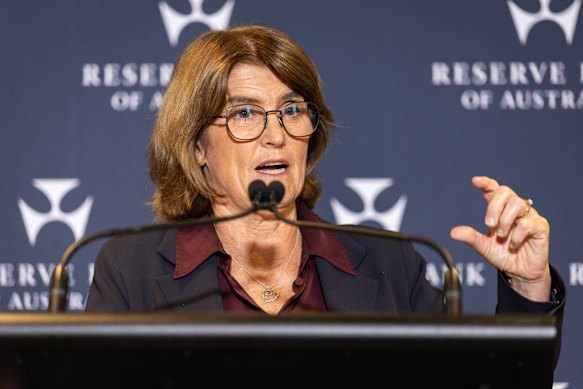
Speaking to reporters after the rate call, RBA governor Michele Bullock said the central bank would “not rule out further tightening in monetary policy, if that is what is required to bring inflation down”.
The RBA board found both underlying and headline inflation were still too high despite oil prices easing, house prices falling in some capital cities and consumer spending slowing. It also noted that “heightened uncertainties” remain about the outlook for the domestic economy and inflation, with global oil supply issues taking some time yet to resolve, maintaining upward pressure on global energy prices and inflation.
“Today’s decision reflects a central bank looking through a very cloudy outlook before deciding whether future meetings require more tightening, or simply more time,” said Stephen Smith, partner at Deloitte Access Economics.
Mining stocks were mixed after their bumper session on Monday, with BHP ending unchanged, Rio Tinto dropping 0.3 per cent and Fortescue falling 1.3 per cent as prices of copper and iron ore eased.
But gold producers continued their golden run, with the long-awaited peace deal raising hopes that the oil price shock will ease, lowering inflation and the pressure on central banks to raise interest rates. Higher rates are a headwind for precious metals, which don’t pay any interest to investors. Northern Star added 2.5 per cent and Evolution Mining added 1.2 per cent.
Interest-rate-sensitive consumer discretionary stocks declined, with Bunnings and Officeworks owner Wesfarmers finishing down 1.1 per cent and pokies maker Aristocrat losing 1.6 per cent.
Financial stocks edged up, with Commonwealth Bank inching up 0.1 per cent, while Westpac and National Australia Bank rose 1.2 per cent and ANZ Bank added 0.9 per cent.
Energy stocks advanced, even as oil headed for its longest losing streak this year amid hopes for a revival in supply, with leading Wall Street banks reducing their oil forecasts. Brent Crude fell below $US83 a barrel, dropping for a fourth day, while West Texas Intermediate was near $US80.
But there are mixed opinions as to how quickly supply can be restored after the opening of the Strait of Hormuz. Woodside Energy rose 2 per cent, with buyers wading back in after the stock’s slump on Monday. Santos rose 0.8 per cent, and local refiners Ampol and Viva Energy added 0.4 per cent and 1.4 per cent, respectively.
Technology stocks declined, with WiseTech slumping 4.2 per cent, Xero falling 1.7 per cent and Technology One down 2 per cent.
“Volatility may persist in the near term as markets assess the implementation and durability of the deal, but we maintain our view that resilient growth and robust earnings should continue to drive stocks higher,” said Ulrike Hoffmann-Burchardi at UBS Chief Investment Office.
On Wall Street overnight, the S&P 500 rose 1.7 per cent on hopes that this time, the announcement of an Iran-US agreement will mean a long-term fix to a conflict that has worsened inflation around the world. The Dow Jones climbed 468 points, or 0.9 per cent, to a fresh record, and the Nasdaq composite jumped 3.1 per cent.
Iran confirmed the peace deal, but it does not include a final agreement on issues like its nuclear program. Negotiations on that are expected to continue over the next 60 days, which leaves opportunity for hiccups that could derail the deal. And even if the Strait of Hormuz does fully reopen on Friday as expected, it will likely take months for the energy industry to get back to full speed.
For now, though, relief swept through the US market. Stocks of companies with big fuel bills were instant winners. United Airlines flew 3.9 per cent higher, and cruise operator Royal Caribbean Group rose 6.6 per cent.
Stocks of companies enmeshed in the artificial-intelligence industry also jumped. These stocks have yo-yoed in recent weeks, going from roaring to records to suddenly turning lower. The concern is whether such stocks shot too high, too fast because of AI mania, and their careening moves have sometimes reversed direction by the hour.
Micron Technology rallied 10.8 per cent, and Advanced Micro Devices rose 7 per cent. Nvidia’s climb of 3.5 per cent was the strongest force pushing the S&P 500 upward because the AI chip company is Wall Street’s most valuable company, giving it more weight on the index than any other.
SpaceX, Elon Musk’s rocket company that also owns the AI company xAI, rose 19.6 per cent in its second day of trading on Wall Street. Its successful trading debut on Friday suggested plenty of demand still exists among investors for AI. The market has given SpaceX a total value of more than $US2.5 trillion ($3.6 trillion), making it bigger than Exxon Mobil, Bank of America and Coca-Cola combined.
In the bond market, Treasury yields eased on hopes that lower oil prices will remove pressure on central banks to raise interest rates.
The yield on the 10-year Treasury slipped to 4.47 per cent from 4.48 per cent late on Friday.
The Fed will announce its latest decision on interest rates later this week, which will be the first under its new chair, Kevin Warsh. Traders see it as a near certainty that the Fed will leave its main interest rate steady after its two-day meeting ends on Wednesday.
Traders had been raising bets that the Fed may have to raise interest rates this year because of how much inflation has accelerated and how solid the US job market remains. But the tentative deal between the United States and Iran means traders are now betting on only a 57 per cent chance of a hike this year, down from 71 per cent a week ago, according to data from CME Group.
Elsewhere on Wall Street, Roku fell 1.9 per cent after the company announced that Lachlan Murdoch’s Fox Corp is buying the streaming pioneer in a cash-and-stock deal valued at approximately $US22 billion.