

Source : the age
Australia’s first case of the highly infectious H5 bird flu has been confirmed and experts and officials state outbreaks of the virus in wild populations are almost inevitable and native birds and mammals could be pushed to the brink of extinction, or beyond.
Agriculture Minister Julie Collins announced on Saturday that H5 infection had been confirmed in a dead Brown Skua found at Cape Le Grand National Park in southwest Western Australia. A Giant Petrel found nearby has also returned a positive result, with further verification tests underway.
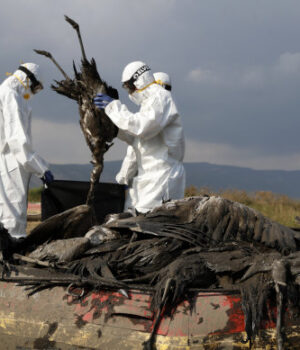
H5 virus is particularly virulent and deadly and has killed millions of birds around the world, including seabirds, penguins, waterfowl and birds of prey and almost wiped out entire colonies of some aquatic mammals, like seals.
“This will be concerning news for many Australians who, like me, have a strong connection to our wildlife,” said Collins, who has ministerial responsibility for biosecurity.
Only two birds have tested positive for H5, and no outbreak of the virus is evident in wildlife or farmed birds, but Chief Veterinary Officer Beth Cookson said infected birds would continue to come to Australia.
The two infected birds are from the sub-Antarctic and many species migrate to Australia from Europe and Asia in summer.
“If it doesn’t establish this time then it doesn’t mean that we won’t continue to see sick migratory birds turn up with this virus,” Cookson said.
Invasive Species Council chief executive Jack Gough said an outbreak of H5 “could be one of the greatest wildlife disasters Australia’s ever faced”.
“If this strain of bird flu takes hold in Australia, we can expect carnage when it comes to our birds and other wildlife populations,” Gough said.
“Look at the 95 per cent death rate of baby elephant seals in South America. When it got into Heard Island elephant seal pup colonies collapsed.”
Bird flu hit South America in 2022 and has killed more than 30,000 South American sea lions, 17,000 southern elephant seal pups and unknown numbers of porpoises, dolphins and otters, as well as at least 650,000 native birds.
“In bird populations there has been between 30 per cent and 70 per cent declines in their populations. There are horrific images of islands in England where there were huge aggregations of birds the previous year, and one after they look almost bare,” Gough said.
Dr Emma Grant of the La Trobe Institute for Molecular Science said the risk to human health is low.
“Globally, human infections with H5N1 are rare, and there is no evidence of human-to-human transmission,” Grant said.
It was considered inevitable that the virus would hit Australia, given migratory birds that journey to Australia had already brought bird flu to every continent, and most corners of the globe.
The federal government has been praised by environment groups for its efforts to prepare for the virus.
The Albanese government committed $113 million to preparations to deal with an H5 incursion, with an emphasis on teams to swiftly remove carcasses of infected animals to prevent further spread and stopping farmed poultry from mixing with wild birds.
There may also be potential to shield endangered species, for example by taking some of those most at risk into captivity to ensure species survival.
The virus has circulated in the northern hemisphere for several decades, but its impacts on Australian animals are unpredictable. Several families of birds and mammals that are unique to the country have never come into contact with H5.
“We can’t overstate how significant this moment is for Australian wildlife. This virus has devastated wildlife populations overseas,” said BirdLife Australia chief executive Kate Millar.
“This could be the beginning of a long fight to protect birds and wildlife in Australia.”
Black swans have been particularly susceptible in captivity in the northern hemisphere. They are not a threatened species but experts fear they are at risk of massive wild population losses under an outbreak.
The government has plans in place to prevent extinctions of susceptible animals like Tasmanian devils, which is a scavenger, and endangered birds like the orange bellied parrot, of which there are less than 100 in the wild.
Members of the public are encouraged to look for signs of bird flu in wild and domestic animals.
The government says people who see multiple sick or dead birds and other animals should not touch them, but instead record their location and call 1800 675 888.
In wild birds, signs of bird flu include sudden death, difficulty breathing, standing, walking or flying and an unusual posture.
In poultry, look for sudden death, reduction in egg production, lethargy, swollen head or limbs, bruising, and breathing issues.
In mammals, bird flu is indicated by sudden death, weakness and lethargy, difficulty breathing and walking, also drooling, seizures, tremors and walking in circles.
Cut through the noise of federal politics with news, views and expert analysis. Subscribers can sign up to our weekly Inside Politics newsletter.
 Mike Foley is the climate and energy correspondent for The Age and The Sydney Morning Herald.Connect via email.

