
Source : the age
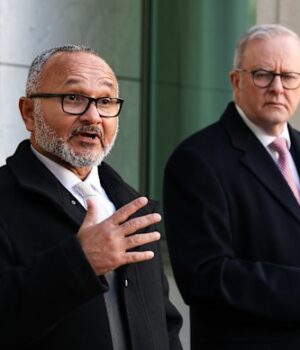
One of Solomon Islands’ most senior ministers has called for security and policing co-operation with China to be sidelined in a boost for Australia’s efforts to counter Beijing’s influence in the Pacific.
Prime Minister Anthony Albanese will conduct a Pacific diplomacy blitz in July, including a visit to the Solomons to drive forward negotiations on a new comprehensive treaty while finalising pacts with Fiji and Vanuatu.
Recently elected Solomons Prime Minister Matthew Wale vowed to review a controversial security agreement struck with China during a visit to Canberra this month and promised a “reset” in the relationship with Australia after years of tension and distrust.
Peter Kenilorea Junior, the minister of national planning and development coordination, said the new government was seeking a “a rebalancing of relations” with its development partners after the nation moved closer to China under previous governments.
Asked if he wanted to see a winding back of China’s role in policing and security in the Solomons, Kenilorea told this masthead that “we would like to focus more on economic development”.
He continued: “The security space, in my own personal opinion, is a little bit too crowded for a small country like the Solomons. So I would definitely emphasise the development aspect of China’s involvement.”
Chinese police have been fingerprinting Solomon Islanders and getting them to fill out household registration cards under a community policing model based on a Mao Zedong-era system requiring citizens to keep tabs on each other.
Kenilorea said last year he was concerned about the practice, describing it as an invasion of privacy.
Chinese police have also been offering martial arts and self-defence training to Solomon Islanders.
The Albanese government has insisted that Pacific nations’ security and policing co-operation should be limited to other island nations including Australia.
Kenilorea said he believed the Australia-Solomons relationship would be “very positive” under the new government as he urged the nations to strike a new treaty “sooner rather than later”.
“The reset or the rebalancing that we set out during prime minister Wale’s initial visit to Australia has been well received here in country,” he said.
“I think the next step that we’re looking forward to is announcing the comprehensive treaty…The end of the year would be good timing. The next six months are a good deadline for us to put pen to paper.”
Kenilorea, the son of the Solomon Islands’ first independent prime minister, said he expected the treaty to contain a deepening of security ties as well as expanded access for Solomon Islanders to live and work in Australia.
A new Australia-Solomons treaty would follow pacts Labor has struck with Tuvalu, Nauru and Papua New Guinea since returning to office in 2022.
Wale initially promised to release the 2022 security treaty with China, but said earlier this month he would not be able to make it public because of a non-disclosure clause in the pact.
“We have different partners that have different ways of doing things that perhaps not as transparent as other partners,” Kenilorea said.
Often described as a possible future prime minister, Kenilorea has been an outspoken critic of China, previously calling for the security pact to be torn up and blasting Beijing’s attempts to influence Solomon politicians.
Albanese is planning to travel next month to the Solomons and Fiji, where he hopes to seal a major new security pact with Fijian Prime Minister Sitiveni Rabuka.
The prime minister is also hoping to finalise a treaty agreement with Vanuatu, but it is expected that a clause limiting China’s involvement in critical infrastructure such as ports and airports will have to be removed to get the agreement over the line.
The Quad nations of Australia, the US, India and Japan agreed in May to jointly build a port in Fiji as part of their efforts to limit China’s influence in the Pacific.
Cut through the noise of federal politics with news, views and expert analysis. Subscribers can sign up to our weekly Inside Politics newsletter.
 Matthew Knott is the foreign affairs and national security correspondent for The Sydney Morning Herald and The Age.Connect via X, Facebook or email.