

Source : the age
As a clinical psychologist, Joanne Corrigan has been occasionally quoted in newspaper stories on such thorny topics as why men find it so difficult to cry and how to break up gracefully.
But after the death of her husband, the much-loved broadcaster, musician and author James Valentine, Corrigan suddenly found herself talking about more profound subjects.
Just a day after Valentine died in April, while many of us would have been barely able to speak with grief, Corrigan had the presence of mind to take a phone call from this reporter and warmly talk about his living wake, his decision to use Voluntary Assisted Dying (VAD) and his emotional final hours.
She revealed such touching details as Valentine being called on for one last performance: staying alert enough in pain to tell the VAD team he knew who they were. And that, surrounded by Corrigan and their two children – Ruby, 28, and Roy, 25 – he chose her side of the bed for “a very gentle end to the suffering” in their apartment in Sydney’s eastern suburbs.
He had the higher profile but she was clearly impressive, too.
Buoyed by the outpouring of love for Valentine on radio at a Sydney Town Hall memorial service, Corrigan said over lunch that she had been able to speak so freely because of the dignified way he died.
“We got to be with him and say goodbye,” she said. “It was the most perfect day. I dream to go back there. I long for that sense of intense love that we all had. It was exhilarating.”
Two months after that life-changing day, Corrigan admitted that – bizarrely and surprisingly – she was feeling good, though she noted there had been “anticipatory grieving” for two years.
“I totally understand that grief is an intense emotion that will go on for years,” she said. “I probably will fall into a hole but at this point it’s almost like James set us up that you don’t have to grieve in a particular way. You can still be joyful or laugh or celebrate things.”
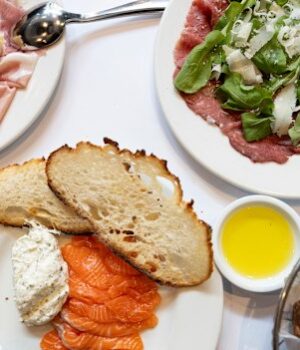
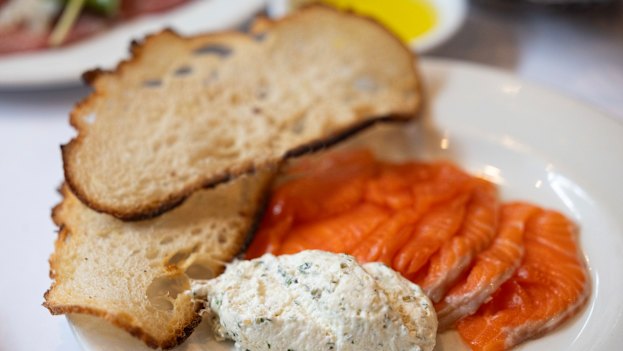
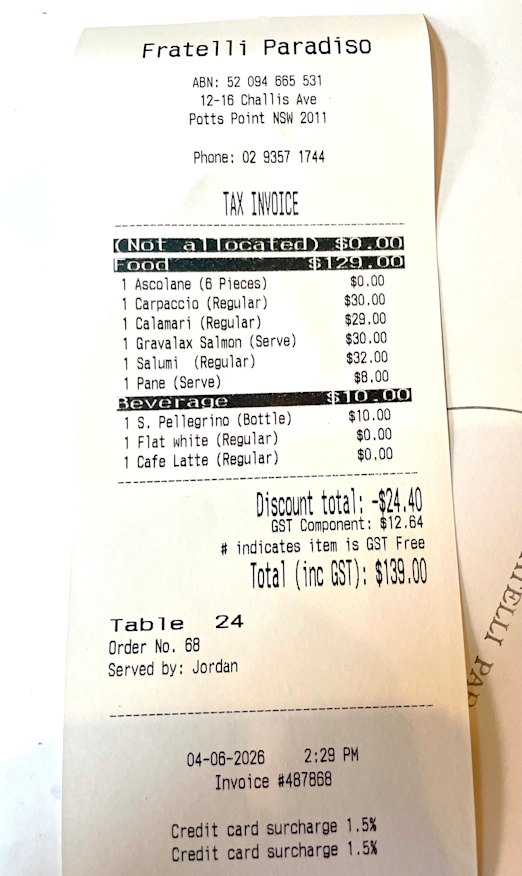
The spirited Corrigan has chosen one of the couple’s favourite restaurants, Fratelli Paradiso in Sydney’s Potts Point – the venue for one of Valentine’s last meals out. She is happy to choose some entrees to share: calamari Sant’Andrea, carpaccio di manzo, salmone al gravalax and salumi formaggio e gnocco fritto.
She gave up drinking when Valentine was down to his last months in February so we stick with sparkling mineral water. “If I’d been drinking alcohol through this process, and no doubt leant on it for a coping mechanism, that just would not have helped at all,” she said.
Having grown up in Dee Why on the northern beaches as one of five children – her father was pioneering sports medicine doctor Brian Corrigan and her mother, Monica, was “probably a very frustrated entrepreneur” – Corrigan met Valentine in 1985 in a way that could have come from a romcom.
At the time she was a music publicist whose previous boyfriend was Melbourne saxophone player Wilbur Wilde. James Packer had an 18th birthday party at Palm Beach and Valentine’s band, the Models, were playing. She went with a friend, Carla, who was going out with their keyboard player.
Sparks flew. “Clearly I was looking for a saxophonist from Melbourne,” Corrigan said. “Wilbur was fun but wild. James was delightful and calmer.”
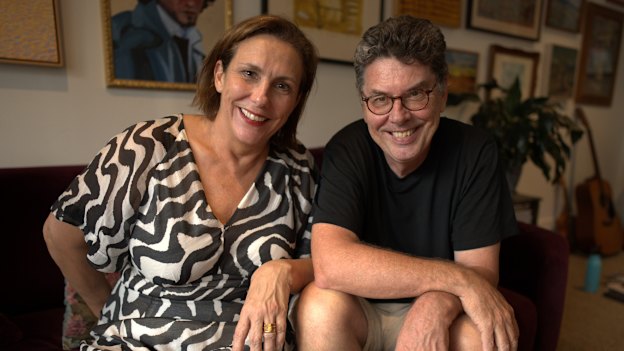
Before she left the party with her friends, Corrigan and Valentine arranged to meet later at a Kings Cross cafe. She waited there for two hours with her friends before giving up; at a time before mobile phones, he waited by himself for two hours before giving up in the cafe next door.
They realised their crossed wires when they ran into each other two weeks later. The first romantic night was when the Models played at Selina’s, in Coogee, on New Year’s Eve. They were married three years later.
“James had a very feminine energy,” Corrigan said. “He was very polite, he was very patient. He was just a charming kind of man – very thoughtful – and I have a lot of masculine energy, racing all over the place and quite irritable and demanding.
“He loved shopping and cooking and being the provider in the family, and I’d work hard and come in just like my dad used to, watch the 7 o’clock news and eat. There was an energy from both of us that, together, made a good pair.”
The food has started to arrive – the restaurant has thrown in some ascolane (crusted olives) for a favourite customer – and quickly proves to be as delicious as promised.
In her 30s, Corrigan decided, with Valentine’s encouragement, to become a therapist. “I went back to uni and did six years of study – two children, three universities – so it was a long, arduous road,” she said. “But by the time I got to my 40s I was a clinical psychologist [and] it’s the best job ever. I love my clients.”
Even after years of helping patients whose partner or a friend had died, Corrigan found many surprises around Valentine’s death.
One was how much a life-threatening illness brought out the best in people, whose many acts of love included bringing over food for the family. “I wish people reacted to mental illness in as enthusiastic and kind ways as you do if you say you’ve got cancer,” she said. “We’re frightened if someone’s at home with depression or feeling suicidal – no one’s going to come over – and that’s probably who needs it more.”
Another revelation was how supportive Valentine’s fellow musicians were. Jimmy Barnes and daughter Mahalia, Kate Ceberano and Paul Kelly all performed stunningly at the memorial service.
“I’m so surprised that I could ring up Jimmy Barnes and say, ‘could you come and sing?’, and he said, ‘yes’, and then Kate said, ‘sure’, and Paul said, ‘in a heartbeat’,” Corrigan said. “It didn’t occur to me that people necessarily would but it was great. Then Jimmy had me and the kids over for dinner last night. It’s just been delightful.”
Not so much a surprise as a joy was “watching all the peripheral stuff in life that doesn’t really matter drop away” as Valentine became sicker. What really mattered – really mattered – was his family.
“In the last six months it would be day by day,” Corrigan said. “A good day might be that he just contemplated the clouds going across the sky. It really slowed down. He was really unable to, in the end, get to the shops or go for a walk – slowly, slowly shedding [his] skin: can’t play saxophone, can’t go for a bushwalk.
“What he really wanted to do was go down and have an ocean swim, and he couldn’t do that. So that was a real test of temperament or personality.”
Another surprise was the outpouring of love for him. “James obviously had a very honest and connected relationship with his audience and he knew the reaction that they would have,” she said. “But then, in the last six months, he’d been out of action. He wasn’t on the radio any more. He was just so sick. He was just this little guy at home on the couch. We fell into a whole other rhythm and a whole other life.”
That made all the expressions of love after his death overwhelming.
While Corrigan said being a psychologist helped throughout Valentine’s illness, it was still awful learning that the oesophageal cancer had returned, had metastasised and was terminal. “I just went into shock,” she said. “You take a deep breath in and you just never let it out. You just get shock after shock after shock and your whole parasympathetic nervous system just never comes down again. It’s all that anticipatory grief.”
Her job became focusing on the timeline – questions like “How would they tell Valentine’s mother when they visited her in Ballarat?” and “What would they do over the holidays?” – while dealing with the emotions of the treatment and such day-to-day issues as how she could help him sleep, organising all the medication, running the household and making sure their kids were OK.
“Then, as well, just trying to be present with him,” Corrigan said. “The partner has to traverse all sorts of timelines. You’re a nervous wreck whereas he just went more and more calm and silent – ‘OK, I’m dying. What makes this a good day? I’ll have a cup of tea with my friend and I’ll really appreciate that.’ He had a very different experience of time and the illness.”
On why Valentine chose VAD, Corrigan said the decision came after watching the 2017 TV series Mary Kills People, about a Canadian emergency doctor who provides assisted dying, and reading Sogyal Rinpoche’s The Tibetan Book of Living and Dying.
“If you know you’re dying, why would it not be advantageous to gather people, say goodbye, and do it in a way that everyone’s there and there’s no panic?” she said. “If anyone gets pregnant we spend months running around, trying to work out how to have a good birth. So if we’re going to die, do you not want a good death as well?”
Even so, Corrigan was not sure she wanted Valentine to die in their bed at home.
“I have to live in the apartment by myself,” she said. “Will I be freaked out every time I walk past? So I was a bit dubious about that. And then it was like, maybe we could get a hospital bed and he could die in that one and we’ll pack it up and send it away.

“Then, of course, my worst fears came [true]. It was like, oh, you want to be in my spot on the bed? I can’t say no to that. But it doesn’t matter. I love – I love – that he chose that spot and that’s where he felt safe.”
Somehow the food has disappeared – very much secondary to listening to Corrigan, who, like a good therapist, asks many questions of her own – so we order coffees.
Corrigan has kept returning to the idea that she has a choice about grieving. She can just “completely freak out” thinking, “I’ll never see him again, I’ve lost my soulmate, I don’t want to be in the world alone” – thoughts that stir up mourning, panic and fear. Or she can acknowledge those feelings, then try to get up and do something more helpful and remember the positives.
“I have this feeling of how lucky I am to have had 40 years with James, who I didn’t realise was so dearly loved by everyone,” she said. “We had a great relationship. He had no regrets. He lived a great life. He was musical and creative and fun. We had two beautiful children and he loved them. What is there to be sad about?”
Read more great conversations over lunch
Jacqueline Maley explores loss with Bob Carr: Bob Carr on marriage, grief and finally learning how to do a load of laundry
Stephen Brook asks Michael Rowland about his future: In the space of 14 months, Michael Rowland upended his ABC life. There’s more upheaval to come
Margot Saville laughs with Kathy Lette: Kathy Lette on ageing fabulously … and giving cheek to the King
David Wenham bares his scars to Louise Rugendyke: David Wenham on cancer, getting older and being lusted after
Start the day with a summary of the day’s most important and interesting stories, analysis and insights. Sign up for our Morning Edition newsletter.