

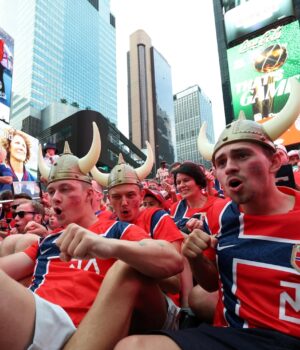
Source : ABC NEWS
Every four years, the FIFA World Cup becomes much more than a football tournament.
It turns into a global festival powered by millions of fans who come together to support their nations.
From Norway flaunting its Viking culture to Japan cleaning up the stadium, the event creates one of the most diverse gatherings in modern sports history.
As the crowd is divided into two teams, fans kick off with traditional rituals that begin long before the referee blows the whistle and long after the match has concluded.
There is truly nothing more wholesome or more patriotic than fans attending a World Cup.
Norway Viking row
What is the best way to invade New York’s Times Square?
A Viking row, of course.
The viral rowing trend has become the signature move of Norway’s football fanbase.
Loading Twitter content
For their team’s opening game against Iraq in Boston, fans rode the escalators from Boston’s South Station by rowing up them.
While it isn’t the kind of longship that once carved paths through the northern seas, it nevertheless invokes a national symbol that remains significant in Norwegian cultural identity.

Before Norway’s second match against Senegal, fans took over one of the best-known public spaces in Manhattan, the Red Glass Stairs, a popular set of steps overlooking Times Square.
Loading Twitter content
With one fellow banging a drum, others made a coordinated rowing motion after each beat while uttering a loud “Ro!”
This might be the World Cup’s most impressive tradition. Or one could call it an ‘oar-some’ scene?
Scotland traffic cones
Boston’s streets are teeming with monuments and landmarks that tell the story of US history.
But they have experienced something of a makeover since the World Cup started — Scotland fans have been decorating the statues with bright orange traffic cones.
Why, you may ask.
Well, the practice is familiar to anyone in Glasgow, where the Duke of Wellington statue at the Gallery of Modern Art has been wearing a cone since the 1980s.
The Tartan Army, which is the collective name for supporters of the Scotland national football team, have also adopted the traffic cone as their own form of headgear.
It has really become a bit of an icon.
Netherlands Oranje Fanwalk
Techno beats and chorusing chants pierce the air over the background buzz generated by a massive crowd.
When you see them, it is like witnessing the tail end of a sunset as it disappears behind the horizon.
Suddenly, everything is awash in a brilliant, bright orange as Dutch supporters join together in one of global football’s most famous spectacles.
Ahead of the Netherlands World Cup match against Sweden, thousands of Dutch fans took to the streets of Houston to take part in the Oranje Fanwalk, which includes a sort of side-to-side dance motion as one big crowd.
Loading…
It often becomes a part of the march to a stadium, which in this case was the 4-kilometre march to NRG Stadium.
The Netherlands’ Oranjegekte (orange craze) actually originated in the 1930s when people flooded the streets to celebrate the monarchy.
Now, it has become a collective expression of national unity during major international tournaments.
Japan clean-up
Most football fans are accustomed to walking over empty cups and half-eaten food when they leave stadiums after a match.
The same cannot be said for Japanese supporters.
They stay behind, well after the match has finished, to tidy up the venue, regardless of who won.
The practice, known in Japan as gomi hiroi, reflects an emphasis on taking responsibility for shared spaces.
The tradition became prominent when the men’s team made its World Cup debut in 1998.
Barbara Holthus, the deputy director of the German Institute for Japanese Studies in Tokyo, says cleanliness and cleaning up after oneself in public places is deeply ingrained in Japanese culture.
“If you grew up with a certain way of how things are being done, you apply that to even cleaning up a stadium afterwards,” she told the Associated Press.
“Japanese learn early on that you don’t want to inconvenience other people.”
Bosnia’s unofficial anthem
When Bosnian band Dubioza Kolektiv released ‘USA’ back in 2011, they never imagined their satirical song about leaving Bosnia for a better life in America would become their nation’s unofficial football anthem 15 years later.
The song, with its catchy chorus, “I am from Bosnia, take me to America”, has been updated with football-specific lyrics and become a viral hit online.
Bosnians have been heard singing the song loud and proud across the US and Canada, and supporters from other countries have even jumped on the bandwagon.
Loading…
“I’m Italian but I love this. You have my heart,” one social media user said.
“Best World Cup song 2026. Good luck from Germany,” another wrote.
A Balkan earworm at its finest.
DR Congo’s living statue
The Democratic Republic of Congo has a secret weapon at this year’s World Cup.
The nation’s football team do not just have the typical 26-man squad, but an extra key member: Michel Nkuka Mboladinga, better known as “Lumumba Vea”.
He is not your ordinary DR Congo fan.
Instead of displaying passionate support for his team in the form of cheering, Mboladinga will stand perfectly still for the entire match, arm raised in a significant pose.
His outfit is deliberate too. The whole image is an effort to resemble and honour the country’s first prime minister, Patrice Lumumba, who was assassinated in 1961.
The pose is similar to one held by Lumumba in a statue of him in the country’s capital, Kinshasa.
“He’s the one who gave us the freedom to express ourselves,” Mboladinga told the Associated Press of the Congolese leader.
“He sacrificed his life for us, to give us liberty. So he’s a hero for us, Lumumba is a spirit for us, he’s a model for us.”
The super-fan has been attending games as a living statue since 2013, but became famous more recently during the 2026 Africa Cup of Nations.
Mboladinga was not in attendance for DR Congo’s opening match due to a mandatory quarantine because of the Ebola outbreak.