

Source : the age
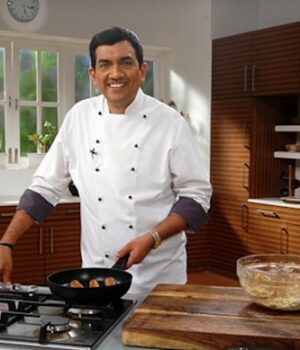
There isn’t a person in India who doesn’t know the name Sanjeev Kapoor. He’s a celebrity chef, broadcaster, writer, entrepreneur and global cooking and food superstar. He has written more than 200 cookbooks, boasts 20 million followers online and hosted the longest-running TV cooking show in Asia (Khana Khazana) for 19 years.
Kapoor also launched India’s first 24-hour Hindi-language cooking channel, FoodFood, now viewed by millions of people; was a primary judge on MasterChef India for two seasons; and, in 2017, he was awarded the Padma Shri, the fourth-highest civilian award of the Republic of India, for his outstanding contributions to the field of culinary arts.
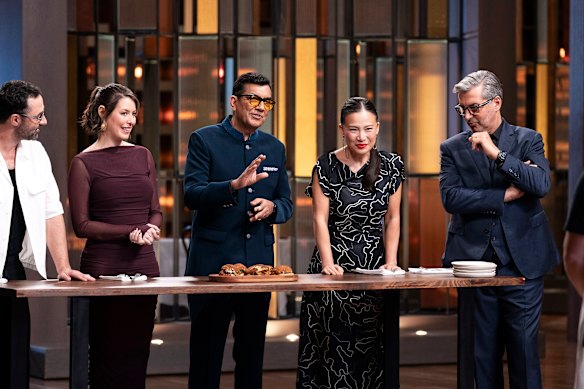
Next Sunday, however, some Australians may meet him for the first time as a guest judge on MasterChef Australia. Lenny Ann Low spoke to him ahead of his local debut about the competitive cooking show’s importance in India, his favourite Australian ingredients and what a star chef chooses for breakfast when he’s at home.
Hello Chef Kapoor, what is happening in Mumbai this morning?
We’ve been waiting for monsoon rains and it’s been delayed. Typically, in the first week of June, the rain in Mumbai starts. There’s been a bit of anxiety because India depends on monsoon rains. But this morning, when I woke up, I heard the sound. The first day of rain. A short spell but I went out and the roads are wet and everything is looking more green, so it’s good.
Are you often at home in Mumbai or are you travelling around the world a lot?
Normally [I’m travelling], yes. When people ask me, “Where are you?” I say, “Today I am in here.” So today I am in Mumbai.
What does the renowned Chef Kapoor prepare for breakfast at home?
I have this fresh mango [he shows segments of brilliantly orange fruit] and – you may not have seen this fruit [he holds up something that looks like a large dark shiny olive]. It’s called jamun. It’s so delicious. It’s kind of a berry. It has a large seed and it makes your whole mouth purple. It’s not just the flesh – the seed is good for diabetics.
You’re known as a pioneer in changing the stigma of men cooking in domestic kitchens in India. How did that happen?
Back when I got into it, this profession was looked down upon. It was something that you would say, “Oh, you are a chef, so it’s difficult for you to get married if you were to wish it.” Men in the kitchen was a definite no-no. It was not a place that men can be seen. I was educated, I was working hard [as executive chef at the Centaur Hotel in Mumbai], luck was on my side. I was awarded the Best Chef of India award. That actually changed everything.
How did that change things?
In my mind it changed everything because it bothered me that, if I had achieved this so early – I was not even 28 at the time – what am I going to do for the rest of my life? At the time [the 1990s] there were no freestanding restaurants. It was largely large hotels, I was an executive chef at a large hotel, and then I had more hotels under me. That’s when I said, “No, I have to do something more.”
How did you do that?
I studied more. I joined a course, masters in marketing management, while I was working as a chef. Then I was on a TV cooking show for one episode but I immersed myself into it. I gave much more than any other chef because, to me, it was something that was different. I converted that one episode to 19 years of non-stop TV [on Khana Khazana]. It became No.1. In some sense, what Julia Child did in the US with food and TV, I did that in India. And through that I realised men were no longer seen as not being in the kitchen. And women started to get independence in some sense. My dad said, early on, “Your contribution is not just teaching them how to cook, it’s a real emancipation of women.” It was in some sense a social change that happened.
Tell me about the popularity of MasterChef Australia in India. It’s as loved as MasterChef India, is that right?
Yes. There are two TV markets in India. One which watches MasterChef India. There are more than four or five MasterChefs in India, in different languages. And then MasterChef Australia, of course, is in Australian English, so the viewership is very different. It is very popular.
What was it like joining MasterChef Australia as a guest judge?
It was fantastic. I know this world [TV cooking shows] very well and I think MasterChef Australia, in terms of competitive cooking on-screen, is the epitome of how it’s done. It’s the first one that cracked the code of being competitive yet very loveable. It’s the camaraderie that you see. It brings everyone together in a world where everyone is trying to break the world.
What is the power of a cooking show, competitive or not?
The beauty of a show like MasterChef Australia is that it’s changed the verbalisation of food. Not just the nation but the entire world. Shows like this have made this possible. The words that they use in the show is something that you start to taste.
When you travel to Australia, what are the ingredients you love?
I’ve been coming to Australia for a long time. I’ve been, as Tourism Australia call it, a “friend of Australia”. I’m in touch with chefs there and, actually, one of our most successful series on TV, the Out of the World series, included Out of the World: Australia. So I have travelled extensively there.
Ingredient-wise, I would say banya seeds [which are] very different. But something I think should be made mainstream is a finger lime. You can use it on anything. Those small pearls, they’re so good.
Why do you love them?
People ask me, “What is the taste of India?” l’ll tell you the answer in Hindi: khatta, meetha, teekha and namkeen. Four tastes. That’s sour, sweet, pungent or spicy hot, and salty. And what do I start with? I say sour, khatta, first. Finger lime sits right at the top. That fruity acidity is a very unique thing. What it does, while other flavours are playing on your palate, it starts to clean everything. It’s a cleanser. So it’s tasting, it’s cleaning, it’s tasting. It is enhancing the taste of everything else. You don’t need it to be harsh.
A tangerine or orange is nice but it’s too sweet. A lemon or a lime is too tart. A finger lime – it is tart, not sweet. It is very fresh. Sometimes it can be pink and the pearls look like small, shiny, pink caviar. It is really like nothing else.
MasterChef Australia is on Sundays at 7pm and Monday to Wednesday at 7.30pm on Ten and 10 play. Sanjeev Kapoor is a guest judge on Sunday, July 5.