

Source : the age
For a murder mystery with its beginnings in the red dirt of Broken Hill, you would think The Killings at Parrish Station had its origins in similar real-life scenario. After all, there’s plenty of open space out there in which to hide a body or three.
Instead, the drama’s origins come from somewhere quite different: a frozen Russian mountain and a baffling cold case in which nine experienced hikers mysteriously died in the Ural Mountains in 1959. Was it an avalanche? Misadventure? Or something more sinister? UFOs, missile testing or a government cover-up?
Fast-forward 60 years or so and comedy writer Ben Jenkins is sitting at home in Sydney – during the depths of COVID-19 – digger deeper and deeper into the rabbit holes of the internet when he stumbles across the case known as the Dyatlov Pass incident.
“It’s just a really creepy horrible story,” says Jenkins. “But basically a big search party was launched from them. They found their bodies in really bizarre and kind of inexplicable circumstances. The tent that they were staying in had been cut open, but from the inside, as if somebody was fleeing in terror.
“One of the bodies had injuries that were so traumatic in terms of impact, that it was in line with, like, a car accident. And then there were mutilations and all that sort of stuff.”
But what really interested him was the reaction of his Russian mother-in-law when he told her the story.
“My mother-in-law was like, ‘Dyatlov? But why are you talking about Dyatlov Pass?’” recalls Jenkins. “And she knew all about it, and she’d grown up with this story, and she was telling me how as she got older in the USSR, the story just kept coming back.
“There were like parliamentary hearings, and every now and again, a journalist would go digging, and careers were made or ruined on the back of this thing that happened so long ago. And that was really the seed for this. It was like, ‘How do you tell a story about something that refuses to go away?’”
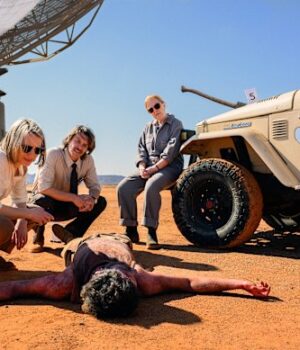
And so begins The Killings at Parrish Station – not with the deaths of Russian hikers, but with four scientists found murdered in 1987 at an outback research station. The only survivor is delirious and keeps muttering cryptic phrases. Also taking an interest in the deaths is the son of a wealthy mining family, whose uranium mine seems to have links to the station’s radio telescope and a 15th century book called The Bone Gospel.
It’s cosmic and creepy and really gives the crime genre a decent nudge in a very different direction.
“Audiences aren’t stupid,” says Jenkins, who has worked on The Chaser’s election specials and the ABC’s consumer affairs series The Checkout. “And even if they don’t articulate this stuff out loud, they know the shape of a crime realm. They know, ‘OK, we’ve gone from A to B, now we’ve got to go to see [this bit]’, and there’s a point at which that stops becoming comfortable and starts just becoming annoying.
“One of the joys of making this show was we were operating in a really established genre space, in terms of crime investigation, and we were able to use that comfort to surprise people in a way because you use that expectation, you go, ‘No, no, we’re not doing that, you are not watching the show you thought you were watching.’”
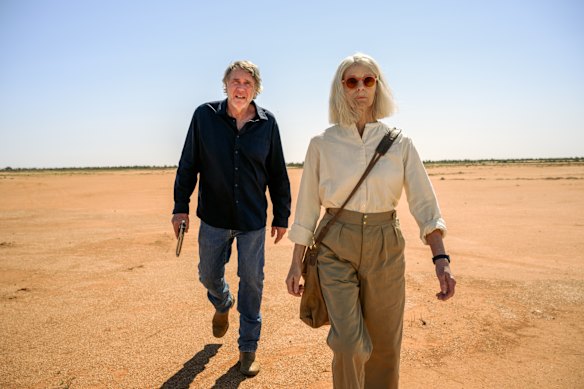
Investigating the case is Detective Georgie Cooke and her partner, Michael Thorne. City detectives, they arrive in Broken Hill hot and out of sorts, collars stuck to sweaty necks and confronted with a grisly crime scene. We meet them across two timelines – in 1987, played by Mia Wasikowska and Xavier Samuels – and then in the present, played by Heather Mitchell and Robert Taylor, which is when a copycat killer appears to surface.
“She’s a detective who’s battling her own traumas from the job,” says Wasikowska of her character, Georgia. “And then also from her own life, and so she’s coming into this case with her own baggage.”
The show marks Wasikowska’s first TV role in 18 years after she got her start as a teenager in the splashy HBO drama In Treatment and then followed that with films, such as the indie hit The Kids Are All Right and Tim Burton’s kaleidoscopic live-action version of Alice in Wonderland.
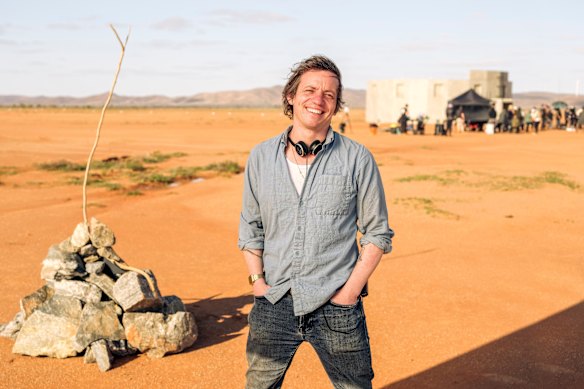
The Killings at Parrish Station is a homecoming for her in more ways than one, as it meant she was able to live and film in the same city for the first time in years.
“As you get older, the idea of going to a film set for two months and being completely removed from your own life here is sort of less appealing,” Wasikowska, 36, says. “So it’s nice to be seeing same people again and working with people again, and the crew as well. Those are the things that I’m interested in, that’s a really nice feeling.”
Parrish Station also marked another screen milestone for Wasikowska: her first time playing a detective.
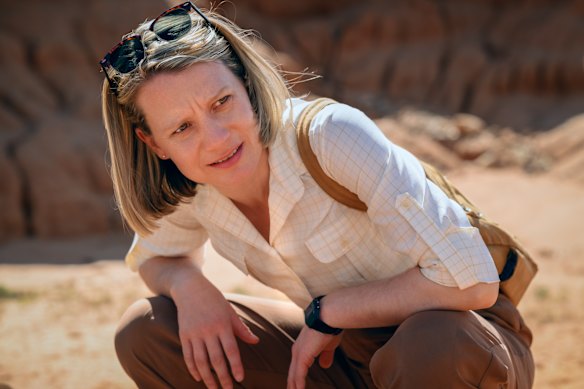
“I was like, as long as I can put my sunglasses on my head and have a cigarette moment, then I’ll be happy,” she says, laughing. “As long as you can crouch down next to a body with a dictaphone, then I feel like I’ve like ticked off some detective moves.”
And the gory stuff? Parrish Station is filled with bodies in several states of disrepair. “It’s … very effectively disturbing,” she confirms.
Keeping it the appropriate level of disturbing was something Jenkins was keen to do. He didn’t want the murders at the centre of the story treated as pure entertainment, which is why the present-day storyline includes a pointed poke at true-crime podcasts.
“There’s something about treating murder in a very twee way,” says Jenkins. “It’s treating the worst thing that ever happened to people as entertainment, and that was a big starting point for me in this story.
“These true crime podcasters, [in the show are a] case in point. I want to show there is this dreadful traumatic thing that happens, and you’re at the centre of it, and you think, ‘I’ve got to muddle through this, and I’ve got to work out how to keep living after this’, but what you don’t control is 20 years later, people are selling tote bags off the back of it, and turn it into this like fun, almost fictionalised puzzle box.”
Jenkins’ background is in writing sketch comedy for stage and screen. And while that is not an obvious pathway to drama, Jenkins says comedy is what sharpened his drama instincts. After all, it worked for Katie Dippold, a comedy writer who worked on Parks and Recreation before creating the hit show Widow’s Bay, and for Zach Cregger, who wrote and directed the horror films Barbarian and Weapons after getting his start in a sketch comedy troupe.
“You write so much and so much gets thrown away,” says Jenkins. “And you just get really good at living with that. Sketch teaches you to be really economical, because every line has to do about six different things. It also teaches you, I think, a very healthy terror of boring people, especially if you’ve done live sketch. I did that for years, and I think every writer would benefit from doing that.
“Because there is a moment when you’re doing a show, and you know it’s not going very well, and you can see the audience, and you can see somebody in the audience, and their face unmistakably says, ‘I can’t believe we hired a babysitter for this’ and it gives you so much respect for people’s time.”
The Killings at Parrish Station is streaming on Stan (which is owned by Nine, the publisher of this masthead).