

SOURCE :- THE AGE NEWS
Ypsilanti, Michigan: Abdul El-Sayed takes the microphone, and the 100-or-so-strong crowd rises to their feet in applause. He leads them in a call-and-response of his election slogans. “Money out of …?” he yells. “Politics,” they respond. “Money in your …? Pocket. Medicare for …? All.”
It is not a glamorous setting. We are in a basement at the Michigan Firehouse Museum in Ypsilanti, a small city between Detroit and Ann Arbor. Surrounding us is a collection of old-school firefighting vehicles and a 1913 Ford Model T repainted to look like one.
These are the unassuming rooms in which future leaders are made. In El-Sayed’s case, possibly an important leader. A doctor, unionist and Muslim, he is vying to become the Democratic candidate for the US Senate here in Michigan, a swing state that will decide the outcome of the midterms.
And he is at the forefront of a broader contest between the Democratic establishment and a new wave of progressives – some of whom are card-carrying members of the Democratic Socialists of America – challenging the party’s policy positions, identity and brand.
It has worked in deep-blue New York City with 34-year-old Zohran Mamdani. But could it work in Michigan? Could it work elsewhere in America?
On Tuesday, Democrats will pick their candidate. El-Sayed is up against Haley Stevens, a four-term congresswoman and moderate Democrat, who flipped a Republican-held seat in 2018. The retiring senator they hope to replace in November, Gary Peters, is also a Democrat.
The stakes are high and cut to the heart of the Democratic Party’s strategy. “Democrats are much less likely to win this Senate seat if El-Sayed’s the nominee,” says Adrian Hemond, chief executive of Grassroots Midwest, a bipartisan public relations consultancy.
“Because Abdul’s a much more ideological candidate and is running much further left, it’s going to be harder for him to pivot back to the centre and get the independent voters that you need to be elected in Michigan.”
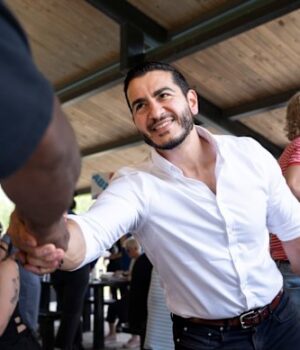
The first thing you notice about El-Sayed is that he is good-looking and built (he says he only lifts twice a week, which I find hard to fathom). He wears a crisp white shirt that hugs his large biceps and fitted suit pants that are tight around his thighs. He is 41 – an elder millennial. In other words, he is a little like a Midwestern Mamdani.
The son of Egyptian immigrants, El-Sayed played lacrosse at the massive University of Michigan in Ann Arbor, delivered the commencement speech at his graduation and completed a doctorate in public health at Oxford on a Rhodes scholarship. He then got his medical degree from Columbia University in New York.
But he has never received a medical licence and has been criticised by his opponents for calling himself a physician. Rather, he spent his career as a health officer and executive director in the Detroit Health Department.
El-Sayed puts “Medicare for all” at the centre of his policy platform. It sounds reasonable to an Australian ear, but are Americans in a purple state ready for socialised medicine? “They love it,” he tells this masthead after the Ypsilanti rally. “They’ve just been told that they should hate it.”
“Sixty per cent of all the healthcare in this country is publicly funded. We just do it in the most oblong way possible. We wait until you’re old enough or poor enough to give you the healthcare that you should have had the whole time.”
El-Sayed is not a DSA member, saying he supports regulated capitalism. But he has attended its events in the past, and it is campaigning for him. He is backed by the progressive movement’s big names: Vermont senator Bernie Sanders and Democratic congresswoman Alexandria Ocasio-Cortez. And their platforms are strikingly similar.
“His policy platform is socialist,” says Hemond emphatically. “[But] a DSA-branded candidate is dead on arrival in a general election in Michigan.”
One policy they share is a proposal to end US military aid to Israel. El-Sayed frames it as a savings measure, arguing Michiganders’ money should be spent on schools, hospitals and roads at home. “We should not be funding genocide and apartheid with our tax dollars,” he tells the rally. It earns the loudest applause of his 15-minute speech.
Later, I ask him whether he would also cut US military aid to Ukraine. No, he says – because aid to Ukraine comes with conditions.
“We are supporting the Ukrainian military under the condition that their neighbour has violated their territorial sovereignty,” El-Sayed argues. “I support the effort to uphold international law by empowering them to fight back. That’s different from the money that we give to Israel, or to Egypt, where my family came from.”
He pointedly adds: “I always talk about [how] I want to withhold unconditional foreign military aid to Egypt, and nobody ever calls me anti-Egyptian.”
Proportionally, Michigan is home to the largest Arab population of any US state, though it is only 2.15 per cent. Trump won the Muslim stronghold of Dearborn in 2024 and carried Michigan, amid a backlash to Joe Biden and Kamala Harris’ handling of the conflict in Gaza.
Israel and the pro-Israel lobby are big issues in this race, as they can be in elections nationally. No Democratic primary has ever had more outside money thrown into it: $US60 million ($85 million) and counting.
The vast majority has gone to Stevens, and at least half of it has come from the United Democracy Project, a super PAC – or political action committee – backed by the American Israel Public Affairs Committee (AIPAC), which aims to elect pro-Israel candidates around the country.
AIPAC and its money are toxic on the American left. El-Sayed raises the subject regularly, arguing centrist Democrats and Republicans are “bought off” by the lobby group, along with Big Tech, Big Pharma and the scandal-ridden Detroit energy company DTE.
El Sayed’s fundraising is more grassroots, though his backers include the super PAC Fighting for Michigan, which has spent about $US3 million and counts his father-in-law, nephrologist Jukaku Tayeb, among its largest donors. He is also supported by the large United Auto Workers union, headquartered in Detroit.
In American elections, PACs cannot legally co-ordinate with the official campaigns. “The race is awash in money, but relatively little of it is being spent by the candidates,” says Hemond.
Many Americans on the left are simply fed up with the omnipresence of private money in their elections. It’s what motivated Holli Andrews to place El-Sayed’s posters on the window of her Ypsilanti pet store, as well as his healthcare policy and commitment to aiding small businesses.
“Nobody should be making money out of the process of democracy,” she tells me after calling a hula-hoop contest at a vintage car fair. “Especially those who just can’t seem to get enough.”
Andrews is a classic progressive Democrat: grew up in New England, tertiary-educated, former community planner who helped revive downtrodden CBDs. She is optimistic about El-Sayed’s chances but savvy enough to realise he could lose to the Republican, Mike Rogers.
“That is a dangerous and scary thought,” Andrews says. “That is a consequence that I personally can’t live with … I was just listening to a really great podcast on The Atlantic – they were saying there is no crystal ball. We can look at polls, but we don’t know.”
The polls are inconsistent, but one released on Thursday by Emerson College had El-Sayed ahead of Stevens by 54 points to 39. According to RealClearPolitics, he has an average 10-point lead.
Hemond feels the contest is quite close, with Stevens comfortably winning black Americans and seniors. “Those are two of the most reliable voting blocs in a statewide Democratic primary in Michigan.”
Meanwhile, El-Sayed needs younger voters to show up. “It’s pretty close to an iron law of American politics that people don’t start voting until they get to be about my age, about 50,” Hemond says.
For the Democratic Party, the broader political effects could be significant either way. If Stevens wins the primary, it will indicate there is a limit to the appeal of progressive candidates, at least outside blue cities.
Progressives will be thrilled with an El-Sayed win on Tuesday, but they will then sweat on the November 3 general election. It should be an easy Democratic win: despite being a purple state, Michigan has sent only two Republicans to the US Senate since 1960. And with Trump deeply unpopular, Democrats are widely expected to see swings towards them at these midterms.
“If El-Sayed loses in that environment, it does almost insurmountable brand damage to progressives and their ability to argue that they’re electable outside the most left-wing enclaves in America,” says Hemond.
There is also the matter of fellow Democrats further down the ballot. Several Michigan seats are competitive and arguably vital for Democrats to win if they are going to take control of the House of Representatives and quell Trump’s power.
Hemond submits Tom Barrett in the 7th district and Bill Huizenga in the 4th as two Republican incumbents who will hold their seats if Abdul El-Sayed is on the ballot as the Democrats’ Senate candidate. “You can set your watch by it.”
Get a note directly from our foreign correspondents on what’s making headlines around the world. Sign up for our weekly What in the World newsletter.
 Michael Koziol is the North America correspondent for The Age and Sydney Morning Herald. He is a former Sydney editor, Sun-Herald deputy editor and a federal political reporter in Canberra.Connect via X or email.