

SOURCE :- THE AGE NEWS
London: Spain will install a new barrier to keep migrants from Morocco out of its enclave of Ceuta after more than 50,000 people stormed into the territory, as European leaders call an urgent meeting to toughen border rules.
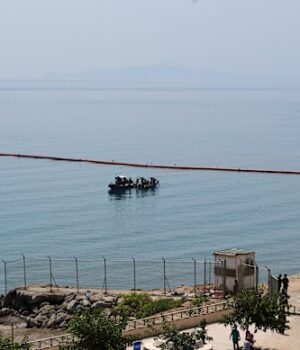
The floating containment barrier will stretch for 500 metres along the sea border at the North African enclave in a move to prevent a future crisis after almost all the recent arrivals walked back to Morocco.
In the worst event of its kind in decades of tension at the border, 67 people died when thousands of young people swam, walked around the rocks or charged through the border checkpoints to get from Morocco into Ceuta.
The Spanish government said many of the deaths occurred in the water, while some people died in a stampede as the crowd rushed across the border.
Spanish Prime Minister Pedro Sánchez has blamed people smugglers and misinformation on social media for encouraging the sudden rush, while rebuking fellow European leaders who called on him to take tougher action against asylum seekers.
“The European Union cannot afford this kind of selfish, polarising and unlawful reaction,” Sánchez said of the complaints about the Spanish border controls.
His remarks, in a letter on Saturday, followed extraordinary pressure from 22 leaders who joined forces to call for an emergency EU meeting of interior ministers on migration.
The decision to issue the letter was led by Italian Prime Minister Giorgia Meloni, a conservative, and Danish Prime Minister Mette Frederiksen, a social democrat, and highlighted the concern about border security across the political spectrum.
“We cannot allow uncontrolled mass crossings,” they wrote. They urged action to stop the perception that illegal entry into the EU was possible and that a migrant’s illegal entry could turn into a legal right to stay.
“The events of the last days require an immediate and coordinated European response.
“We welcome that Spain and Morocco are cooperating closely to ensure the swift return of migrants that entered illegally and that a large number of them have already been returned.”
They also said they were willing to take “any necessary measures” to safeguard public order, including temporary internal border controls – raising the prospect of checkpoints along borders with Spain.
The letter was signed by the leaders of Italy, Denmark, Austria, Belgium, Bulgaria, Cyprus, Croatia, Czechia, Estonia, Finland, Germany, Greece, Hungary, Latvia, Lithuania, Malta, the Netherlands, Poland, Romania, Slovenia, Slovakia and Sweden.
The mayor-president of Ceuta, Juan Jesus Vivas, estimated that 60,000 people had rushed over the border. The Spanish government put the number at 50,000 and said 48,300 had returned to Morocco by the end of Friday (early on Saturday, AEST).
“The situation has been almost entirely reversed,” Spanish Interior Minister Fernando Grande-Marlaska told reporters in Ceuta on Saturday.
Videos aired by Spanish media showed police escorting thousands of would-be migrants, most of them young men, back to Morocco. The videos also showed government boats taking a floating barrier out to sea to try to stop more people from trying to swim to the Spanish enclave.
Ceuta has been Spanish territory since 1580 but is surrounded by Morocco, leading to years of friction, including a flood of 10,000 migrants across the border in 2021. Migrants have also seen the nearby Spanish enclave of Melilla as a place where they can seek a transfer to mainland Spain, 25km across the Mediterranean.
Reporters from Spanish newspaper El País described young people wandering barefoot around Ceuta with garbage everywhere and stores closed, as local residents stayed indoors during the sudden influx.
“We’re leaving because there’s no food, they won’t sell us milk for our daughter,” one migrant told the newspaper. Others told reporters that police were herding thousands back across the border.
Spanish newspaper El Mundo reported on Saturday afternoon (early on Sunday, AEST) that some migrants remained in Ceuta, some hiding from police in residential areas, and that local residents were organising patrols to watch over their streets.
The influx from Morocco was so great that claims spread on social media that the Moroccan government had encouraged the crowd in order to put pressure on Spain, with some videos showing Moroccan police choosing not to intervene when some rushed the border.
The Telegraph of London reported that Morocco facilitated the crisis to serve as “punishment” because of diplomatic frustrations with Spain, citing unnamed sources at a Western intelligence service from a country it did not name.
One factor appeared to be social media coverage of a Spanish court ruling that eased the rules on migrants who arrived in Ceuta, spreading claims online that swimming to the enclave would entitle someone to a transfer to the Spanish mainland and the European Union.
The Spanish interior minister sought to rebut the claims that Morocco was to blame.
“The events require an evaluation by Spain and Morocco,” he said.
“Morocco is not a threat to Ceuta, or to the rest of Spain. It is a reliable partner.”
Get a note directly from our foreign correspondents on what’s making headlines around the world. Sign up for our weekly What in the World newsletter.
 David Crowe is Europe correspondent for The Sydney Morning Herald and The Age.Connect via X or email.