

Source : the age
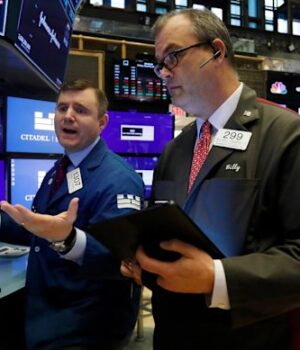
The Australian sharemarket jumped close to a record high on Tuesday, buoyed by a strong session on Wall Street, where US stocks soared to the edge of an all-time high after easing oil prices helped to calm investors’ worries over inflation.
The S&P/ASX 200 finished up 126.50 points, or 1.4 per cent, at 9145.80, not far from its 9200.90 high point in March, with tech stocks and banks powering the gains. The local bourse added 0.5 per cent on Monday after US President Donald Trump said at the weekend that he was holding off on new strikes against Iran at the urging of allies in the region. The Australian dollar rose 0.2 per cent to US70.17¢.
Tech stocks soared after America’s tech megacaps posted their best day since March overnight, with Amazon becoming only the fifth company to top a $US3 trillion ($4.3 trillion) market-cap threshold, having gained 4.6 per cent. Data analytics software giant Palantir Technologies soared 15 per cent in after-hours trading after raising its sales and income forecasts.
The bullish sentiment swapped over to the local tech sector, with WiseTech Global up 3.1 per cent, Xero climbing 3.5 per cent and Technology One up 3.4 per cent. Family tracking app Life 360 rallied 11.4 per cent while network provider Megaport jumped 5.7 per cent. AI data centre operator NextDC climbed 4.2 per cent.
Financial stocks, which make up more than a third of the ASX, also helped to drive the market higher, with all big four banks posting strong gains. CBA was up 1.6 per cent, Westpac gained 1.7 per cent, National Australia Bank climbed 3 per cent and ANZ Bank gained 2.4 per cent.
Materials companies – the other local heavyweights – struggled in the morning as the price of iron ore, Australia’s biggest export, sank to the lowest level in more than a year with concerns surfacing over a major physical trader of the commodity Radiant World, compounding existing market softness linked to a challenging demand outlook.
Global commodities traders Vitol and Cargill have stopped doing business with Radiant World, a privately held company, amid concerns over fake invoices, Bloomberg News reported.
However, by session close the sector was swept up in the bullish market sentiment and closed firmly in the green. Rio Tinto gained 1.7 per cent and Fortescue Metals rose 1.6 per cent, but BHP, the largest miner, slipped 0.3 per cent on concerns over looming strikes at its Port Hedland operations in Western Australia.
Gold miners also finished higher. Chinese institutional investors have swooped on bullion in recent weeks, helping to arrest the precious metal’s decline and keep prices above the key threshold of $US4000 an ounce. Northern Star shares rose 2.1 per cent, Evolution Mining gained 1.8 per cent and Newmont rose 2.1 per cent. Meanwhile, Lynas Rare Earths rallied 6.6 per cent.
Real estate investment trusts were also strongly up, with Goodman Group closing 1.1 per cent higher, Westfield shopping centres landlord Scentre up 1.5 per cent and Vicinity gaining 2.3 per cent. In the healthcare sector, biotech giant CSL jumped 3.6 per cent and sleep apnoea devices maker ResMed added 1.5 per cent.
The energy sector rebounded to close 0.7 per cent higher as oil rose after its biggest drop in a week, with Trump saying his latest offer of talks is Tehran’s “last chance” and he expects a full reopening of the Strait of Hormuz. Brent crude traded near $US85 a barrel, after losing almost 5 per cent in the previous session.
“We’re talking about the strait, the opening of the strait, having it open literally by tomorrow,” Trump told reporters in the Oval Office on Monday. “This is a last chance for them to sign a good document,” he said, without clarifying what negotiations he was referring to or who was involved. “I want to give them every last chance before decapitation.”
Local oil and gas giant Woodside rose 1.4 per cent and Santos added 0.9 per cent, while refiners Ampol and Viva Energy were down 2.9 per cent and 3.6 per cent, respectively.
Qantas slipped 0.3 per cent. The Flying Kangaroo is considering outsourcing up to 1000 roles to India as part of a deal with consulting giant Accenture that looks to harness the power of artificial intelligence. The airline would consider shifting jobs in marketing, finance, human resources and other back-office positions, the company said this morning, confirming media reports.
On Wall Street overnight, the S&P 500 jumped 1.5 per cent and closed just 0.1 per cent below its record set earlier this summer. It’s coming off a wild July, where it swung up and down as oil prices shot higher because of the war with Iran and other worries. The Dow Jones Industrial Average added 1.3 per cent, and the Nasdaq composite climbed 2.1 per cent.
The ease in oil prices helped US airlines and other companies with big fuel bills to lead the market. United Airlines flew 5.8 per cent higher, while American Airlines climbed 5 per cent. Norwegian Cruise Line Holdings steamed 6.6 per cent ahead.
Boeing soared 8 per cent. US regulators certified its new 737 MAX-7 planes, clearing it for commercial service after years of work to provide pilots with clearer information and warnings, along with other improvements.
Keeping markets unsettled, though, are the big swings for stocks of companies that make computer chips. They’ve been veering up and down for weeks on worries over whether their surging revenues in the artificial-intelligence boom are sustainable.
If AI ends up producing less profit and productivity than hoped, Big Tech companies could curtail their spending sprees on data centres that have helped chip stocks soar to tremendous heights. Micron Technology went from a drop of 6.4 per cent to close 0.7 per cent higher overnight. It’s still up roughly 190 per cent for the year to date. Meanwhile, AI chip behemoth Nvidia jumped 2.9 per cent.
The manic swings for AI stocks have been most dramatic in South Korea, where the Kospi index is dominated by just two tech titans, Samsung Electronics and SK Hynix. Seoul’s Kospi fell 5.1 per cent Monday, coming off Friday’s 17.9 per cent surge that was its best day in history.
In neighbouring Japan, Tokyo’s Nikkei 225 fell 0.9 per cent after the US and Japan confirmed they had moved together to prop up the value of the Japanese yen against the dollar. A stronger yen would help to limit inflation in Japan, but it could also potentially hurt Japan’s exporters.