

Source : the age
When is census night, how do you fill it out, and do you need to be at home?
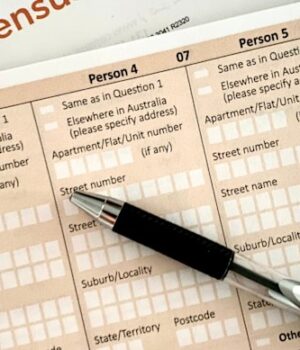
Census night this year is August 11. But, as more than 1.2 million households have already done, you can complete your census form before that date.
If you complete your census form before August 11, you need to fill it out as if you were home on that day.
If a member of a household is away from home on the special night, you can include them as if they were home. If you are visiting someone, make sure you’re included in their household form. But make sure you’re counted only once.
For those travelling or staying at hotels, caravan parks and registered campgrounds, operators should have census forms for you to complete.
If you happen to be free camping or staying at a remote location, various visitor information centres will have census forms. If that doesn’t work, you can get a census number from the ABS so you can complete your form when you have access to the internet.
Why do we have the census?
Since the Babylonians in 3800 BC, governing bodies have sought to count the number of people under their control.
The census that features in the Gospel of Luke was conducted by authorities for taxation and administration reasons as Rome brought the province of Judea under its control.
Outside of tax, censuses have been used to plan for services such as schools and cemeteries, while in many countries they are central to the allocation of electorates in parliaments.
The first official census in this country was in 1828. It was termed a “muster” and held in NSW to help align the number of people in the colony with its food supplies. Colonial headcounts were carried out until the mid-1880s.
In 1905, the federal government passed the Census and Statistics Act. The Australian Bureau of Statistics (ABS) was created the following year. The first national census was held on April 2, 1911.
That census counted 4.45 million people (excluding the nation’s Indigenous population).
Some of the questions used in that census have disappeared. We are no longer asked if we live in a wagon or if the family home is made from spinifex or calico.
But others have remained constant, though maybe the answers change. In 1911, 79 people said their religion was Callithumpian, while another 32 described their belief as “wowser”.
At the 2001 census, almost 70,000 people said they were Jedi.
What happens if you don’t complete the census?
Completing the census is compulsory, and has been since the first count in 1911.
If a household does not complete and submit a census form, the ABS will contact you and ask for it to be done. If a household continues to hold out, it can be served a formal direction to complete the census, which is a legal instruction.
At this point, if you continue to refuse to fill out the form, you can be prosecuted and fined up to $364 a day.
What is a census field officer, how are they chosen, and how much are they paid?
The census is one of the nation’s largest one-off job opportunities. The ABS is employing more than 16,000 field officers – the people who go around to households with forms and then pick them up – through the census period.
It’s a job that appeals to seniors or those looking for some casual work, and the pay starts around the $33-an-hour mark.
There are thousands of other positions that require more specialist skills or being in particular parts of the country, such as isolated regions.
What has changed in Australia because of the census?
One of the most important discoveries in health was uncovered by Australian statistician Oliver Lancaster.
He used the 1911, 1921 and 1933 censuses – which asked a question on deaf-mutism – to establish for the first time the link between rubella and congenital problems in unborn children.
More recently, housing experts noticed a drop in the number of home owners between the 1996 and 2001 census. This continued into the national headcounts of 2006, 2011, 2016 and 2021.
This decline in ownership rates, particularly across people in their 20s and 30s, has been highlighted by advocates for changes in housing policy, including taxation policy.
The Treasury analysis contained in this year’s federal budget, which contained changes to negative gearing and capital gains tax, referenced this census data.
What happens to your data, and is it a privacy concern?
Some people are concerned about their personal data as the census form collects names and addresses.
To protect privacy, during data processing, names and addresses are removed from other census data. They are then stored separately.
Census form names are retained for up to 18 months before they are deleted or destroyed. Addresses are kept for up to 36 months before they are deleted or destroyed.
The collected information is not shared with other government departments or direct marketing companies. The Bureau of Statistics is sworn to lifetime secrecy provisions.
You can ask to have your census form stored in a “national time capsule” for 99 years, so your relatives can track down your details in 2125. The data will be held by the National Archives and cannot be accessed until next century.
Cut through the noise of federal politics with news, views and expert analysis. Subscribers can sign up to our weekly Inside Politics newsletter.
 Shane Wright is a senior economics correspondent for The Sydney Morning Herald and The Age.Connect via X or email.