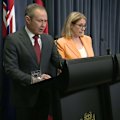
source : the age
Jacinta Allan’s time as premier of this state may be over, but her parting words still echo.
In arguing against a royal commission into Big Build corruption, she dismissed the idea as one that would deliver a report but not real-world change.
Defending the state’s burgeoning debt in her resignation speech, she pointed to spending in schools, hospitals, roads and public transport. “That’s what it’s paid for,” she said.
This week’s series of confronting exclusives by The Age’s reporters on Victoria’s mental health sector – more than five years after a landmark royal commission delivered its final report – perhaps provides insight into Allan’s prediction about governments dismissing awkward review findings but also raises urgent questions about where promised money has gone.
But above this is a bigger question: is our government serious about saving lives or does it just want to protect its image?
The rewriting of the Mental Health and Wellbeing Commission’s latest report into the sector, presented to the government in December but not published until June, was more than a mere updating of details; it was an attempt to gloss over a failure to deliver and to hide funding uncertainty.
We have seen the government interfere in the marking of its homework like this before, when the Country Fire Authority’s assessment of its funding situation was “revised”.
In a piece for The Age this week, Professor Patrick McGorry – who chaired the royal commission’s expert advisory committee – wrote that talk of progress on mental health provision “gaslights not only people and families of their own experiences, but also frontline clinicians and their leadership”.
It gets worse. In response to the royal commission’s report, the Andrews government legislated a Mental Health and Wellbeing Levy from which all revenue raised would be spent on mental health services to “supplement the current level and future expected growth of the Victorian government’s existing funding commitments”.
As we have reported this week, money supposedly ring-fenced for mental health is instead being spent in other areas of our creaking health system and the levy is acting as an offset for reduced mental health funding.
The pool of cash may technically be larger, but not by anything like the amounts the royal commission envisioned, or the levy was meant to ensure to meet escalating need.
We would like to tell you exactly where money such as that pledged to provide housing for people with mental illness is going. That is made much more difficult than it should be by a government that refuses to open the books or says it simply doesn’t compile the relevant information.
The Mental Health and Wellbeing Commission was set up to scrutinise Victoria’s progress on mental health provision, but the decision to gut its staffing following the Silver Review of the state’s public service led to a joint letter from agencies across the sector warning of a return to “decisions being made about people, rather than with them”.
McGorry put it another way when he wrote that “the ambulances are still all at the bottom of the cliff”. When attention turned to our “broken” mental health system during the pandemic, it was understood that the system’s failure cheated all of us.
To realise the promises of the royal commission will require a reset on spending and scrutiny.
Mental illness is not a fringe phenomenon; it affects us in our streets, our workplaces and our homes. At the time, it was estimated that poor mental health was costing the state $14.2 billion.
Years later we are still dealing with what the royal commission called a system driven by crisis. The housing instability its report identified as compounding mental illness is still with us. The cost can be measured not only in dollars but in human lives lost.
The royal commission Daniel Andrews set in motion was too important for its lessons to be squandered. Yet the funding meant to deliver change and the pipeline meant to make sure it reached those most in need are full of holes.
On September 29, Jennifer Black will become the mental health and wellbeing commissioner, with Katie Larsen as her deputy. They will inherit an agency at a crossroads, faced with a government that insists, contrary to the evidence, that all is going well.
To realise the promises of the royal commission will require a reset on spending and scrutiny. The question is whether they, new Premier Ben Carroll and Mental Health Minister Ingrid Stitt, deliver it.
In the opening remarks of its report, the royal commission acknowledged “the strength of people living with mental illness” and their families, carers and supporters. The Age’s coverage has shown that those working on the front line of services are putting their own health at risk.
Enough. The government and the commission must provide the funding, support and meaningful oversight to move us away from a system that remains, after all these years, manifestly not fit for purpose. We have been shown a better way. We need to take it, for all our sakes.
Start the day with a summary of the day’s most important and interesting stories, analysis and insights. Sign up for our Morning Edition newsletter.
 The Age’s View – Since The Age was first published in 1854, the editorial team has believed it important to express a considered view on the issues of the day for readers, always putting the public interest first.