source : the age
Holden, Ford, Toyota, Nissan, Mitsubishi. For years these are the brands which have dominated the driveways of Australian homes.
Now brands such as XPeng, Zeekr, Haval, GAC, Geely, Chery and Leapmotor are competing for customers – and you probably know someone who drives one, even if you don’t yourself … yet.
One in every three vehicles sold in Australia in the first six months of this year was made in China. There are at least 10 Chinese automotive companies selling more than 20 individual brands, mostly EVs and plug-in hybrids. And more are coming. Names such as BAW, Changan, Forthing and Nio, all hoping to make a mark in what is widely considered the most competitive car market in the world.
But none has yet made the impact of BYD, which launched in Australia with the hopeful moniker Build Your Dreams in 2022, before rebranding its vehicles with the shorter and more palatable initialism soon after. There was scepticism when, not long after launch, its executives told a packed media room that it would be a top-five brand in Australia in 2025, and then continue to grow. For a new brand with only a handful of models, it seemed incredible hubris. But in mid-year 2026, BYD is ahead of schedule.
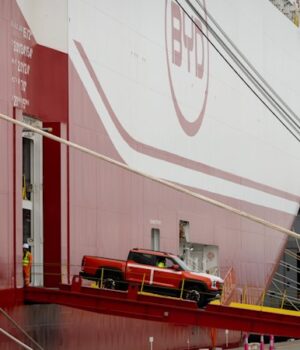
The scale of the appetite for the Chinese auto giant’s cars was evident when the vast BYD Zhengzhou ship sailed into Melbourne in June, with almost 5000 vehicles on board the 200-metre-long floating showroom. BYD had mobilised the shipment in response to the demand for “greener” vehicles in Australia. The same month, the company sold almost 19,000 vehicles here – just 243 sales short of Toyota. The last time a brand beat Toyota in the monthly sales race was in May 2011 – and that was Holden.
BYD local chief operating officer Stephen Collins says technology is now a key factor being sought by Australian motorists, who were open to new brands who could deliver.
It hasn’t all been smooth sailing on BYD’s Australian ascent, though. The champagne that was no doubt flowing following the brand’s best-ever month in June would have quickly soured when, in July, it emerged that more than 1200 customers had been sold 2025-build vehicles, not the 2026 models they had paid for. A BYD spokesman was reported as saying it was due to an “administrative error”, and the company has since offered all those affected the option of a full refund.
In May, the federal opposition called for a security review into whether any Chinese EVs should remain on the list of taxpayer-funded cars available to parliamentarians, with opposition special minister of state James McGrath describing them as “effectively rolling Chinese data centres”.
Legacy brands are watching the newcomers in the Australian market. The local CEO of Korean auto giant Hyundai, Don Romano, bristles when asked if he is surprised at the speed at which BYD had grown here. “I think there’s a big difference between growth at any cost and growth organically,” he said.
Vice-president of sales and marketing of Toyota, Australia’s best-selling marque, John Pappas says that something will have to give. “There are all these other brands coming, but the market itself is not growing. So it’s going to be a challenging environment for some of these brands to be sustainable,” he says.
BYD might be the headline act, but it is only the tip of a very long spear. Few brands demonstrate the automotive gold rush under way in China better than Dreame, a home electronics company most famous for robotic vacuum cleaners after launching its first stick vacuum in 2018. The brand claims that within the next 18 months, Dreame cars will be for sale in Australia – though details of the SUV range have yet to be revealed – with the brand exploring retail outlets such as Harvey Norman as a substitute for a traditional dealership network. The plan, presumably, is to allow you to buy a couch, a TV and a vacuum cleaner – and then the car you need to get them home.
“There are legacy brands who just believe their repeat customers are always going to be there. If we can come in and really showcase the value of our brand, there’s a gap there where we believe customers will transition through,” says Dreame’s Australian manager James Moore.
The speed of this change to our new-car market is staggering. In 2020, 30,000 cars sold in Australia were made in China (and in 2019 it was more like 17,000). Over the first six months of 2026, that number was almost 200,000. China is now the single biggest source of origin for vehicles sold in Australia, snapping a 28-year record held by Japan. Helping, too, is that brands like Tesla also source their vehicles from China.
Several events have driven this growth. Over the past five years here, international conflicts have spiked petrol prices, inflation-driven rate rises have hurt household budgets, government incentives have accelerated the adoption of greener vehicles, wait times for certain legacy manufacturers have spiralled, and the 2025 introduction of the ever-tightening New Vehicle Efficiency Standard (which fines brands that don’t meet it) has driven a move to rush EVs to market.
Meanwhile, a Chinese manufacturing glut, which has prompted authorities there to clamp down on new car-making facilities and price-cutting wars, inspired company executives to look outwards a few years ago. Europe and the US both have domestic automotive industries to protect. Australia does not, and so has some of the lowest barriers to entry on the planet. Gas meets match.
Mike Costello, an auto analyst at Cox Automotive and Manheim Australia, says that China had over-produced for its local market and started looking for export markets. “China leads the world in all things to do with electrification, and so they recognised that they could really steal a march on everybody as we moved into this new, electrified world,” he says. “They also knew that, through sheer economies of scale or through government help or through really low-cost manufacturing, they could get a leg-up on price as well.”
That, says Costello, is a critical point. Chinese vehicles are often cheaper than their rivals, sport more equipment and features on their cheapest, entry-level models and with world-class battery technology. For perspective, the Toyota RAV4 is one of the nation’s bestselling vehicles, and a plug-in hybrid version of this mega-popular SUV arrived in Australia in June. The cheapest version is $58,840 before any on-road costs. The similarly sized Starray from Chinese brand Geely is $37,490. Brand loyalty is suddenly rather expensive.
On the surface, the consumer benefits most. The arrival of this army of new brands is driving down prices significantly. But, says Costello, one of the few things not included in the sticker price of a new brand’s vehicle is the implied security of legacy.
“The one thing the Chinese brands don’t have is long-term proven residual values and long-term proven reliability in Australia. And that’s not to say that they won’t have those things. But if you buy a Toyota or a Honda or a Hyundai, you know, to a degree, that this vehicle is going to do the job,” he says.
“My two cents is that these vehicles are built to the same standards as pretty much anything else in terms of how sophisticated they are. But only time will unlock the truth or the falsity of that. The question we have is that, in a position where we are going to have 70 or 80 different brands from all over the world in this market, including 30-odd from China, can a market of our size truly support that in a sustainable, profitable, long-term way?
‘Are all these brands going to survive? I think the general consensus is no.’
“The general sentiment in the industry is that it’s extremely difficult to imagine that we won’t see some brands pack up and leave because they just can’t sell enough vehicles to justify staying. Now, that may include some traditional brands, but it will also include some of these Chinese brands.”
It’s a thought echoed by Hyundai’s Romano, who suggests the collapse of brands in Australia – newcomer or legacy – could have a devastating ripple effect on customers and the market more broadly.
“The question is, are all of these brands going to survive? And I think the general consensus from every manufacturer is no. So the question then becomes, when they leave, who holds the warranty liability? I think it’s a worry that some of the big dealer groups are holding onto a number of brands that may or may not be around – and I’m not talking about Chinese brands, it could be any brand.”
The dominoes are wobbling. TrueEV, the Australian company responsible for selling and servicing models from the Chinese brand XPeng, had administrators appointed in March before closing its only Sydney showroom. XPeng’s Chinese HQ has since stepped in to establish operations in Australia and will set up its own dealer network for sales and servicing, in the same way brands like Toyota, Nissan or Mitsubishi are operated here. In July, the distributor for the French brand Peugeot relinquished its distribution rights for the brand, with the French marque’s future here currently uncertain, though it insists it will continue in some capacity.
The question, then, isn’t whether Chinese brands will succeed in reshaping Australia’s new-car market. Much like the BYD Zhengzhou, that ship has sailed. It’s which brands, household names or otherwise, will survive.
Get the best of Good Weekend delivered to your inbox every Saturday morning. Sign up for our newsletter.