

Source : ABC NEWS
Legendary commentator Sid Waddell was (almost certainly) joking when he likened darts legend Eric Bristow to Alexander the Great during the 1984 World Championships.
Bristow, the Crafty Cockney, was two-time world champion at that stage and on his way to the third of an eventual five world titles as part of a career in which he claimed 22 major tournament trophies.
“When Alexander of Macedonia was 33, he cried salt tears because there were no more worlds to conquer,” the ever-excitable Waddell sardonically squeaked in his indomitable Northumbrian tones.
“Bristow’s only 27!”
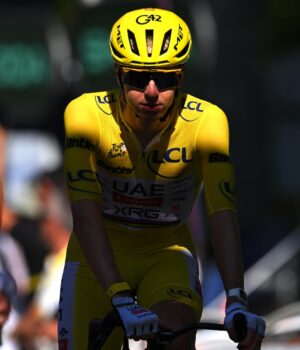
Reigning two-time cycling world champion Tadej Pogačar is only 27, too.
And as he lines up for this year’s Vuelta a España, which gets underway on Saturday night AEST, he is taking another step towards conquering all of men’s professional cycling.
Pogačar’s near total dominance

Tadej Pogačar has won five Tours de France in the last seven years. He finished second the other two times. (Getty Images: Jean Catuffe)
Comparing a darts player from a time when the sport was played at venues such as Jollees Cabaret Club in Stoke-on-Trent, however exceptional he was, to one of antiquity’s most well-known figures was intentionally incongruous from Waddell.
But doing the same to a waif-like cyclist somehow seems like less of a stretch.
Pogačar’s dominance over professional cycling is near total.
So dominant is he that it’s simply not a stretch to imagine the Slovenian at the head of a rampaging UAE Team Emirates-XRG squad leading the charge to conquer the Kingdom of Spain via its mountain passes.
Of course, nothing is absolute in professional cycling.
Crashes and illness could derail Pogačar’s quest to add the only one of cycling’s grand tours missing from his palmares.
But rarely has there ever been a rider for whom victory seems so assured as Pogačar when he hits the front of a race.
Tadej Pogačar and Mathieu van der Poel are engaged in the most thrilling of rivalries in the Spring Classics. (Getty Images: Billy Ceusters)
As Pogačar proved during his staggeringly dominant Tour de France victory, the rest of the field was barely given a sniff.
From the moment the Slovenian star climbed away from the only man to ever claim yellow ahead of him, Jonas Vingegaard, on the slopes of the Col du Tourmalet during stage six, only the gods of misfortune ever had a hope of ripping another triumphant Paris visit from his grasp. Mere mortals cannot hope to come close enough to land a telling blow.
So far this year, Pogačar has had 37 race days in 2026, winning 16 of them (43 per cent) as well as winning all of the three stage races he has started.
In 2025 he had 17 wins from 50 race days (34 per cent). In 2024, it was 22 wins from 58 days (38 per cent).
Victories in that time frame include three straight Tours de France, a Giro d’Italia, two world championships and a whopping eight Monument one-day races.
Such unfettered dominance is not universally acclaimed. Some of the more perniciously fickle French roadside supporters even booed Pogačar from time to time.
But some of the biggest questions have come from those who simply don’t believe what they are seeing, as the curse of cycling’s past looms large over the achievements of the present crop.
Alpe d’Huez record raises eyebrows
Tadej Pogačar’s ascent of Alpe d’Huez was simply stunning. (Getty Images: Dario Belingheri)
Pogačar’s emphatic victory in this year’s Tour de France was not a surprise.
But as a result of his latest success, and the success he has earned across races from the sport’s greatest grand tours to the one-day classics of northern Europe, Pogačar cannot avoid being tainted by the shadows of the sport’s nefarious past.
The spectre of doping hangs over cycling like an ancient curse, which is not far off given the century or more of scandals that have rocked the sport and its most iconic race.
As a result, winning the Tour de France is only part of the battle.
Winning over the sceptics is something else entirely, and an arguably far greater, perhaps even impossible, challenge.
Pogačar’s riding at this year’s race was filled with displays of verve and daring and free-spirited riding of the likes many had thought had been eliminated from the professional peloton since the advent of power meters and team radios.
Tadej Pogačar’s joie de vivre is evident with every victory. (Getty Images: Dario Belingheri)
Nothing illustrated this more than the final stage in Paris, a thrilling two-up battle with Classics rival Mathieu van der Poel that saw Pogačar pay the ultimate tribute to the jersey by relentlessly pursuing a stage win.
However, two of his five wins stand out above all others.
His sixth-stage 42-kilometre solo victory via the Col du Tourmalet was exquisite, a masterful solo attack of the like he has made his trademark since he rode himself onto the podium on stage 20 of the 2019 Vuelta a España with a similarly impressive 37km attack, which he has since repeated at the last two world championships, Liège–Bastogne–Liège and Strade Bianche.
Then, his Alpe d’Huez masterclass on stage 19 was even better, as heart-stopping a spectacle as anyone in cycling has ever seen, perhaps even the greatest single display of cycling in history.
But that ride raised even more questions, as Pogačar erased a three-and-a-half minute gap on a collection of sensational climbers ahead of him and obliterated the previous record for the 13.8km ascent of Alpe d’Huez, set by Marco Pantani during the 1995 Tour de France.
Tadej Pogačar obliterated the previous record to ride up Alpe d’Huez. (Getty Images: Luc Claessen)
Pantani’s time for the ascent, 36 minutes and 40 seconds, has long been viewed with equal parts romance and scepticism.
The mid-90s were rife with drug taking in the professional peloton, with the blood-booster EPO just entering the system of the world’s leading riders.
When EPO first emerged, there was no test for the drug other than to measure the percentage of blood volume made up of red blood cells.
The UCI decided that, given a percentage value of 50 per cent was at the upper limit of what a healthy adult male would have, any rider with a value above that would be sat out of a race for their own safety when tests were introduced in 1997.
That gave some riders a remit to simply top up their natural levels to be closer to that 50 per cent limit.
“If we go back to the doping era, what happened was that basically riders were getting their levels artificially raised,” former Tour de France yellow jersey wearer David Millar said on the For The Love of Cycling podcast during the Tour.
“So what people were doing, they were just tweaking themselves up to those levels and so that was levelling the playing field, if you like.”
David Millar (right) was a contemporary of Lance Armstrong (left). (Getty Images: Bongarts/Friedemann Vogel)
Now, with the advances in testing and the introduction of the biological passport, which tracks riders’ levels over their entire career, riders that have natural advantages are allowed to thrive.
“The freaks are allowed to be freaks,” Millar said.
“If we look at any elite sport … the people who are the best, they’re not normal people, they’re freaks.
“I think it’s great now that we’re getting to see these genetic freaks, with also psychological ability to be able to handle their physical gifts and do exceptional things.
“Pogačar is a poster boy of that.”
Pantani, whose complicated legacy lives on in the peloton and for those who follow it, was an avid user of EPO and likely had blood the consistency of porridge when he ascended the 21 hairpins on that day.
Indeed, later in that same 1995 season, Pantani suffered a horrific crash on a descent in the Milano-Torino race. His hospital admission report noted that his hematocrit was at a hideous level of 60.1 per cent.
Pogačar’s time in this year’s race was 35 minutes and 27 seconds, 1 minute and 13 seconds faster than anyone has ever gone up there before.
Of course there are some areas where Pogačar has an advantage.
Marco Pantani set the fastest ascent of Alpe d’Huez in 1995, likely fueled by a cocktail of drugs. (Getty Image: Allsport/Mike Powell)
Pantani was riding a titanium-framed Carrera Titanio, a bike light years behind Pogačar’s carbon fibre Colagno and its state-of-the-art wheels, which would not have weighed much more than the 6.8kg minimum limit prescribed by the UCI, aiding not just on the climb, but easing the amount of energy that riders use on the way to it.
Pogačar was also wearing lightweight, high-tech kit, had ridden fewer kilometres in the stage leading up to the climb (127km to 159km) and was the beneficiary of nutrition plans that, in the modern era, are beyond the comprehension of riders from even a handful of years ago.
In short, it’s impossible to compare the two ascents properly.
But it’s not stopped people from noting how jarring it is to see Pogačar’s name atop a list littered with avowed dopers; Pantani appears no fewer than three times, disgraced former champion Lance Armstrong is there twice, with Jan Ullrich, Alex Zülle, Bjarne Riis and Richard Virenque also named in the list of fastest ever climbs.
“Alpe d’Huez is still something we have to process,” 2012 Tour de France winner Bradley Wiggins said on The Move podcast.
“We’re getting used to his insane performances … [but] we’ll still be talking about that in 50 years.”
‘Bring me evidence’, says the man who brought down Armstrong
David Walsh helped bring down Lance Armstrong. (Getty Images: David Levenson)
Journalist David Walsh will be known to many as one of the key men who brought the curtain down on Lance Armstrong’s reign of chemically enhanced success at the Tour.
The result of Walsh’s efforts leaves a glaring gap in the official record books between 1999 and 2005, the silence of which screams even more relentlessly into the void than the man who actually claimed the yellow jersey through those years.
Walsh’s credentials for going to the ends of the earth to reveal cheaters make him a figure almost beyond reproach in the fight for clean sport.
But during this year’s Tour, the veteran Irish journalist told The Cycling Podcast that he had a message to the doubters, and underlined why Pogačar was so different to the arch-villains of the past.
“For those people who may have reservations about, ‘How can he be so good?’ I say, just give me one reason, other than a gut feeling, other than instinct, other than a scepticism based on the past, give me one bit of what I would call serious evidence that we could go and investigate,” Walsh said.
“Because nobody ever has.
“The reason why a number of people were sceptical of Lance Armstrong was there was a significant amount of evidence out there and then, when you went looking, what you found under the stone was far more damning than what brought you to the stone.”
Lance Armstrong won seven straight Tour de France overall titles, but was stripped of them all. (Getty Images: TempSport/Corbis/VCG/Jean-Yves Ruszniewski)
Walsh even went as far as to say that he doesn’t believe that doping is essential to win the Tour de France anymore.
“The climate has significantly changed,” he said.
“I’m not saying that there aren’t people out there still doping, still trying substances that are banned; I’m not saying that, there may well be.
“But I don’t think you have to dope to win the Tour de France now. I don’t believe Tadej Pogačar is doping.
“And I say that because we’ve had six years of him, we’ve seen the level he’s on.
“All those dopers in the past, they didn’t have even seasons because they had to give their bodies a chance to get back to normal after they had filled it up with EPO or cortisone or testosterone or human growth hormone.
“You can’t be taking that stuff all the time. You had to have periods where you gave your body a chance to go back to its natural state, then start another cycle. So you had wild fluctuations in form.
“What I’m seeing now is the endless talk about nutrition, the talk about the way you train, the altitude camps, the equipment, how much lighter the bike is, the clothing, what they put into that, the amount of time they spend talking about rest, and the off-the-bike work they’re doing.
“We’re at a point now, [where] we have a generation of cyclists now who thinks: ‘There’s loads of ways I can improve, whether it’s nutrition or training or resting, whatever; there are lots of ways I can improve.’
“In the old days, there was only one way you improved: you doped.”
Doping questions will never go away
Cycling may well be destined to forever be tainted by the stain of its past. (Getty Images: Dario Belingheri)
As Pogačar lines up with the rest of the professional peloton in Monaco this weekend for the start of the Vuelta, it’s clear that the stain of cycling’s past will never wash away.
Even when it was revealed that Pogačar and Vingegaard had been woken up in the early hours of the morning for a surprise doping test during the Tour de France, it was accepted as something that simply had to happen to maintain any semblance of respectability and credibility.
If, as it is expected, Pogačar wins in Spain, then heads to Canada and wins the world championships for a third-straight time, what does that say about the sport that one man can be so dominant?
The Vuelta is likely to be contested at a rip-roaring pace, just as the Tour de France was before it, completed at an average speed of 43.227km/h for its 3,482km, the fastest average speed in history.
In 1995, when Miguel Induráin won, the average speed for the entire 3,635km of racing was 39.193km/h.
The peloton didn’t achieve an average of over 40km/h until 1999, the first year of the since-annulled Armstrong era and the world knows all too well what that speed increase was fuelled by.
As performances continue to improve, and Pogačar continues to produce some of the most spellbinding riding you’ll ever see across mountains and cobbles and days and weeks, the questions will always exist.
That is the price the sport must pay for the sins of the past.
When is the Vuelta a España?
The only previous time Tadej Pogačar has raced the Vuelta, he rode into third place overall with a solo attack on the penultimate stage as a 20-year-old. (Getty Images: Justin Setterfield)
The Vuelta gets underway on August 22 in Monaco and runs through to September 13 where it will finish in Granada.
Riders will race 21 stages and will cover a total distance of 3,275km.
How can I watch the Vuelta a España in Australia?
SBS will have live coverage of the race on SBS, SBS Viceland and SBS On Demand.


