SOURCE :- THE AGE NEWS
Washington: The US is issuing deadlines to countries to stop all financial dealings with Iran as part of a new “Operation Economic Outcast” aimed at isolating the Islamic regime in Tehran from the rest of the world.
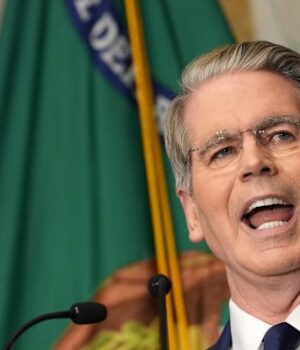
Treasury Secretary Scott Bessent said President Donald Trump was calling his global counterparts with specific demands regarding their commercial interactions with Iran. If they fail to comply, their institutions face exclusion from the US financial system.
“Our objective is to sever every economic lifeline that sustains this tyrannical regime until Tehran stands alone,” Bessent said at a news conference in Washington on Monday (US time).
“It is no longer acceptable to operate in the grey spaces of this conflict … Any entity that facilitates money laundering on behalf of Iran will be removed from the US dollar system. The clock just started ticking.”
In a speech that was heavy on threatening rhetoric, Bessent likened the announcement to “D-Day” – the start of the allied invasion of Nazi-controlled Europe during World War II.
But he provided few specifics, and did not unveil any immediate secondary sanctions against other countries or banks. He said it was likely that a major financial institution would be hit with sanctions by the end of the week.
Asked why the US was not imposing secondary sanctions straight away, Bessent said: “We are giving everyone the opportunity to remedy bad behaviour. Why would I want to blow up the global financial system?”
The US has so far resisted targeting Chinese banks and intermediaries, which process the bulk of Iranian oil sales. Trump has a high-stakes meeting with Chinese President Xi Jinping at the White House next month.
When asked, Bessent suggested Chinese banks were not immune from sanctions, but said the US preferred to engage in “quiet diplomacy”.
“If they facilitate transactions and are part of the ecosystem that turns Iranian oil into money – into repression – they will be targeted,” he said.
Several new measures were announced on Monday, including sanctions against nearly 60 Iran-linked entities, individuals and vessels.
That included a procurement scheme for Iran’s ballistic missile development and nuclear research, a malicious cyber group and a network of brokers and vessels transporting Iranian oil, according to US Treasury.
And the US expanded its list of sectoral sanctions against Iran. Anyone operating in the fields of digital assets, technology, gold, aviation and shipping was now liable to be sanctioned.
Bessent said that every branch of Iran’s Bank Melli – the largest regime-controlled commercial bank – must be “shuttered and dark”.
The move signals a transition in the war against Iran from primarily a military conflict to an economic battle where the US will try to use the weight of its financial system to cut Tehran off from all revenue.
Friday marks the six-month anniversary of the war, which Trump initially said would last four to six weeks. Although fighting has subsided for most of that time, a peace deal to end the conflict has proved elusive.
Trump pulled back from a threatened military offensive against Iran’s energy infrastructure and bridges, but reinstated a naval blockade on all Iranian ports in July. Meanwhile, the US is trying to establish safe passage through the Strait of Hormuz for the rest of the world’s ships.
Shortly before Bessent’s speech, Iranian parliamentary speaker Mohammad Bagher Ghalibaf, who signed the now-expired memorandum of understanding with the US, said no one was buying America’s “bombast”.
“The United States is not in an economic position to further restrict its relations with other countries. Iran’s trading partners, both in the media and through messages sent to us, have made it clear that they don’t take these statements into account anywhere,” Ghalibaf said on X.
Meanwhile, Israeli Prime Minister Benjamin Netanyahu thanked Trump and Bessent for the move. “You justly exact a steep price from that cruel dictatorship and from those who assist its continued aggression,” he said.
But American analysts drew attention to the gulf between the Trump administration’s rhetoric and Bessent’s failure to announce any immediate secondary sanctions.
Aaron David Miller, a former State Department negotiator and Middle East expert, said time would tell if the administration would actually cut off China, Turkey, India, Pakistan and others from the US financial system, initiating a trade war.
“This really doesn’t seem to be D-Day,” he said. “This is D-Day plus however many days the administration is going to give all these countries … It’s hard for me to believe, on the eve of Xi’s visit here, that that’s the way they’re going.”
Miller said Iran’s enablers were unlikely to comply with US sanctions. And “the Iranians are not going to sit around like some potted plant and just suffer this”, he added. “They’re going to strike back.”
Get a note directly from our foreign correspondents on what’s making headlines around the world. Sign up for our weekly What in the World newsletter.
 Michael Koziol is the North America correspondent for The Age and Sydney Morning Herald. He is a former Sydney editor, Sun-Herald deputy editor and a federal political reporter in Canberra.Connect via X or email.