SOURCE :- THE AGE NEWS
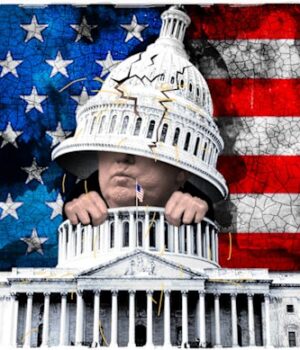
The US remains immensely powerful. Yet, week by week, Donald Trump is exposing the limits of its power.
Of course, he’s not doing it deliberately. He does it unwittingly through blunder, bluster and bad strategy. On his current trajectory, he will leave America weaker than he found it in three ways, with urgent questions now arising about a fourth.
Most glaring is Trump’s failure at arms. He is being “humiliated” by a much smaller rival, as German Chancellor Friedrich Merz has remarked.
His supposed “two to four weeks” war against Iran is approaching six months. By refusing to countenance the expert advice of his generals, he handed control of the Strait of Hormuz to his enemy.
The US failure in Iran has nothing to do with Pete Hegseth’s fetish over falling levels of troop testosterone. It has everything to do with strategy.
The Islamic Republic is still in place, its stature much enhanced, and the price of oil remains around 30 per cent higher than when Trump and Benjamin Netanyahu launched their war.
Persistent inflation is one result. The average American household has paid at least $US1200 ($1675) in higher costs as a result, according to economist Mark Zandi of Moody’s Analytics.
The taxpayer is on track to spend more than $US100 billion for the war, 18 US service members are dead, more than 600 wounded, America’s Gulf allies have lost confidence in their ally, and US stature is much reduced.
Worse, by moving assets from other theatres to fight a losing war in the Middle East, US global readiness is weakened. The spoils of war, indeed. It’s not the first time the US has waged an expensive and futile war. But Trump shows that the US has not learnt vital lessons from earlier Middle East mistakes.
The war “has not the slightest purpose beyond the ego of the commander in chief”, in the words of Phillips P. O’Brien, an American professor of strategy at St Andrew’s College.
As an Australian expert on strategic affairs, Paul Dibb, has ventured, you need to reach back to the Crimean War to find an operation as aimless as this American one. And that was 170 years ago.
The American public will, no doubt, recoil yet further from the use of war as a policy tool as a result of this debacle. And this comes as the predators in Moscow and Beijing are pressing their territorial ambitions and overturning Pax Americana with little US resistance.
Second is Trump’s vandalism of America’s “virtual empire”, a global network of alliances and institutions. It was a creation born of US genius.
In contrast to traditional empires of domination, which are sustained by coercion and occupation, the US postwar empire is a volunteer one. Foreign nations asked, even clamoured, for the privilege of becoming US allies.
Almost every prosperous democracy, and a few autocracies as well, joined to form an alliance system of some 40 nations. No other power came close. It’s a defining US advantage over its rivals. Or it was. Trump’s non-stop abuse of US allies has inflicted serious harm. Instead of supporting allies, he threatens to seize their territories.
As Russia threatens hostility against America’s European allies, Trump withdraws some troops from NATO and announces “a review that some countries will fail”, in the words of Hegseth.
As North Korea threatens South Korea, Trump scales back annual manoeuvres with Seoul and praises Kim Jong-un, undercutting America’s ally and boosting its enemy.
Trump’s tariff policy is another act of hostility. His latest announcement of new tariffs on Canada was greeted by The Wall Street Journal with the headline “The Dumbest Trade War Revisited”.
Australia is a case study in Trump’s erosion of alliances. America’s uniquely loyal ally had fought side by side with the US in every major war since and including World War I. But not this time.
Canberra has sent an electronic warfare plane, a Wedgetail, plus personnel to help defend the UAE from Iran’s missiles. But nothing to help the US and Israel against Iran. This is a historic breach for Australia and the alliance, a sign of the Trumpian times.
Third is the US dollar’s “exorbitant privilege” as the world’s reserve currency. The status and dominance of the dollar has been ebbing gradually for some years. This accelerated in 2022 when Joe Biden was in power.
Putin’s full-scale invasion of Ukraine prompted a Western decision to freeze some $US335 billion in Russian central bank cash.
Realising their vulnerability to Western sanctions, central banks in the rest of the world moved to buy gold, a physical asset that they could hold in vaults outside the US-dominated system.
So Trump did not start the global resurgence of gold. But he supercharged it. His wild policy thrashings alarmed foreign governments and investors. They took refuge principally by selling US assets to buy gold. By the end of 2025, the gold price was up by 109 per cent over two years.
The animating force was captured in this headline from London’s Financial Times in early 2026: “What do Chinese gold traders want? Three more years of Donald Trump”.
Most global trade still is transacted in greenbacks, but “de-dollarisation is unfolding in central bank foreign exchange reserves, where the share of US dollars has slid to a two-decade low”, as US investment bank Morgan Stanley noted last year. This “could shift the balance of power among countries” against the US.
The Iran war interrupted gold’s advance against the US dollar. But recent evidence is that falling trust in the US is again fuelling a flight to gold and other assets. In June, gold overtook US Treasury bonds as the top global reserve asset.
Fourth, a new front on Trump’s war against US credibility has opened in world bond markets. US government deficits are now spooking the world’s investors. As US federal debt passes 120 per cent of the country’s GDP, investors are asking whether Washington will repay its debts. US interests rates are edging up nervously. Trump’s responses have been unconvincing.
None of these emerging limits to US power is final or fatal. These problems are man-made and can be reversed by sane and steady policy. But approaching the halfway mark of Trump’s term, sane and steady policy is an endangered species in Washington.
Peter Hartcher is political and international editor. His political column appears on Saturdays.
Get a weekly wrap of views that will challenge, champion and inform your own. Sign up for our Opinion newsletter.
 Peter Hartcher is political editor and international editor of The Sydney Morning Herald and The Age.Connect via email.