Source : the age
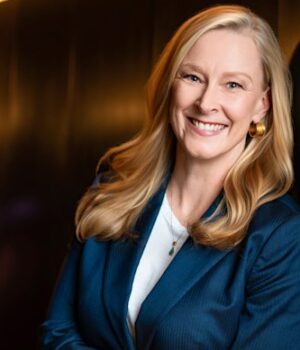
After three decades as a TV news and current affairs fixture, the secret sauce behind Australian Story’s long-running success might be the way viewers see themselves reflected.
“We do this deep-dive into the reality of what people’s lives are really like,” says Leigh Sales, who has anchored Australian Story since 2023. “You see people who have been able to adapt to things you would never imagine or want to adapt to, and audiences feel, ‘I can connect to that person on a human level’. And also, ‘Wow, people are amazing.’
“The way each Australian Story is told means you are seeing the richness of people’s lives and the fact that joy can coexist with grief – that wonderful things can happen at the same time as terrible things are happening.”
Executive producer Greg Hassall says the program, which has won eight Logie Awards and ten Walkley Awards and aired more than 1400 episodes since beginning in 1996, is also unique for its formula.
“Having people tell their story in their own words is very powerful,” he says. “When the program started, that was quite unusual, almost innovative, and there is an intimacy in that. It’s now pretty much the default for documentary making but, when we started, it was quite a different thing.”
Actor Claudia Karvan, who was featured in a 2023 episode, Making A Scene, says she trusted the program to talk about her unconventional childhood, her close, supportive relationship with her older brother, Rupert, who has schizophrenia, and managing her late father’s mental illness, while showing her life and career at 50. “I’ve grown up with Australian Story,” she says. “I’ve watched it for 30 years and wept at so many episodes.
“But you always trust the storytellers. The tone is always consistent, it’s respectful and there’s depth and intelligence and sensitivity. It’s always inspiring. It was the perfect platform, and I’m really glad I did it.”
Karvan says the most eye-opening daunting aspect of being part of the program was watching her then 21-year-old daughter, Audrey’s, interview.
“Greg [Hassall] wasn’t necessarily planning on interviewing her,” Karvan says. “But he said she ended up being one of the most valuable interviewees because she managed to string everything together.”
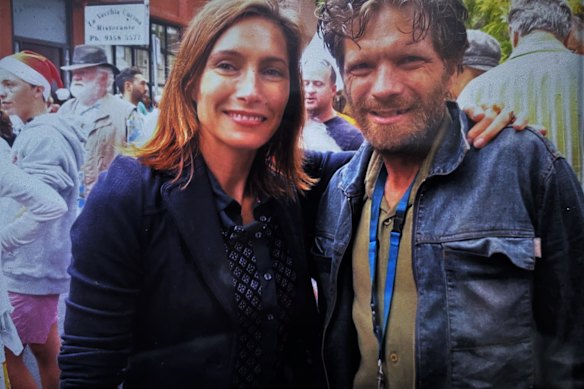
Karvan asked her if she wanted to participate and was surprised when Audrey said yes. “She’s never been one to want to be in the public eye,” Karvan says. “So that, firstly, was amazing. Then, before she did the interview, I said, ‘How are you feeling?’
“And she’s like, ‘Uh, I don’t know. I can’t really think of any story that doesn’t make you out to be a total bitch and a jerk.’”
Karvan laughs heartily.
“I thought, ‘Oh Jesus, OK, this is a bit of a worry.’ I told Greg that afterwards and he said, ‘She’s amazing. She just blew me away. She was just so articulate and had so much perspective and context.’ He said, ‘I wish she had told us some stories that made you out to be a bitch. It was all very glowing.’
“So that was the biggest surprise. How I was just so proud of my daughter, how self-possessed she was because you don’t really have those sorts of conversations with your children. You exist day to day, or you deal with their lives and the dramas in their lives. You don’t really look at family history. To hear her unpacking her childhood and my childhood to a stranger was a once-in-a-lifetime thing. Who gets to have that happen?”
Focusing on storytelling is key, says Hassall – something viable in a 30-minute format. But perhaps Australian Story’s most important ingredient is participants feeling trust.
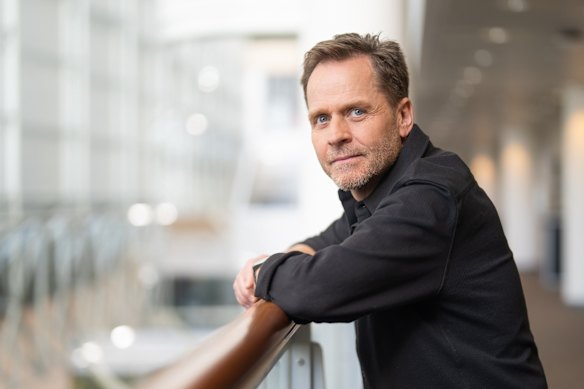
“We have to earn that,” Hassall says. “It’s such a precious thing. We’re always so mindful of never abusing that trust, of being transparent with people, of being upfront with what is entailed in making their story and about how we’re telling their story all the time.
“Because people make themselves very vulnerable. It’s hard for them [in] that they don’t really know what the story is going to be. They don’t have editorial control over it. They have to trust us to treat them fairly, and if we abuse that trust, I don’t think we’d be on air.”
Over its 30 years, Australian Story has shown that current affairs can be compelling without resorting to intrusion or sensationalism. Participants have unveiled aspects of themselves and their lives few knew about. They include Hazel Hawke, the former wife of former Australian prime minister Bob Hawke, publicly revealing her diagnosis with Alzheimer’s disease in 2003, and, 23 years later, dancer Roz Hervey, alongside her daughter, actor Tilda Cobham-Hervey, allowing a rare and raw insight into mortality and voluntary assisted dying in her final hours.
Some episodes have brought renewed attention to longstanding justice outcomes and legal cases, including the reopening of a coronial investigation into the death of Melbourne woman Louisa Ioannidis after doubt was cast over whether she drowned or was instead the victim of foul play. Australian Story has also been in the news, when it pulled an episode in February only hours before broadcast after it emerged the subject, 73-year-old Bendigo man Ian Williams, had been convicted of indecent assault more than 30 years previously.
The process of selecting people to feature is complex. Hassall says the ABC is “inundated” with external pitches, and a couple become stories each year, but most episode ideas stem from program researchers and reporters and producers watching who and what is in the news.
“It’s a mix of stuff, but it’s a big job,” he says. “We have to do 37 episodes a year, and you do not want to get stuck in a situation where you’re six weeks out from a black hole in the schedule,” he says. “That’s terrifying. At the same time, you don’t want to over-commission, so you can’t allow for serendipity, for something to fall into your lap. I find that balance the hardest thing to get right.”
Stories also need enough depth to sustain 30 minutes of storytelling, including narrative, tension, conflict, resolution and compelling characters.
“The founding EP of the show Deb Fleming used to talk about the now and the wow,” Hassall says. “It’s what are you doing now that we can film and that feels new, and what is going to make someone go, ‘Oh wow’. To learn something or be surprised. It’s a simple formula, but it’s a good one.”
While some news and current affairs shows trumpet their hard-hitting nature, is an Australian Story episode soft in comparison?
“I personally don’t think they’re soft,” Hassall says. “They’re told through the voice of someone. We’re certainly never going to ambush someone or do a hatchet job on someone, and we often tell very positive stories. I think we’re unusual within the news and current affairs genre but I don’t think, once we’re doing a story, we’re soft.”
Sales, who has a hands-on role editorially, agrees.
“I think the criticism that something is soft is a way to undercut or attempt to spoil someone who’s scooped you,” she says. “An easy way to criticise it is to go, ‘Oh well, it was soft, they only landed so-and-so for an interview because they knew they were going to get a soft go.’ But actually, the level of scrutiny and detail that Australian Story goes into with somebody, it’s pretty hard to get half an hour of entirely soft content.
“Even though you don’t hear the reporters’ voices usually in our pieces, often they’ve asked tricky, difficult questions that the person has had to respond to if they’re a controversial figure.”
Sales points to the recent Australian Story episode, Unleashed – Barnaby Joyce, as an example.
“Our producer on that, Robyn Powell, has put all sorts of tricky questions to Barnaby Joyce in the context of that. It’s the same rigour that would be applied to any ABC news and current affairs program.”
Hassall says Australian Story’s approach is to be respectful.
“It comes back to trust,” he says. “If people are going to trust us to tell their story, we’re going to be respectful and transparent and honest.”
Karvan laughs about the exposing nature of having Australian Story’s cameras film her domestic life, specifically one home-cooked dinner with her two children, Audrey and Albee, and ex-husband, Jeremy Sparks.
“I didn’t have any time to prepare because I was rehearsing, so it was whatever was in the fridge,” she says. “My son had just bought an air fryer and I went, ‘Let’s try this.’ [The food] was completely last minute and not gourmet. When I saw it on television, I was like, ‘Whoa, that looks disgusting.’”
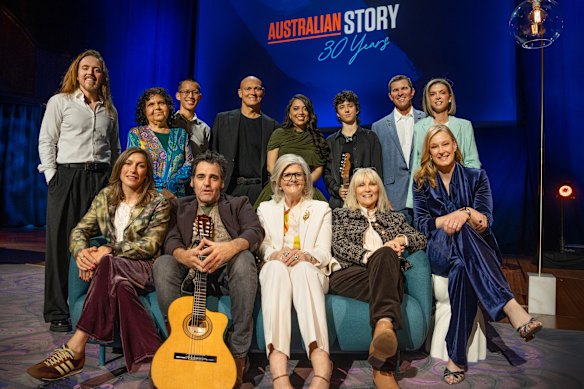
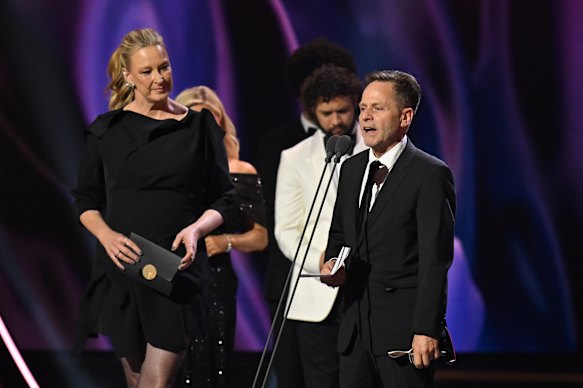
To mark the show’s anniversary, the ABC is screening Australian Story Live: Celebrating 30 Years, an event recorded at the Sydney Opera House in August.
Filmed at the Concert Hall, the sell-out event featured performances from Tim Minchin and Alex Lloyd, along with appearances from Karvan, Governor-General Sam Mostyn, Olympic champion Michael Klim, First Nations community leader Mechelle Turvey, maths teacher and YouTube star Eddie Woo, graziers Gayle and Mac Shann and Australian Story’s founding executive producer Deborah Fleming.
Sales says of all the comments she receives about Australian Story, the most common is how decent and admirable humans still exist.
“I think if you’re just looking at social media or the news, you feel like there’s a lot of bad people,” she says. “But actually, there’s really a lot of good people in the world.”
Australian Story Live: Celebrating 30 Years airs at 8pm on Monday, August 31, on the ABC and ABC iview.