Source : INDIA TODAY NEWS
At Adarsha Tribal Higher Secondary School in Assam, geography teacher Rajesh Barua’s lessons do not always end when the school bell rings. His students have taught their mothers how to use digital payments, taken part in campaigns against child marriage in their villages and learnt traditional weaving from members of the Mising community.
For Barua, these are not activities outside education. They are part of it. This year, that approach has earned him a place among the 48 teachers selected for the National Teachers Award.
advertisement
But Barua’s own journey into his students’ world began with something much simpler: a language barrier.
Nearly 99 per cent of the students at the school belong to the Mising community. They speak Mising at home but are expected to communicate in Assamese at school. When Barua first entered the classroom, he quickly realised that even ordinary instructions could become difficult if students did not fully understand the language being used.
So he decided not to leave all the adjustment to his students.
He began learning Mising words from them.
Instead of simply asking students to sit down, he would use the Mising word “tet”. When he wanted a student to come closer, he would use “iroppe”.
“I wanted them to feel that we were not forcing them to learn Assamese. We were also trying to learn their language,” Barua recalls.
It was a small gesture, but it changed the relationship between teacher and students.
Barua began to understand that teaching them would also require him to understand the community they came from.
A GEOGRAPHY TEACHER WHO LOOKS BEYOND THE TEXTBOOK
Barua did not enter the profession with a grand plan to become a teacher.
After completing his Master’s degree in 2000, he enrolled for a BEd. There, he met the late Ananda Chandra Goswami, a teacher whose classroom left a deep impression on him.
Barua remembers watching Goswami use body language, gestures and expression to hold the attention of an entire class. Students would sit for an hour, completely absorbed.
Goswami eventually encouraged Barua to take up teaching.
He followed that advice.
In 2002, Barua began teaching geography at Jorhat Government Girls’ Higher Secondary School. Around the same time, he also worked as a lecturer at a B.Ed college. He later became principal of a private school in Nagaland before joining government service in 2013.
One of his early experiences as a geography teacher convinced him that he had found his calling.
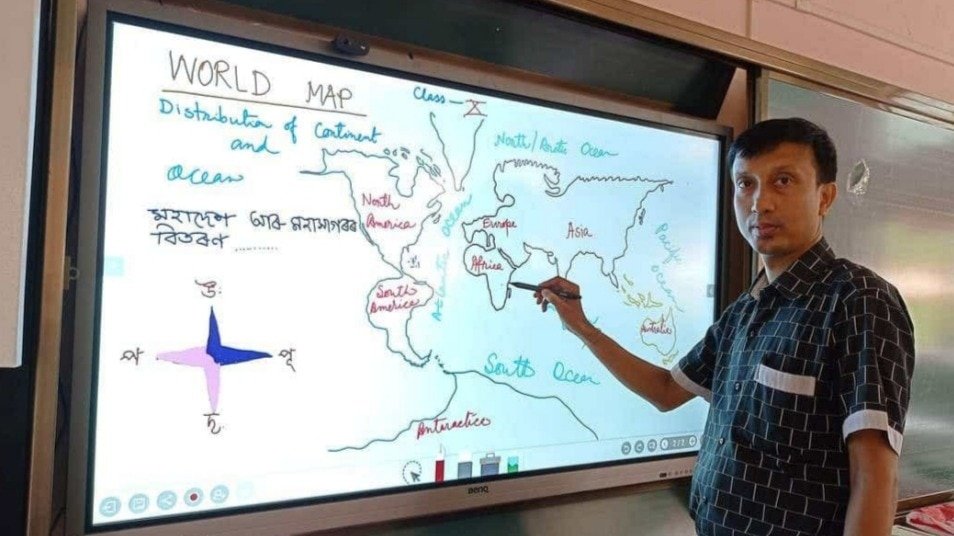
While teaching Classes 11 and 12, Barua would draw maps of the world, India and Assam by hand and use them to explain geographical concepts.
His students began telling him that after attending his class, they did not feel the need to study the topic again at home.
Then came 2004.
Two of his Class 12 students secured letter marks, meaning above 80 per cent marks, in geography. They returned to school carrying sweets and shared them with their teacher.
“That day, I can never forget the happiness I felt,” he says.
For Barua, the moment changed teaching from a profession into something deeply personal.
HE LETS STUDENTS QUESTION THE TEACHER
Walk into Barua’s classroom and there may be something that sounds unusual in a school: noise.
“There will be noise,” he says.
He does not see that as a problem.
Barua has deliberately changed the conventional classroom dynamic. Instead of beginning a lesson by asking students questions, he asks them to question him.
“I tell them, you ask the questions and I will give the answers. In the examination, the question paper will ask the questions and you will answer them.”
The approach is particularly significant for students who are hesitant to speak because of the language barrier.
A student afraid of giving a wrong answer may remain silent. But a student encouraged to ask a question has already taken the first step towards participating.
So his classroom has conversations, laughter and sometimes what Barua calls “noise”.
For him, that is evidence that students are comfortable enough to engage.
The relationship often continues outside school.
Students invite him into their homes. When the first bottle gourd grows on a student’s family farm, Barua says, it may be brought to him first.
“I enjoy being with the students. When they are happy, I am happy too,” he says.
WHEN STUDENTS BECAME TEACHERS TO THEIR MOTHERS
Many of Barua’s initiatives begin with a question: what does a child need to learn beyond the textbook?
At his school, many students are first-generation learners. Their parents may have had limited access to formal education and, increasingly, to digital tools.
That led Barua to create a Class 10 geography project called “Each One Teach One: Student Teach Their Mother for Digital Literacy.”
The idea was simple. Students had to become teachers at home and help their mothers understand digital tools.
There was a practical reason for the project.
Many local farmers and vegetable sellers interacted with traders from Jorhat town, where digital payments such as Google Pay were becoming common. Some parents were uncomfortable with digital transactions and preferred cash.
Barua saw an opportunity to turn the children into a bridge between their homes and the changing digital economy.
The project did not transform every household, he admits. He estimates that it achieved around 30 per cent success in a short period.
But it also changed how some parents viewed their children.
The students were no longer simply recipients of education. They had something to teach their families.
WHEN GEOGRAPHY BECAME A TOOL AGAINST CHILD MARRIAGE
The school’s work also extends to a more difficult social problem.
Located close to the Brahmaputra, the school serves students from economically disadvantaged families. Barua noticed that some students would suddenly stop attending school.
In some cases, the reason was child marriage.
The school responded by taking its awareness efforts beyond the campus. Teachers and Class 10 students began visiting villages and conducting awareness activities in their own communities. Students were encouraged to document their work and speak to people around them.
The idea was to make children participants in addressing a problem that directly affected their education.
About two months before, Barua said, the village head of Dhekelichapori sent a letter to the school stating that no child marriage case had been reported in the village since the awareness campaign.
For Barua, that kind of response is more meaningful than a certificate.
“I don’t say that what we did was something very different. We just tried to think a little differently,” he says.
PRESERVING TRADITION WHILE THINKING ABOUT THE FUTURE
Barua’s classroom also looks at the skills and knowledge already present in the community.
During bagless days, students visit local weavers and learn how Mising women create traditional designs on garments.
But the lesson does not stop with observing the craft.
Barua encourages students to think about how photographs, videos and social media could help local artisans showcase their work and reach more customers. It is the kind of connection he tries to make repeatedly: traditional knowledge with digital tools, geography with livelihoods and classroom learning with everyday life.
For him, education should help students understand the world immediately around them.
A SCHOOL THAT WORKS AS A RESOURCE CENTRE
Barua also wants the school to become a support system for students beyond regular lessons.
Teachers have created a career counselling cell to help students with online applications, employment-related registrations and other digital processes.
This is particularly useful for students interested in careers in the armed forces, police and other government services.
The school also assists students with online submissions related to their Scheduled Tribe certificates and other requirements.
For families unfamiliar with these systems, such help can determine whether a student can actually access an opportunity.
Barua speaks particularly fondly of former student Swadhina Doley.
She studied geography, completed her graduation from DCB College, Jorhat, and has now enrolled in a B.Ed programme. Barua hopes she will eventually become a geography teacher.
There is a certain circularity to that hope.
The student he once taught could one day return to a classroom and teach the same subject.
HIS CLASSROOM DOES NOT ALWAYS HAVE FOUR WALLS
Barua’s teaching methods often move beyond the school building.
On Saturdays, students may visit a local market and learn mathematics through buying and selling vegetables. They calculate prices, negotiate with sellers and work out change.
Students also bring produce from their homes to sell at a school market. Teachers buy the vegetables, giving the children a small income that can be used to purchase notebooks and books.
Other lessons take place outdoors.
Students visit the riverbank and nearby natural surroundings to understand the relationship between people and their environment.
Barua describes the approach as “zero investment in education” — using locally available materials, the surroundings and the community rather than relying on expensive teaching aids.
The school also recognises students with the highest monthly attendance with simple rewards such as pens or notebooks.
Teachers visit students’ homes and speak to their parents. Students borrow library books for around 10 to 12 days and return them after sharing what they learnt. Parents are sometimes asked to sign their children’s notebooks so they remain connected with what happens in school.
None of these interventions is particularly spectacular on its own.
Together, they reveal how Barua thinks about education.
For him, learning does not have to remain inside a classroom, and a teacher does not have to be the only person who teaches.
‘JUST REMEMBER ME AS RAJESH SIR’
Barua has received recognition at different levels, including the Assam government’s state-level teacher recognition and the East Zone Best Educator recognition from the Sri Sri Ravishankar Vidya Mandir Trust.
Now, he is among the 48 teachers selected for the National Teachers Award.
Yet when asked what he wants his students to remember years from now, his answer is remarkably simple.
Not as an award-winning teacher. Not as someone who appeared on a national list.
“They don’t have to remember me as an award-winning teacher. Just remembering me as Rajesh Sir is enough,” he says.
Perhaps that is also the clearest way to understand his approach to teaching.
He entered his students’ classroom to teach them geography. Along the way, he learnt their language, entered their homes, understood their communities and turned their everyday lives into lessons.
His students, in turn, became teachers to their mothers, ambassadors against child marriage and observers of the traditions and livelihoods around them.
For Barua, education is not about how much of a textbook a child can remember. It is about whether what happens in school can travel home, into a village and eventually back into the classroom. And perhaps that is why, despite the awards and recognition, he does not want his students to remember him for any title.
Just Rajesh Sir.
– Ends
SOURCE :- TIMES OF INDIA