

Source : Perth Now news
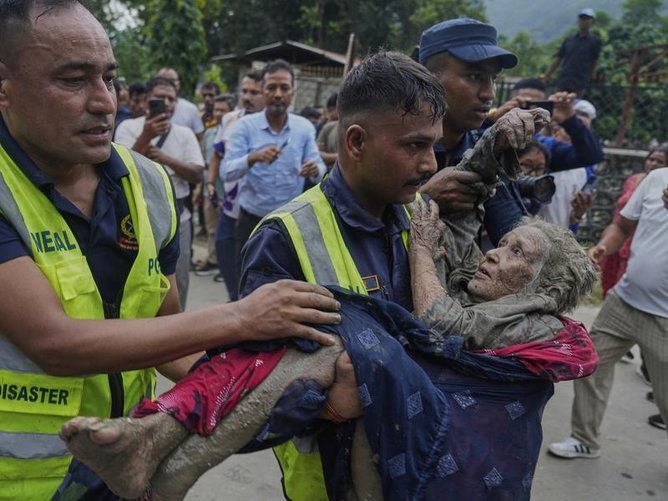
Nepal and China are warning of a dangerous new flood threat in the Himalayas, with two newly formed lakes at risk of bursting as rescuers continue searching for nearly 1000 people missing in the catastrophic disaster.
The warnings come as authorities continue combing debris-strewn valleys and hillsides following Wednesday’s devastating flood along the Nepal-China border, which has killed at least 362 people, according to police.
Dozens of Australians remain among those unaccounted for, with the latest figures from the Nepal Tourism Board listing 35 Australians missing in Nepal.
Authorities in both Nepal and China have blamed the initial catastrophe on a glacier collapse that sent a massive volume of rock, ice, mud and debris into mountain river systems.
Now, the aftermath of that collapse could pose another deadly risk.
New lakes spark fears of another disaster
Nepal’s disaster authority issued a fresh warning on Thursday after a lake formed behind debris blocking a river at the flood site began rising.
Authorities fear the natural barrier could fail, suddenly releasing the accumulated water downstream.
“Residents of the lower banks … passengers, rescuers engaged in rescue operations, and all concerned are requested to exercise special caution and stay in safe places away from the river banks and risky areas,” the authority said.
The warning prompted some rescuers to retreat towards higher ground.
Rescue worker Pawan Koirala and his team of 13 were among those moving away from the river bed after the alert was issued.
Across the border, China is confronting a similar threat.
Aerial footage captured by a Chinese rescue team showed a barrier lake forming, with masses of brown water accumulating in a basin with no visible outlet.
Bushes and trees had already been submerged as the rising water pressed against a barrier of rocks and debris.
Three million cubic metres of water expected
Chinese authorities have warned three million cubic metres of water — equivalent to about 1200 Olympic swimming pools — is expected to flow into the already dammed lake over the next three days.
That could significantly increase the risk of the barrier failing, with peak flow expected on Tuesday.

Forecast rainfall over the coming week could make the situation even more dangerous.
“The volume of water is continuing to increase, and so is the risk,” Zhu Jinfeng, a researcher at the water resources ministry’s hydrology department, told state broadcaster CCTV.
Nearly 1000 remain missing
The fresh warnings come as the scale of Wednesday’s catastrophe continues to emerge.
In Tibet’s Gyirong county, 558 people were missing as of Thursday, according to Chinese state broadcaster CCTV, including 260 foreigners.
China said its death toll remained at three.
In Nepal, 667 people were listed as missing.
Foreigners from more than two dozen countries are among those unaccounted for, including 288 from India, 63 from the United States, 53 from Ukraine, 51 from Malaysia, 35 from Australia, 33 from the United Kingdom, 25 from Canada and five from New Zealand.

There has been some positive news amid the devastation, with the Nepal Tourism Board confirming 31 foreigners previously reported missing had been rescued.
They included two Italians and a Swiss citizen.
Glacier collapse blamed for catastrophe
Authorities in both countries have attributed Wednesday’s initial disaster to a glacier collapse in the Himalayas.
The collapse sent rock, ice, mud and other debris crashing into river systems, unleashing devastating flooding through communities below.
The same debris is now believed to have created natural dams capable of trapping enormous volumes of water.

The threat is particularly dangerous because if those unstable barriers suddenly collapse, the accumulated water could be released downstream with little warning.
Search and rescue operations are continuing, but authorities now face the difficult task of finding hundreds of missing people while protecting rescuers and survivors from the possibility of another major flood.
– With AP and DPA


